

15 Ship Surveillance with High Resolution TerraSAR-X Satellite in African Waters
301
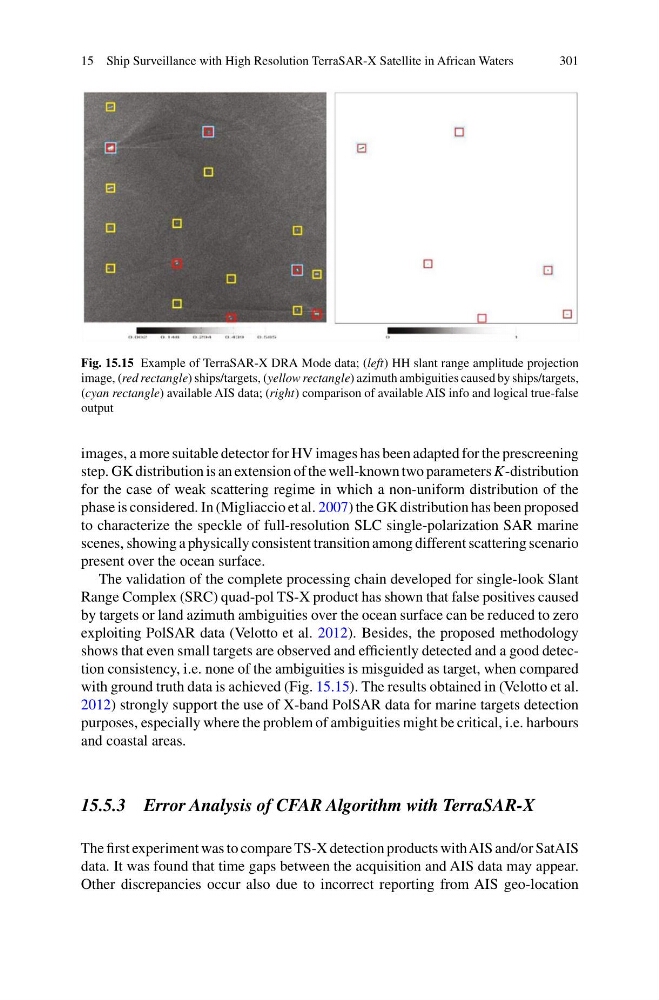
Fig. 15.15 Example of TerraSAR-X DRA Mode data; (left) HH slant range amplitude projection
image, (red rectangle) ships/targets, (yellow rectangle) azimuth ambiguities caused by ships/targets,
(cyan rectangle) available AIS data; (right) comparison of available AIS info and logical true-false
output
images, a more suitable detector for HV images has been adapted for the prescreening
step. GK distribution is an extension of the well-known two parameters K-distribution
for the case of weak scattering regime in which a non-uniform distribution of the
phase is considered. In (Migliaccio et al. 2007) the GK distribution has been proposed
to characterize the speckle of full-resolution SLC single-polarization SAR marine
scenes, showing a physically consistent transition among different scattering scenario
present over the ocean surface.
The validation of the complete processing chain developed for single-look Slant
Range Complex (SRC) quad-pol TS-X product has shown that false positives caused
by targets or land azimuth ambiguities over the ocean surface can be reduced to zero
exploiting PolSAR data (Velotto et al. 2012). Besides, the proposed methodology
shows that even small targets are observed and efficiently detected and a good detection consistency, i.e. none of the ambiguities is misguided as target, when compared
with ground truth data is achieved (Fig. 15.15). The results obtained in (Velotto et al.
2012) strongly support the use of X-band PolSAR data for marine targets detection
purposes, especially where the problem of ambiguities might be critical, i.e. harbours
and coastal areas.
15.5.3 Error Analysis of CFAR Algorithm with TerraSAR-X
The first experiment was to compare TS-X detection products with AIS and/or SatAIS
data. It was found that time gaps between the acquisition and AIS data may appear.
Other discrepancies occur also due to incorrect reporting from AIS geo-location
301
Fig. 15.15 Example of TerraSAR-X DRA Mode data; (left) HH slant range amplitude projection
image, (red rectangle) ships/targets, (yellow rectangle) azimuth ambiguities caused by ships/targets,
(cyan rectangle) available AIS data; (right) comparison of available AIS info and logical true-false
output
images, a more suitable detector for HV images has been adapted for the prescreening
step. GK distribution is an extension of the well-known two parameters K-distribution
for the case of weak scattering regime in which a non-uniform distribution of the
phase is considered. In (Migliaccio et al. 2007) the GK distribution has been proposed
to characterize the speckle of full-resolution SLC single-polarization SAR marine
scenes, showing a physically consistent transition among different scattering scenario
present over the ocean surface.
The validation of the complete processing chain developed for single-look Slant
Range Complex (SRC) quad-pol TS-X product has shown that false positives caused
by targets or land azimuth ambiguities over the ocean surface can be reduced to zero
exploiting PolSAR data (Velotto et al. 2012). Besides, the proposed methodology
shows that even small targets are observed and efficiently detected and a good detection consistency, i.e. none of the ambiguities is misguided as target, when compared
with ground truth data is achieved (Fig. 15.15). The results obtained in (Velotto et al.
2012) strongly support the use of X-band PolSAR data for marine targets detection
purposes, especially where the problem of ambiguities might be critical, i.e. harbours
and coastal areas.
15.5.3 Error Analysis of CFAR Algorithm with TerraSAR-X
The first experiment was to compare TS-X detection products with AIS and/or SatAIS
data. It was found that time gaps between the acquisition and AIS data may appear.
Other discrepancies occur also due to incorrect reporting from AIS geo-location