

300
S. Lehner et al.
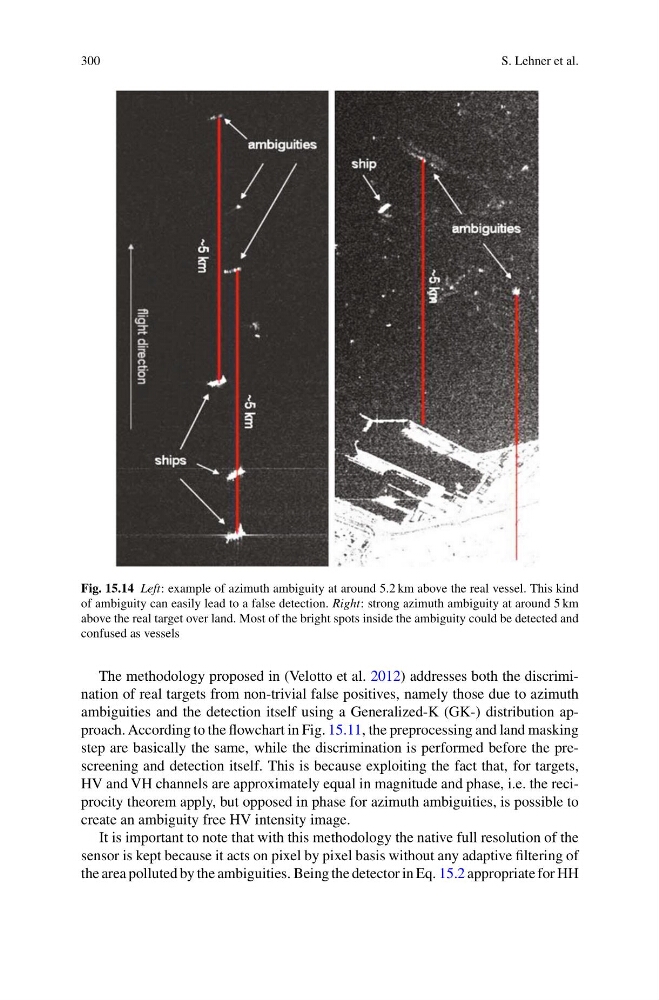
Fig. 15.14 Left: example of azimuth ambiguity at around 5.2 km above the real vessel. This kind
of ambiguity can easily lead to a false detection. Right: strong azimuth ambiguity at around 5 km
above the real target over land. Most of the bright spots inside the ambiguity could be detected and
confused as vessels
The methodology proposed in (Velotto et al. 2012) addresses both the discrimination of real targets from non-trivial false positives, namely those due to azimuth
ambiguities and the detection itself using a Generalized-K (GK-) distribution approach. According to the flowchart in Fig. 15.11, the preprocessing and land masking
step are basically the same, while the discrimination is performed before the prescreening and detection itself. This is because exploiting the fact that, for targets,
HV and VH channels are approximately equal in magnitude and phase, i.e. the reciprocity theorem apply, but opposed in phase for azimuth ambiguities, is possible to
create an ambiguity free HV intensity image.
It is important to note that with this methodology the native full resolution of the
sensor is kept because it acts on pixel by pixel basis without any adaptive filtering of
the area polluted by the ambiguities. Being the detector in Eq. 15.2 appropriate for HH
S. Lehner et al.
Fig. 15.14 Left: example of azimuth ambiguity at around 5.2 km above the real vessel. This kind
of ambiguity can easily lead to a false detection. Right: strong azimuth ambiguity at around 5 km
above the real target over land. Most of the bright spots inside the ambiguity could be detected and
confused as vessels
The methodology proposed in (Velotto et al. 2012) addresses both the discrimination of real targets from non-trivial false positives, namely those due to azimuth
ambiguities and the detection itself using a Generalized-K (GK-) distribution approach. According to the flowchart in Fig. 15.11, the preprocessing and land masking
step are basically the same, while the discrimination is performed before the prescreening and detection itself. This is because exploiting the fact that, for targets,
HV and VH channels are approximately equal in magnitude and phase, i.e. the reciprocity theorem apply, but opposed in phase for azimuth ambiguities, is possible to
create an ambiguity free HV intensity image.
It is important to note that with this methodology the native full resolution of the
sensor is kept because it acts on pixel by pixel basis without any adaptive filtering of
the area polluted by the ambiguities. Being the detector in Eq. 15.2 appropriate for HH