

15 Ship Surveillance with High Resolution TerraSAR-X Satellite in African Waters
299
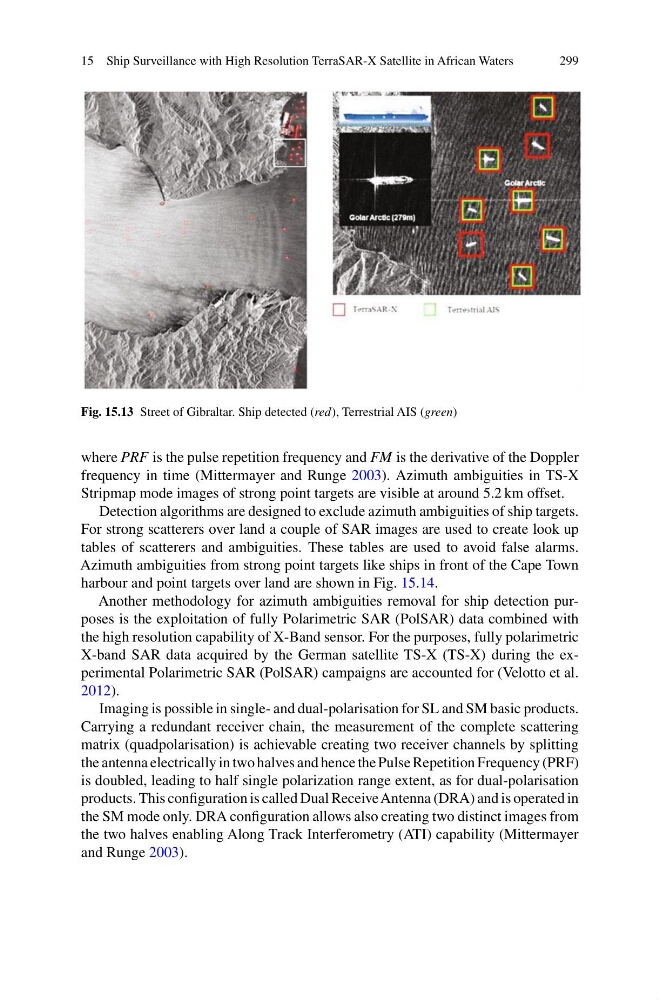
Fig. 15.13 Street of Gibraltar. Ship detected (red), Terrestrial AIS (green)
where PRF is the pulse repetition frequency and FM is the derivative of the Doppler
frequency in time (Mittermayer and Runge 2003). Azimuth ambiguities in TS-X
Stripmap mode images of strong point targets are visible at around 5.2 km offset.
Detection algorithms are designed to exclude azimuth ambiguities of ship targets.
For strong scatterers over land a couple of SAR images are used to create look up
tables of scatterers and ambiguities. These tables are used to avoid false alarms.
Azimuth ambiguities from strong point targets like ships in front of the Cape Town
harbour and point targets over land are shown in Fig. 15.14.
Another methodology for azimuth ambiguities removal for ship detection purposes is the exploitation of fully Polarimetric SAR (PolSAR) data combined with
the high resolution capability of X-Band sensor. For the purposes, fully polarimetric
X-band SAR data acquired by the German satellite TS-X (TS-X) during the experimental Polarimetric SAR (PolSAR) campaigns are accounted for (Velotto et al.
2012).
Imaging is possible in single- and dual-polarisation for SL and SM basic products.
Carrying a redundant receiver chain, the measurement of the complete scattering
matrix (quadpolarisation) is achievable creating two receiver channels by splitting
the antenna electrically in two halves and hence the Pulse Repetition Frequency (PRF)
is doubled, leading to half single polarization range extent, as for dual-polarisation
products. This configuration is called Dual ReceiveAntenna (DRA) and is operated in
the SM mode only. DRA configuration allows also creating two distinct images from
the two halves enabling Along Track Interferometry (ATI) capability (Mittermayer
and Runge 2003).
299
Fig. 15.13 Street of Gibraltar. Ship detected (red), Terrestrial AIS (green)
where PRF is the pulse repetition frequency and FM is the derivative of the Doppler
frequency in time (Mittermayer and Runge 2003). Azimuth ambiguities in TS-X
Stripmap mode images of strong point targets are visible at around 5.2 km offset.
Detection algorithms are designed to exclude azimuth ambiguities of ship targets.
For strong scatterers over land a couple of SAR images are used to create look up
tables of scatterers and ambiguities. These tables are used to avoid false alarms.
Azimuth ambiguities from strong point targets like ships in front of the Cape Town
harbour and point targets over land are shown in Fig. 15.14.
Another methodology for azimuth ambiguities removal for ship detection purposes is the exploitation of fully Polarimetric SAR (PolSAR) data combined with
the high resolution capability of X-Band sensor. For the purposes, fully polarimetric
X-band SAR data acquired by the German satellite TS-X (TS-X) during the experimental Polarimetric SAR (PolSAR) campaigns are accounted for (Velotto et al.
2012).
Imaging is possible in single- and dual-polarisation for SL and SM basic products.
Carrying a redundant receiver chain, the measurement of the complete scattering
matrix (quadpolarisation) is achievable creating two receiver channels by splitting
the antenna electrically in two halves and hence the Pulse Repetition Frequency (PRF)
is doubled, leading to half single polarization range extent, as for dual-polarisation
products. This configuration is called Dual ReceiveAntenna (DRA) and is operated in
the SM mode only. DRA configuration allows also creating two distinct images from
the two halves enabling Along Track Interferometry (ATI) capability (Mittermayer
and Runge 2003).