

294
S. Lehner et al.
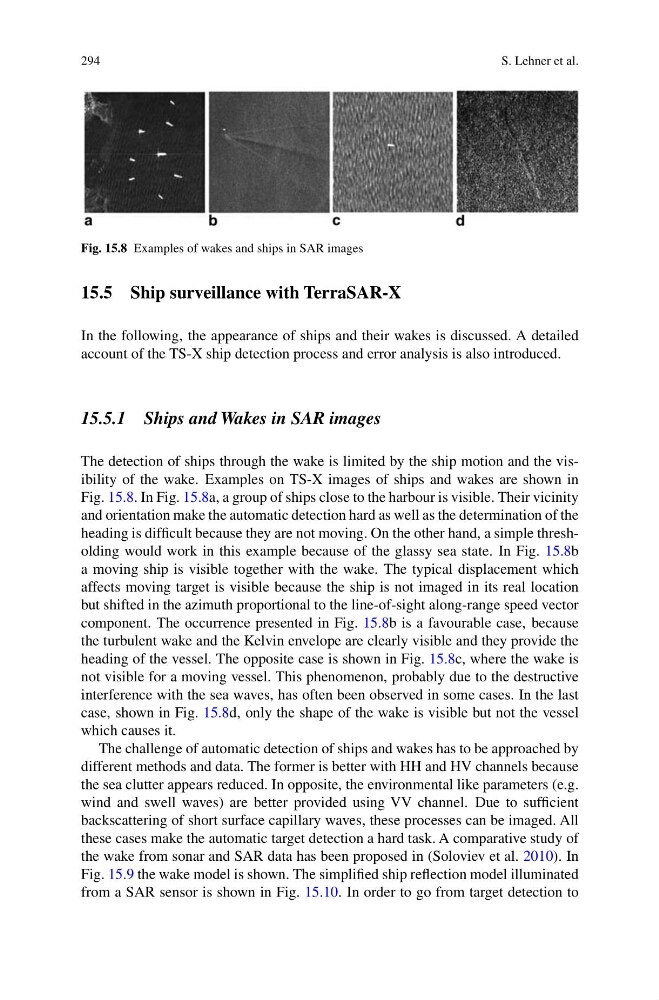
Fig. 15.8 Examples of wakes and ships in SAR images
15.5 Ship surveillance with TerraSAR-X
In the following, the appearance of ships and their wakes is discussed. A detailed
account of the TS-X ship detection process and error analysis is also introduced.
15.5.1 Ships and Wakes in SAR images
The detection of ships through the wake is limited by the ship motion and the visibility of the wake. Examples on TS-X images of ships and wakes are shown in
Fig. 15.8. In Fig. 15.8a, a group of ships close to the harbour is visible. Their vicinity
and orientation make the automatic detection hard as well as the determination of the
heading is difficult because they are not moving. On the other hand, a simple thresholding would work in this example because of the glassy sea state. In Fig. 15.8b
a moving ship is visible together with the wake. The typical displacement which
affects moving target is visible because the ship is not imaged in its real location
but shifted in the azimuth proportional to the line-of-sight along-range speed vector
component. The occurrence presented in Fig. 15.8b is a favourable case, because
the turbulent wake and the Kelvin envelope are clearly visible and they provide the
heading of the vessel. The opposite case is shown in Fig. 15.8c, where the wake is
not visible for a moving vessel. This phenomenon, probably due to the destructive
interference with the sea waves, has often been observed in some cases. In the last
case, shown in Fig. 15.8d, only the shape of the wake is visible but not the vessel
which causes it.
The challenge of automatic detection of ships and wakes has to be approached by
different methods and data. The former is better with HH and HV channels because
the sea clutter appears reduced. In opposite, the environmental like parameters (e.g.
wind and swell waves) are better provided using VV channel. Due to sufficient
backscattering of short surface capillary waves, these processes can be imaged. All
these cases make the automatic target detection a hard task. A comparative study of
the wake from sonar and SAR data has been proposed in (Soloviev et al. 2010). In
Fig. 15.9 the wake model is shown. The simplified ship reflection model illuminated
from a SAR sensor is shown in Fig. 15.10. In order to go from target detection to
S. Lehner et al.
Fig. 15.8 Examples of wakes and ships in SAR images
15.5 Ship surveillance with TerraSAR-X
In the following, the appearance of ships and their wakes is discussed. A detailed
account of the TS-X ship detection process and error analysis is also introduced.
15.5.1 Ships and Wakes in SAR images
The detection of ships through the wake is limited by the ship motion and the visibility of the wake. Examples on TS-X images of ships and wakes are shown in
Fig. 15.8. In Fig. 15.8a, a group of ships close to the harbour is visible. Their vicinity
and orientation make the automatic detection hard as well as the determination of the
heading is difficult because they are not moving. On the other hand, a simple thresholding would work in this example because of the glassy sea state. In Fig. 15.8b
a moving ship is visible together with the wake. The typical displacement which
affects moving target is visible because the ship is not imaged in its real location
but shifted in the azimuth proportional to the line-of-sight along-range speed vector
component. The occurrence presented in Fig. 15.8b is a favourable case, because
the turbulent wake and the Kelvin envelope are clearly visible and they provide the
heading of the vessel. The opposite case is shown in Fig. 15.8c, where the wake is
not visible for a moving vessel. This phenomenon, probably due to the destructive
interference with the sea waves, has often been observed in some cases. In the last
case, shown in Fig. 15.8d, only the shape of the wake is visible but not the vessel
which causes it.
The challenge of automatic detection of ships and wakes has to be approached by
different methods and data. The former is better with HH and HV channels because
the sea clutter appears reduced. In opposite, the environmental like parameters (e.g.
wind and swell waves) are better provided using VV channel. Due to sufficient
backscattering of short surface capillary waves, these processes can be imaged. All
these cases make the automatic target detection a hard task. A comparative study of
the wake from sonar and SAR data has been proposed in (Soloviev et al. 2010). In
Fig. 15.9 the wake model is shown. The simplified ship reflection model illuminated
from a SAR sensor is shown in Fig. 15.10. In order to go from target detection to