

15 Ship Surveillance with High Resolution TerraSAR-X Satellite in African Waters
289
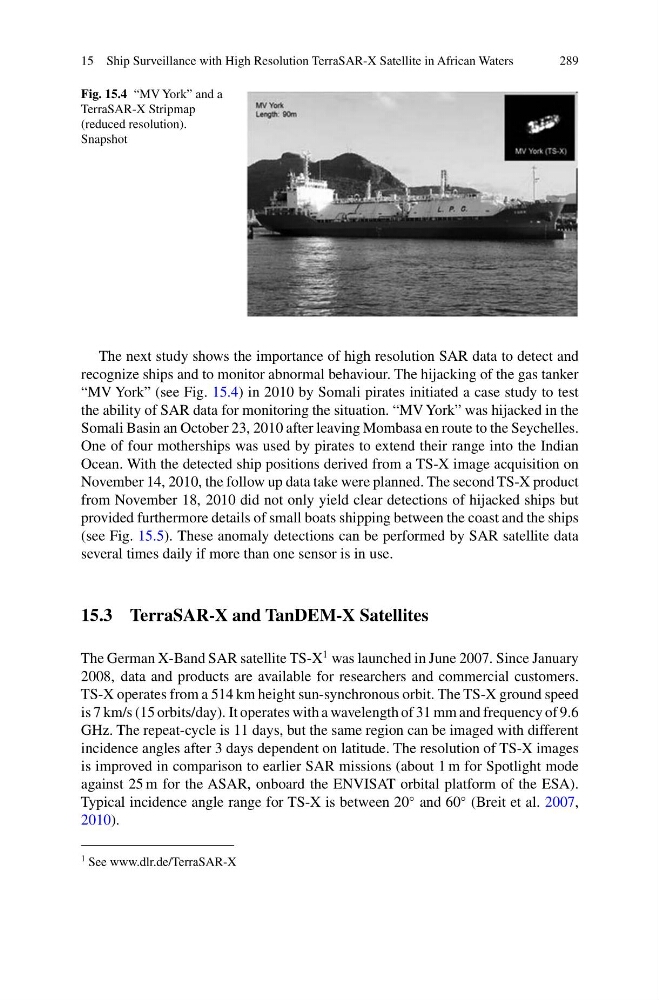
Fig. 15.4 “MV York” and a
TerraSAR-X Stripmap
(reduced resolution).
Snapshot
The next study shows the importance of high resolution SAR data to detect and
recognize ships and to monitor abnormal behaviour. The hijacking of the gas tanker
“MV York” (see Fig. 15.4) in 2010 by Somali pirates initiated a case study to test
the ability of SAR data for monitoring the situation. “MV York” was hijacked in the
Somali Basin an October 23, 2010 after leaving Mombasa en route to the Seychelles.
One of four motherships was used by pirates to extend their range into the Indian
Ocean. With the detected ship positions derived from a TS-X image acquisition on
November 14, 2010, the follow up data take were planned. The second TS-X product
from November 18, 2010 did not only yield clear detections of hijacked ships but
provided furthermore details of small boats shipping between the coast and the ships
(see Fig. 15.5). These anomaly detections can be performed by SAR satellite data
several times daily if more than one sensor is in use.
15.3 TerraSAR-X and TanDEM-X Satellites
The German X-Band SAR satellite TS-X
1 was launched in June 2007. Since January
2008, data and products are available for researchers and commercial customers.
TS-X operates from a 514 km height sun-synchronous orbit. The TS-X ground speed
is 7 km/s (15 orbits/day). It operates with a wavelength of 31 mm and frequency of 9.6
GHz. The repeat-cycle is 11 days, but the same region can be imaged with different
incidence angles after 3 days dependent on latitude. The resolution of TS-X images
is improved in comparison to earlier SAR missions (about 1 m for Spotlight mode
against 25 m for the ASAR, onboard the ENVISAT orbital platform of the ESA).
Typical incidence angle range for TS-X is between 20
◦ and 60
◦ (Breit et al. 2007,
2010).
1 See www.dlr.de/TerraSAR-X
289
Fig. 15.4 “MV York” and a
TerraSAR-X Stripmap
(reduced resolution).
Snapshot
The next study shows the importance of high resolution SAR data to detect and
recognize ships and to monitor abnormal behaviour. The hijacking of the gas tanker
“MV York” (see Fig. 15.4) in 2010 by Somali pirates initiated a case study to test
the ability of SAR data for monitoring the situation. “MV York” was hijacked in the
Somali Basin an October 23, 2010 after leaving Mombasa en route to the Seychelles.
One of four motherships was used by pirates to extend their range into the Indian
Ocean. With the detected ship positions derived from a TS-X image acquisition on
November 14, 2010, the follow up data take were planned. The second TS-X product
from November 18, 2010 did not only yield clear detections of hijacked ships but
provided furthermore details of small boats shipping between the coast and the ships
(see Fig. 15.5). These anomaly detections can be performed by SAR satellite data
several times daily if more than one sensor is in use.
15.3 TerraSAR-X and TanDEM-X Satellites
The German X-Band SAR satellite TS-X
1 was launched in June 2007. Since January
2008, data and products are available for researchers and commercial customers.
TS-X operates from a 514 km height sun-synchronous orbit. The TS-X ground speed
is 7 km/s (15 orbits/day). It operates with a wavelength of 31 mm and frequency of 9.6
GHz. The repeat-cycle is 11 days, but the same region can be imaged with different
incidence angles after 3 days dependent on latitude. The resolution of TS-X images
is improved in comparison to earlier SAR missions (about 1 m for Spotlight mode
against 25 m for the ASAR, onboard the ENVISAT orbital platform of the ESA).
Typical incidence angle range for TS-X is between 20
◦ and 60
◦ (Breit et al. 2007,
2010).
1 See www.dlr.de/TerraSAR-X