

218
W. Alpers et al.
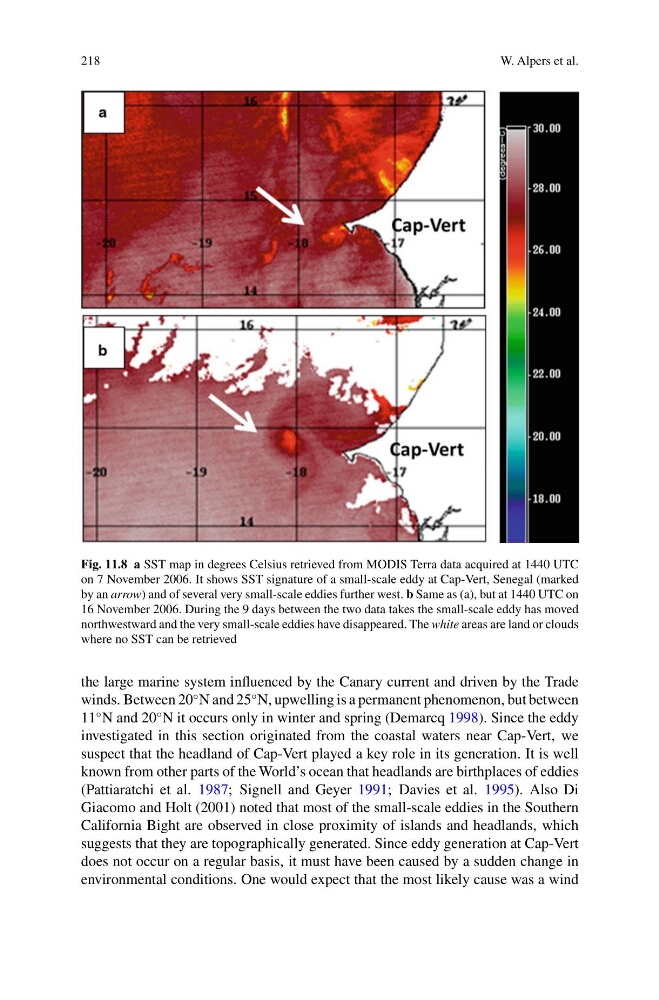
Fig. 11.8 a SST map in degrees Celsius retrieved from MODIS Terra data acquired at 1440 UTC
on 7 November 2006. It shows SST signature of a small-scale eddy at Cap-Vert, Senegal (marked
by an arrow) and of several very small-scale eddies further west. b Same as (a), but at 1440 UTC on
16 November 2006. During the 9 days between the two data takes the small-scale eddy has moved
northwestward and the very small-scale eddies have disappeared. The white areas are land or clouds
where no SST can be retrieved
the large marine system influenced by the Canary current and driven by the Trade
winds. Between 20
◦ N and 25
◦ N, upwelling is a permanent phenomenon, but between
11
◦ N and 20
◦ N it occurs only in winter and spring (Demarcq 1998). Since the eddy
investigated in this section originated from the coastal waters near Cap-Vert, we
suspect that the headland of Cap-Vert played a key role in its generation. It is well
known from other parts of the World’s ocean that headlands are birthplaces of eddies
(Pattiaratchi et al. 1987; Signell and Geyer 1991; Davies et al. 1995). Also Di
Giacomo and Holt (2001) noted that most of the small-scale eddies in the Southern
California Bight are observed in close proximity of islands and headlands, which
suggests that they are topographically generated. Since eddy generation at Cap-Vert
does not occur on a regular basis, it must have been caused by a sudden change in
environmental conditions. One would expect that the most likely cause was a wind
W. Alpers et al.
Fig. 11.8 a SST map in degrees Celsius retrieved from MODIS Terra data acquired at 1440 UTC
on 7 November 2006. It shows SST signature of a small-scale eddy at Cap-Vert, Senegal (marked
by an arrow) and of several very small-scale eddies further west. b Same as (a), but at 1440 UTC on
16 November 2006. During the 9 days between the two data takes the small-scale eddy has moved
northwestward and the very small-scale eddies have disappeared. The white areas are land or clouds
where no SST can be retrieved
the large marine system influenced by the Canary current and driven by the Trade
winds. Between 20
◦ N and 25
◦ N, upwelling is a permanent phenomenon, but between
11
◦ N and 20
◦ N it occurs only in winter and spring (Demarcq 1998). Since the eddy
investigated in this section originated from the coastal waters near Cap-Vert, we
suspect that the headland of Cap-Vert played a key role in its generation. It is well
known from other parts of the World’s ocean that headlands are birthplaces of eddies
(Pattiaratchi et al. 1987; Signell and Geyer 1991; Davies et al. 1995). Also Di
Giacomo and Holt (2001) noted that most of the small-scale eddies in the Southern
California Bight are observed in close proximity of islands and headlands, which
suggests that they are topographically generated. Since eddy generation at Cap-Vert
does not occur on a regular basis, it must have been caused by a sudden change in
environmental conditions. One would expect that the most likely cause was a wind