

11 Satellite Observations of Oceanic Eddies Around Africa
217
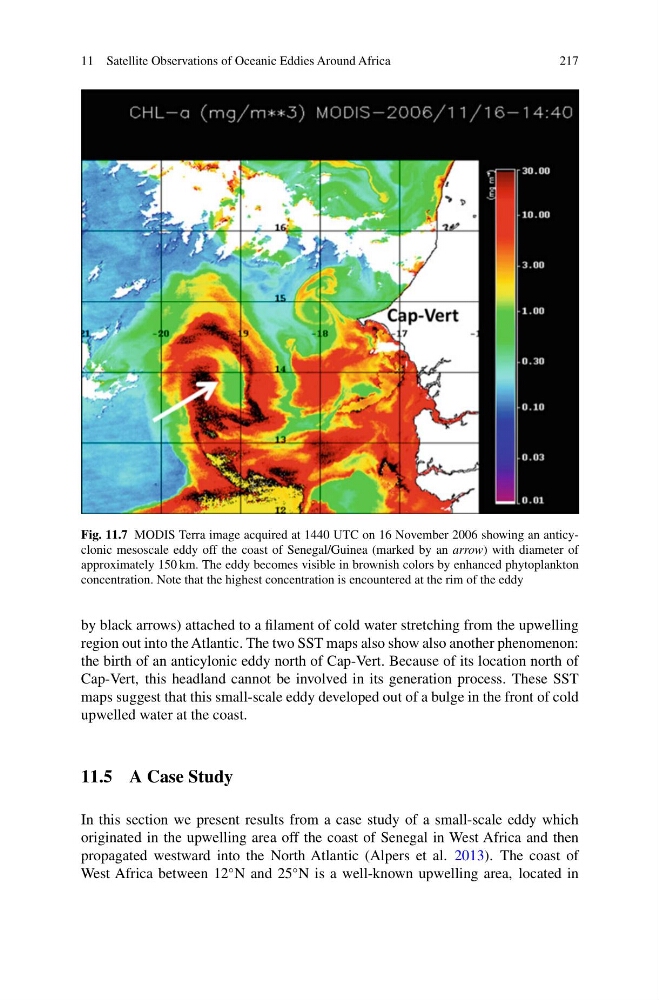
Fig. 11.7 MODIS Terra image acquired at 1440 UTC on 16 November 2006 showing an anticyclonic mesoscale eddy off the coast of Senegal/Guinea (marked by an arrow) with diameter of
approximately 150 km. The eddy becomes visible in brownish colors by enhanced phytoplankton
concentration. Note that the highest concentration is encountered at the rim of the eddy
by black arrows) attached to a filament of cold water stretching from the upwelling
region out into the Atlantic. The two SST maps also show also another phenomenon:
the birth of an anticylonic eddy north of Cap-Vert. Because of its location north of
Cap-Vert, this headland cannot be involved in its generation process. These SST
maps suggest that this small-scale eddy developed out of a bulge in the front of cold
upwelled water at the coast.
11.5 A Case Study
In this section we present results from a case study of a small-scale eddy which
originated in the upwelling area off the coast of Senegal in West Africa and then
propagated westward into the North Atlantic (Alpers et al. 2013). The coast of
West Africa between 12
◦ N and 25
◦ N is a well-known upwelling area, located in
217
Fig. 11.7 MODIS Terra image acquired at 1440 UTC on 16 November 2006 showing an anticyclonic mesoscale eddy off the coast of Senegal/Guinea (marked by an arrow) with diameter of
approximately 150 km. The eddy becomes visible in brownish colors by enhanced phytoplankton
concentration. Note that the highest concentration is encountered at the rim of the eddy
by black arrows) attached to a filament of cold water stretching from the upwelling
region out into the Atlantic. The two SST maps also show also another phenomenon:
the birth of an anticylonic eddy north of Cap-Vert. Because of its location north of
Cap-Vert, this headland cannot be involved in its generation process. These SST
maps suggest that this small-scale eddy developed out of a bulge in the front of cold
upwelled water at the coast.
11.5 A Case Study
In this section we present results from a case study of a small-scale eddy which
originated in the upwelling area off the coast of Senegal in West Africa and then
propagated westward into the North Atlantic (Alpers et al. 2013). The coast of
West Africa between 12
◦ N and 25
◦ N is a well-known upwelling area, located in