

138
E. V. Djagoua et al.
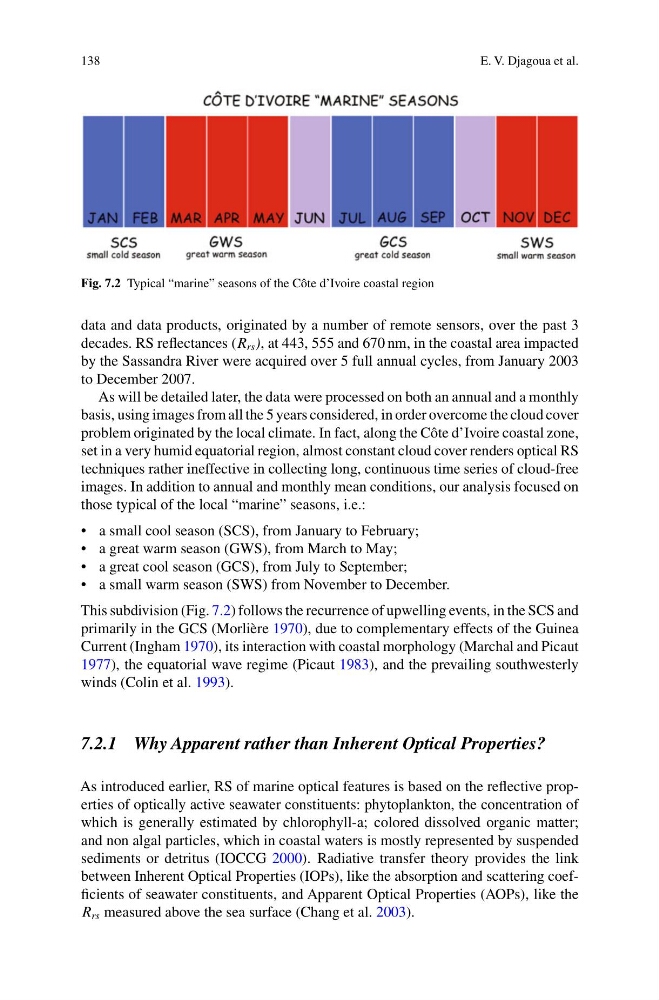
Fig. 7.2 Typical “marine” seasons of the Côte d’Ivoire coastal region
data and data products, originated by a number of remote sensors, over the past 3
decades. RS reflectances (R rs ), at 443, 555 and 670 nm, in the coastal area impacted
by the Sassandra River were acquired over 5 full annual cycles, from January 2003
to December 2007.
As will be detailed later, the data were processed on both an annual and a monthly
basis, using images from all the 5 years considered, in order overcome the cloud cover
problem originated by the local climate. In fact, along the Côte d’Ivoire coastal zone,
set in a very humid equatorial region, almost constant cloud cover renders optical RS
techniques rather ineffective in collecting long, continuous time series of cloud-free
images. In addition to annual and monthly mean conditions, our analysis focused on
those typical of the local “marine” seasons, i.e.:
• a small cool season (SCS), from January to February;
• a great warm season (GWS), from March to May;
• a great cool season (GCS), from July to September;
• a small warm season (SWS) from November to December.
This subdivision (Fig. 7.2) follows the recurrence of upwelling events, in the SCS and
primarily in the GCS (Morlière 1970), due to complementary effects of the Guinea
Current (Ingham 1970), its interaction with coastal morphology (Marchal and Picaut
1977), the equatorial wave regime (Picaut 1983), and the prevailing southwesterly
winds (Colin et al. 1993).
7.2.1 Why Apparent rather than Inherent Optical Properties?
As introduced earlier, RS of marine optical features is based on the reflective properties of optically active seawater constituents: phytoplankton, the concentration of
which is generally estimated by chlorophyll-a; colored dissolved organic matter;
and non algal particles, which in coastal waters is mostly represented by suspended
sediments or detritus (IOCCG 2000). Radiative transfer theory provides the link
between Inherent Optical Properties (IOPs), like the absorption and scattering coefficients of seawater constituents, and Apparent Optical Properties (AOPs), like the
R rs measured above the sea surface (Chang et al. 2003).
E. V. Djagoua et al.
Fig. 7.2 Typical “marine” seasons of the Côte d’Ivoire coastal region
data and data products, originated by a number of remote sensors, over the past 3
decades. RS reflectances (R rs ), at 443, 555 and 670 nm, in the coastal area impacted
by the Sassandra River were acquired over 5 full annual cycles, from January 2003
to December 2007.
As will be detailed later, the data were processed on both an annual and a monthly
basis, using images from all the 5 years considered, in order overcome the cloud cover
problem originated by the local climate. In fact, along the Côte d’Ivoire coastal zone,
set in a very humid equatorial region, almost constant cloud cover renders optical RS
techniques rather ineffective in collecting long, continuous time series of cloud-free
images. In addition to annual and monthly mean conditions, our analysis focused on
those typical of the local “marine” seasons, i.e.:
• a small cool season (SCS), from January to February;
• a great warm season (GWS), from March to May;
• a great cool season (GCS), from July to September;
• a small warm season (SWS) from November to December.
This subdivision (Fig. 7.2) follows the recurrence of upwelling events, in the SCS and
primarily in the GCS (Morlière 1970), due to complementary effects of the Guinea
Current (Ingham 1970), its interaction with coastal morphology (Marchal and Picaut
1977), the equatorial wave regime (Picaut 1983), and the prevailing southwesterly
winds (Colin et al. 1993).
7.2.1 Why Apparent rather than Inherent Optical Properties?
As introduced earlier, RS of marine optical features is based on the reflective properties of optically active seawater constituents: phytoplankton, the concentration of
which is generally estimated by chlorophyll-a; colored dissolved organic matter;
and non algal particles, which in coastal waters is mostly represented by suspended
sediments or detritus (IOCCG 2000). Radiative transfer theory provides the link
between Inherent Optical Properties (IOPs), like the absorption and scattering coefficients of seawater constituents, and Apparent Optical Properties (AOPs), like the
R rs measured above the sea surface (Chang et al. 2003).