

7 Water Constituents Assessment at the Sassandra River Mouth (Côte d’Ivoire)
139
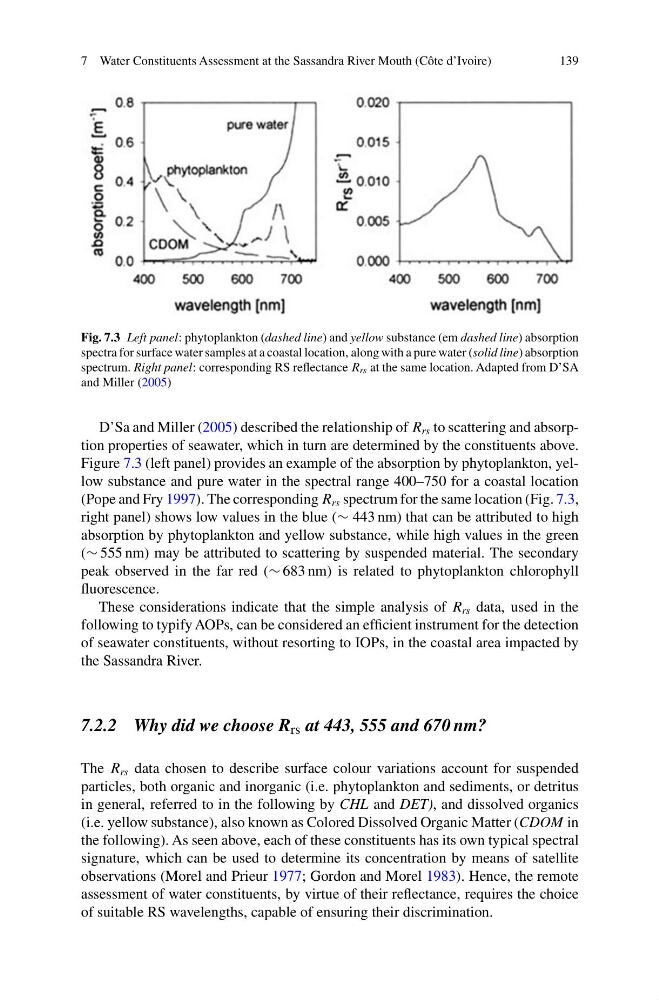
Fig. 7.3 Left panel: phytoplankton (dashed line) and yellow substance (em dashed line) absorption
spectra for surface water samples at a coastal location, along with a pure water (solid line) absorption
spectrum. Right panel: corresponding RS reflectance R rs at the same location. Adapted from D’SA
and Miller (2005)
D’Sa and Miller (2005) described the relationship of R rs to scattering and absorption properties of seawater, which in turn are determined by the constituents above.
Figure 7.3 (left panel) provides an example of the absorption by phytoplankton, yellow substance and pure water in the spectral range 400–750 for a coastal location
(Pope and Fry 1997). The corresponding R rs spectrum for the same location (Fig. 7.3,
right panel) shows low values in the blue (∼ 443 nm) that can be attributed to high
absorption by phytoplankton and yellow substance, while high values in the green
(∼ 555 nm) may be attributed to scattering by suspended material. The secondary
peak observed in the far red (∼ 683 nm) is related to phytoplankton chlorophyll
fluorescence.
These considerations indicate that the simple analysis of R rs data, used in the
following to typify AOPs, can be considered an efficient instrument for the detection
of seawater constituents, without resorting to IOPs, in the coastal area impacted by
the Sassandra River.
7.2.2 Why did we choose R rs at 443, 555 and 670 nm?
The R rs data chosen to describe surface colour variations account for suspended
particles, both organic and inorganic (i.e. phytoplankton and sediments, or detritus
in general, referred to in the following by CHL and DET), and dissolved organics
(i.e. yellow substance), also known as Colored Dissolved Organic Matter (CDOM in
the following). As seen above, each of these constituents has its own typical spectral
signature, which can be used to determine its concentration by means of satellite
observations (Morel and Prieur 1977; Gordon and Morel 1983). Hence, the remote
assessment of water constituents, by virtue of their reflectance, requires the choice
of suitable RS wavelengths, capable of ensuring their discrimination.
139
Fig. 7.3 Left panel: phytoplankton (dashed line) and yellow substance (em dashed line) absorption
spectra for surface water samples at a coastal location, along with a pure water (solid line) absorption
spectrum. Right panel: corresponding RS reflectance R rs at the same location. Adapted from D’SA
and Miller (2005)
D’Sa and Miller (2005) described the relationship of R rs to scattering and absorption properties of seawater, which in turn are determined by the constituents above.
Figure 7.3 (left panel) provides an example of the absorption by phytoplankton, yellow substance and pure water in the spectral range 400–750 for a coastal location
(Pope and Fry 1997). The corresponding R rs spectrum for the same location (Fig. 7.3,
right panel) shows low values in the blue (∼ 443 nm) that can be attributed to high
absorption by phytoplankton and yellow substance, while high values in the green
(∼ 555 nm) may be attributed to scattering by suspended material. The secondary
peak observed in the far red (∼ 683 nm) is related to phytoplankton chlorophyll
fluorescence.
These considerations indicate that the simple analysis of R rs data, used in the
following to typify AOPs, can be considered an efficient instrument for the detection
of seawater constituents, without resorting to IOPs, in the coastal area impacted by
the Sassandra River.
7.2.2 Why did we choose R rs at 443, 555 and 670 nm?
The R rs data chosen to describe surface colour variations account for suspended
particles, both organic and inorganic (i.e. phytoplankton and sediments, or detritus
in general, referred to in the following by CHL and DET), and dissolved organics
(i.e. yellow substance), also known as Colored Dissolved Organic Matter (CDOM in
the following). As seen above, each of these constituents has its own typical spectral
signature, which can be used to determine its concentration by means of satellite
observations (Morel and Prieur 1977; Gordon and Morel 1983). Hence, the remote
assessment of water constituents, by virtue of their reflectance, requires the choice
of suitable RS wavelengths, capable of ensuring their discrimination.