

4 Remote Sensing of African Coastal Waters Using Active Microwaves Instrument
89
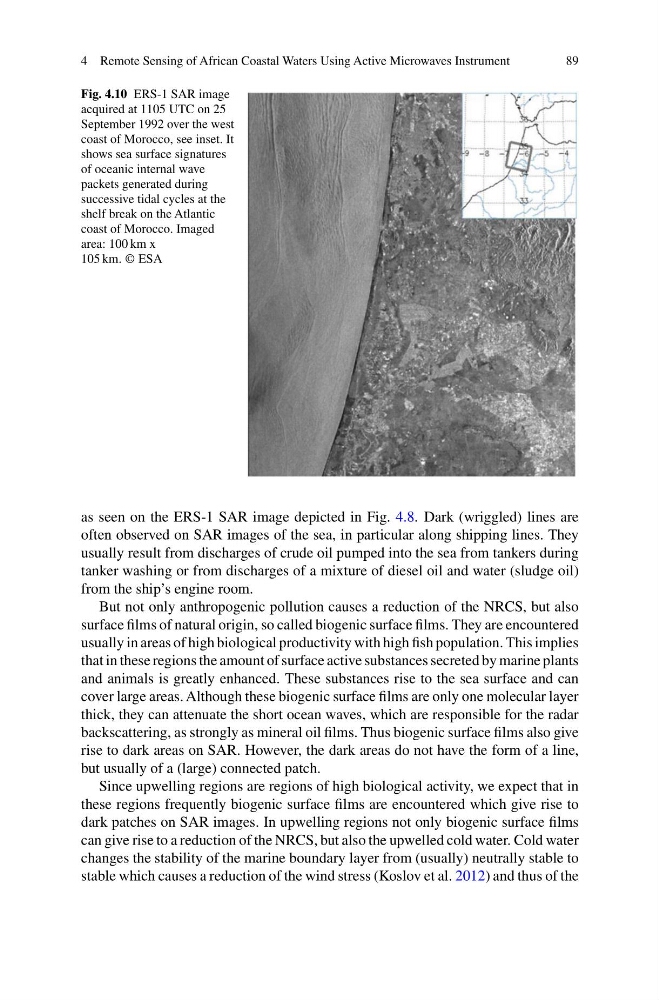
Fig. 4.10 ERS-1 SAR image
acquired at 1105 UTC on 25
September 1992 over the west
coast of Morocco, see inset. It
shows sea surface signatures
of oceanic internal wave
packets generated during
successive tidal cycles at the
shelf break on the Atlantic
coast of Morocco. Imaged
area: 100 km x
105 km. © ESA
as seen on the ERS-1 SAR image depicted in Fig. 4.8. Dark (wriggled) lines are
often observed on SAR images of the sea, in particular along shipping lines. They
usually result from discharges of crude oil pumped into the sea from tankers during
tanker washing or from discharges of a mixture of diesel oil and water (sludge oil)
from the ship’s engine room.
But not only anthropogenic pollution causes a reduction of the NRCS, but also
surface films of natural origin, so called biogenic surface films. They are encountered
usually in areas of high biological productivity with high fish population. This implies
that in these regions the amount of surface active substances secreted by marine plants
and animals is greatly enhanced. These substances rise to the sea surface and can
cover large areas. Although these biogenic surface films are only one molecular layer
thick, they can attenuate the short ocean waves, which are responsible for the radar
backscattering, as strongly as mineral oil films. Thus biogenic surface films also give
rise to dark areas on SAR. However, the dark areas do not have the form of a line,
but usually of a (large) connected patch.
Since upwelling regions are regions of high biological activity, we expect that in
these regions frequently biogenic surface films are encountered which give rise to
dark patches on SAR images. In upwelling regions not only biogenic surface films
can give rise to a reduction of the NRCS, but also the upwelled cold water. Cold water
changes the stability of the marine boundary layer from (usually) neutrally stable to
stable which causes a reduction of the wind stress (Koslov et al. 2012) and thus of the
89
Fig. 4.10 ERS-1 SAR image
acquired at 1105 UTC on 25
September 1992 over the west
coast of Morocco, see inset. It
shows sea surface signatures
of oceanic internal wave
packets generated during
successive tidal cycles at the
shelf break on the Atlantic
coast of Morocco. Imaged
area: 100 km x
105 km. © ESA
as seen on the ERS-1 SAR image depicted in Fig. 4.8. Dark (wriggled) lines are
often observed on SAR images of the sea, in particular along shipping lines. They
usually result from discharges of crude oil pumped into the sea from tankers during
tanker washing or from discharges of a mixture of diesel oil and water (sludge oil)
from the ship’s engine room.
But not only anthropogenic pollution causes a reduction of the NRCS, but also
surface films of natural origin, so called biogenic surface films. They are encountered
usually in areas of high biological productivity with high fish population. This implies
that in these regions the amount of surface active substances secreted by marine plants
and animals is greatly enhanced. These substances rise to the sea surface and can
cover large areas. Although these biogenic surface films are only one molecular layer
thick, they can attenuate the short ocean waves, which are responsible for the radar
backscattering, as strongly as mineral oil films. Thus biogenic surface films also give
rise to dark areas on SAR. However, the dark areas do not have the form of a line,
but usually of a (large) connected patch.
Since upwelling regions are regions of high biological activity, we expect that in
these regions frequently biogenic surface films are encountered which give rise to
dark patches on SAR images. In upwelling regions not only biogenic surface films
can give rise to a reduction of the NRCS, but also the upwelled cold water. Cold water
changes the stability of the marine boundary layer from (usually) neutrally stable to
stable which causes a reduction of the wind stress (Koslov et al. 2012) and thus of the