

88
W. Alpers
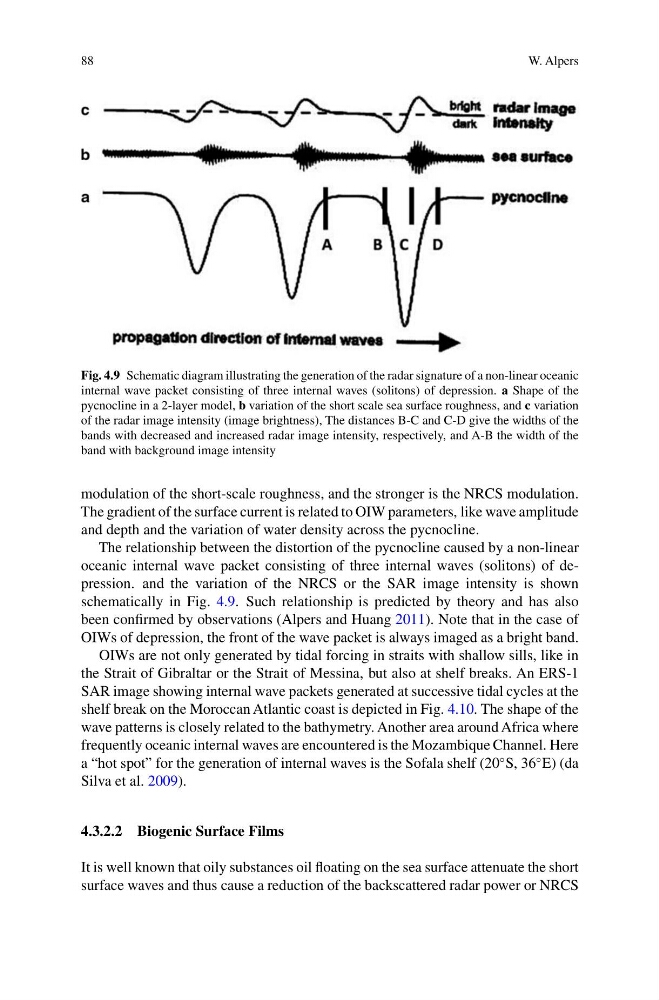
Fig. 4.9 Schematic diagram illustrating the generation of the radar signature of a non-linear oceanic
internal wave packet consisting of three internal waves (solitons) of depression. a Shape of the
pycnocline in a 2-layer model, b variation of the short scale sea surface roughness, and c variation
of the radar image intensity (image brightness), The distances B-C and C-D give the widths of the
bands with decreased and increased radar image intensity, respectively, and A-B the width of the
band with background image intensity
modulation of the short-scale roughness, and the stronger is the NRCS modulation.
The gradient of the surface current is related to OIW parameters, like wave amplitude
and depth and the variation of water density across the pycnocline.
The relationship between the distortion of the pycnocline caused by a non-linear
oceanic internal wave packet consisting of three internal waves (solitons) of depression. and the variation of the NRCS or the SAR image intensity is shown
schematically in Fig. 4.9. Such relationship is predicted by theory and has also
been confirmed by observations (Alpers and Huang 2011). Note that in the case of
OIWs of depression, the front of the wave packet is always imaged as a bright band.
OIWs are not only generated by tidal forcing in straits with shallow sills, like in
the Strait of Gibraltar or the Strait of Messina, but also at shelf breaks. An ERS-1
SAR image showing internal wave packets generated at successive tidal cycles at the
shelf break on the Moroccan Atlantic coast is depicted in Fig. 4.10. The shape of the
wave patterns is closely related to the bathymetry. Another area around Africa where
frequently oceanic internal waves are encountered is the Mozambique Channel. Here
a “hot spot” for the generation of internal waves is the Sofala shelf (20
◦ S, 36
◦ E) (da
Silva et al. 2009).
4.3.2.2 Biogenic Surface Films
It is well known that oily substances oil floating on the sea surface attenuate the short
surface waves and thus cause a reduction of the backscattered radar power or NRCS
W. Alpers
Fig. 4.9 Schematic diagram illustrating the generation of the radar signature of a non-linear oceanic
internal wave packet consisting of three internal waves (solitons) of depression. a Shape of the
pycnocline in a 2-layer model, b variation of the short scale sea surface roughness, and c variation
of the radar image intensity (image brightness), The distances B-C and C-D give the widths of the
bands with decreased and increased radar image intensity, respectively, and A-B the width of the
band with background image intensity
modulation of the short-scale roughness, and the stronger is the NRCS modulation.
The gradient of the surface current is related to OIW parameters, like wave amplitude
and depth and the variation of water density across the pycnocline.
The relationship between the distortion of the pycnocline caused by a non-linear
oceanic internal wave packet consisting of three internal waves (solitons) of depression. and the variation of the NRCS or the SAR image intensity is shown
schematically in Fig. 4.9. Such relationship is predicted by theory and has also
been confirmed by observations (Alpers and Huang 2011). Note that in the case of
OIWs of depression, the front of the wave packet is always imaged as a bright band.
OIWs are not only generated by tidal forcing in straits with shallow sills, like in
the Strait of Gibraltar or the Strait of Messina, but also at shelf breaks. An ERS-1
SAR image showing internal wave packets generated at successive tidal cycles at the
shelf break on the Moroccan Atlantic coast is depicted in Fig. 4.10. The shape of the
wave patterns is closely related to the bathymetry. Another area around Africa where
frequently oceanic internal waves are encountered is the Mozambique Channel. Here
a “hot spot” for the generation of internal waves is the Sofala shelf (20
◦ S, 36
◦ E) (da
Silva et al. 2009).
4.3.2.2 Biogenic Surface Films
It is well known that oily substances oil floating on the sea surface attenuate the short
surface waves and thus cause a reduction of the backscattered radar power or NRCS