

86
W. Alpers
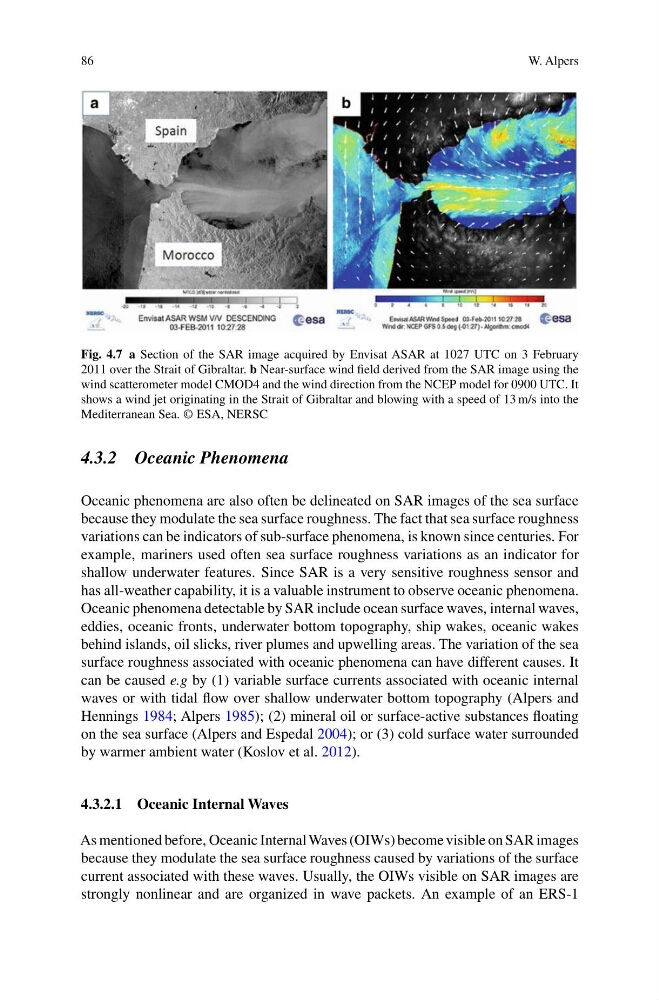
Fig. 4.7 a Section of the SAR image acquired by Envisat ASAR at 1027 UTC on 3 February
2011 over the Strait of Gibraltar. b Near-surface wind field derived from the SAR image using the
wind scatterometer model CMOD4 and the wind direction from the NCEP model for 0900 UTC. It
shows a wind jet originating in the Strait of Gibraltar and blowing with a speed of 13 m/s into the
Mediterranean Sea. © ESA, NERSC
4.3.2 Oceanic Phenomena
Oceanic phenomena are also often be delineated on SAR images of the sea surface
because they modulate the sea surface roughness. The fact that sea surface roughness
variations can be indicators of sub-surface phenomena, is known since centuries. For
example, mariners used often sea surface roughness variations as an indicator for
shallow underwater features. Since SAR is a very sensitive roughness sensor and
has all-weather capability, it is a valuable instrument to observe oceanic phenomena.
Oceanic phenomena detectable by SAR include ocean surface waves, internal waves,
eddies, oceanic fronts, underwater bottom topography, ship wakes, oceanic wakes
behind islands, oil slicks, river plumes and upwelling areas. The variation of the sea
surface roughness associated with oceanic phenomena can have different causes. It
can be caused e.g by (1) variable surface currents associated with oceanic internal
waves or with tidal flow over shallow underwater bottom topography (Alpers and
Hennings 1984; Alpers 1985); (2) mineral oil or surface-active substances floating
on the sea surface (Alpers and Espedal 2004); or (3) cold surface water surrounded
by warmer ambient water (Koslov et al. 2012).
4.3.2.1 Oceanic Internal Waves
As mentioned before, Oceanic Internal Waves (OIWs) become visible on SAR images
because they modulate the sea surface roughness caused by variations of the surface
current associated with these waves. Usually, the OIWs visible on SAR images are
strongly nonlinear and are organized in wave packets. An example of an ERS-1
W. Alpers
Fig. 4.7 a Section of the SAR image acquired by Envisat ASAR at 1027 UTC on 3 February
2011 over the Strait of Gibraltar. b Near-surface wind field derived from the SAR image using the
wind scatterometer model CMOD4 and the wind direction from the NCEP model for 0900 UTC. It
shows a wind jet originating in the Strait of Gibraltar and blowing with a speed of 13 m/s into the
Mediterranean Sea. © ESA, NERSC
4.3.2 Oceanic Phenomena
Oceanic phenomena are also often be delineated on SAR images of the sea surface
because they modulate the sea surface roughness. The fact that sea surface roughness
variations can be indicators of sub-surface phenomena, is known since centuries. For
example, mariners used often sea surface roughness variations as an indicator for
shallow underwater features. Since SAR is a very sensitive roughness sensor and
has all-weather capability, it is a valuable instrument to observe oceanic phenomena.
Oceanic phenomena detectable by SAR include ocean surface waves, internal waves,
eddies, oceanic fronts, underwater bottom topography, ship wakes, oceanic wakes
behind islands, oil slicks, river plumes and upwelling areas. The variation of the sea
surface roughness associated with oceanic phenomena can have different causes. It
can be caused e.g by (1) variable surface currents associated with oceanic internal
waves or with tidal flow over shallow underwater bottom topography (Alpers and
Hennings 1984; Alpers 1985); (2) mineral oil or surface-active substances floating
on the sea surface (Alpers and Espedal 2004); or (3) cold surface water surrounded
by warmer ambient water (Koslov et al. 2012).
4.3.2.1 Oceanic Internal Waves
As mentioned before, Oceanic Internal Waves (OIWs) become visible on SAR images
because they modulate the sea surface roughness caused by variations of the surface
current associated with these waves. Usually, the OIWs visible on SAR images are
strongly nonlinear and are organized in wave packets. An example of an ERS-1