

1:
§J
4:
0.00
0.00
0.00
0.00
2
150.00
300.00
Monlhs
450.00
600.00
18.3. Preliminary Insights
403
• AC1ual Pnc<
2 harvesnnq
3: cal ch,ng
4: Wild Shrimp Biomass
1:
10.00 .. - - - - - -- , - - - - - - -- .
l. 50e+009
1.5Oe+Ol0
4 :
1- - - - - - - - - -
1:
5.00
7.5Oe+OO8
7.5Oe+009
4:
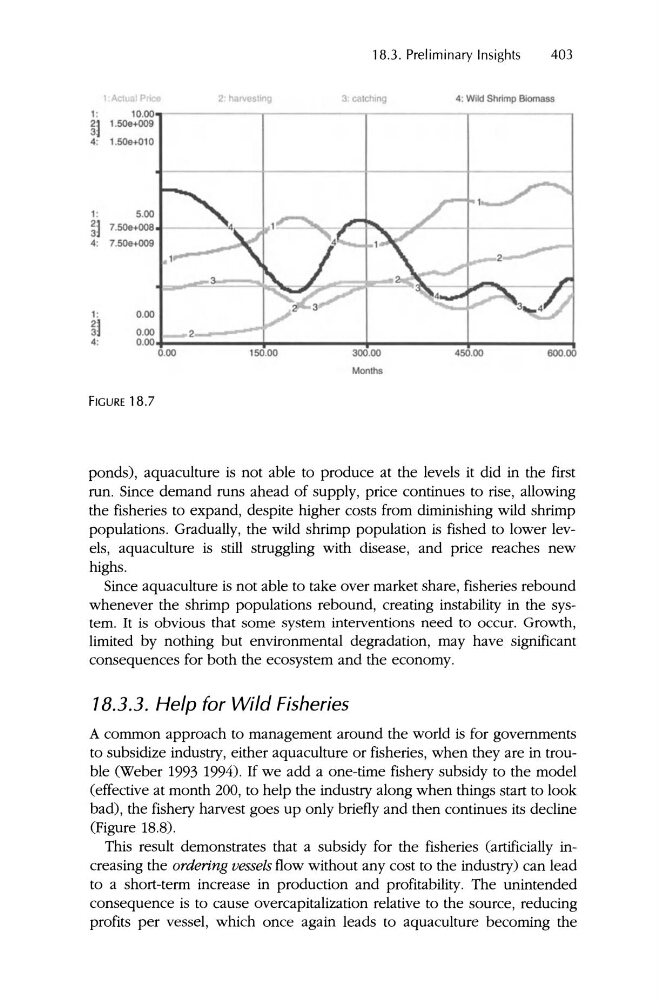
FIGURE 18.7
ponds), aquaculture is not able to produce at the levels it did in the first
run. Since demand runs ahead of supply, price continues to rise, allowing
the fisheries to expand, despite higher costs from diminishing wild shrimp
populations. Gradually, the wild shrimp population is fished to lower levels, aquaculture is still struggling with disease, and price reaches new
highs.
Since aquaculture is not able to take over market share, fisheries rebound
whenever the shrimp populations rebound, creating instability in the system. It is obvious that some system interventions need to occur. Growth ,
limited by nothing but environmental degradation, may have significant
consequences for both the ecosystem and the economy.
18.3.3. Help for Wild Fisheries
A common approach to management around the world is for governments
to subsidize industry , either aquaculture or fisheries, when they are in trouble (Weber 1993 1994). If we add a one-time fishery subsidy to the model
(effective at month 200, to help the industry along when things start to look
bad), the fishery harvest goes up only briefly and then continues its decline
(Figure 18.8).
This result demonstrates that a subsidy for the fisheries (artificially increasing the ordering vessels flow without any cost to the industry) can lead
to a short-term increase in production and profitability. The unintended
consequence is to cause overcapitalization relative to the source, reducing
profits per vessel, which once again leads to aquaculture becoming the
§J
4:
0.00
0.00
0.00
0.00
2
150.00
300.00
Monlhs
450.00
600.00
18.3. Preliminary Insights
403
• AC1ual Pnc<
2 harvesnnq
3: cal ch,ng
4: Wild Shrimp Biomass
1:
10.00 .. - - - - - -- , - - - - - - -- .
l. 50e+009
1.5Oe+Ol0
4 :
1- - - - - - - - - -
1:
5.00
7.5Oe+OO8
7.5Oe+009
4:
FIGURE 18.7
ponds), aquaculture is not able to produce at the levels it did in the first
run. Since demand runs ahead of supply, price continues to rise, allowing
the fisheries to expand, despite higher costs from diminishing wild shrimp
populations. Gradually, the wild shrimp population is fished to lower levels, aquaculture is still struggling with disease, and price reaches new
highs.
Since aquaculture is not able to take over market share, fisheries rebound
whenever the shrimp populations rebound, creating instability in the system. It is obvious that some system interventions need to occur. Growth ,
limited by nothing but environmental degradation, may have significant
consequences for both the ecosystem and the economy.
18.3.3. Help for Wild Fisheries
A common approach to management around the world is for governments
to subsidize industry , either aquaculture or fisheries, when they are in trouble (Weber 1993 1994). If we add a one-time fishery subsidy to the model
(effective at month 200, to help the industry along when things start to look
bad), the fishery harvest goes up only briefly and then continues its decline
(Figure 18.8).
This result demonstrates that a subsidy for the fisheries (artificially increasing the ordering vessels flow without any cost to the industry) can lead
to a short-term increase in production and profitability. The unintended
consequence is to cause overcapitalization relative to the source, reducing
profits per vessel, which once again leads to aquaculture becoming the