

13 .2. The Model
263
hap standing stock
FIGURE 13.1
Energy is then in the prey models at a rate which is set by the user . We do
not know what rates to suggest, since so little is known about the growth
parameters of the prey species. But we do know, based on assumption 9
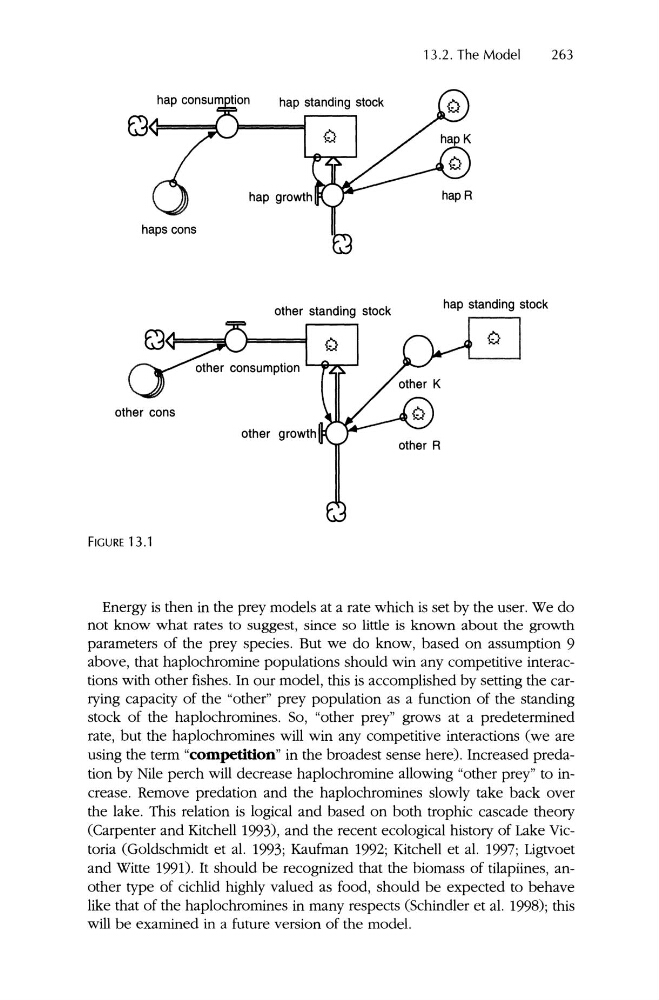
above , that haplochromine populations should win any competitive interactions with other fishes. In our model, this is accomplished by setting the carrying capacity of the "other" prey population as a function of the standing
stock of the haplochromines. So, "other prey" grows at a predetermined
rate, but the haplochromines will win any competitive interactions (we are
using the term "co mpetitio n" in the broadest sense here). Increased predation by Nile perch will decrease haplochromine allowing "other prey" to increase. Remove predation and the haplochromines slowly take back over
the lake. This relation is logical and based on both trophic cascade theory
(Carpenter and Kitchell 1993), and the recent ecological history of Lake Victoria (Goldschmidt et al. 1993; Kaufman 1992; Kitchell et al. 1997; Ligtvoet
and Witte 1991). It should be recognized that the biomass of tilapiines, another type of cichlid highly valued as food, should be expected to behave
like that of the haplochromines in many respects (Schindler et al. 1998); this
will be examined in a future version of the model.
263
hap standing stock
FIGURE 13.1
Energy is then in the prey models at a rate which is set by the user . We do
not know what rates to suggest, since so little is known about the growth
parameters of the prey species. But we do know, based on assumption 9
above , that haplochromine populations should win any competitive interactions with other fishes. In our model, this is accomplished by setting the carrying capacity of the "other" prey population as a function of the standing
stock of the haplochromines. So, "other prey" grows at a predetermined
rate, but the haplochromines will win any competitive interactions (we are
using the term "co mpetitio n" in the broadest sense here). Increased predation by Nile perch will decrease haplochromine allowing "other prey" to increase. Remove predation and the haplochromines slowly take back over
the lake. This relation is logical and based on both trophic cascade theory
(Carpenter and Kitchell 1993), and the recent ecological history of Lake Victoria (Goldschmidt et al. 1993; Kaufman 1992; Kitchell et al. 1997; Ligtvoet
and Witte 1991). It should be recognized that the biomass of tilapiines, another type of cichlid highly valued as food, should be expected to behave
like that of the haplochromines in many respects (Schindler et al. 1998); this
will be examined in a future version of the model.