

262
13. Nile Perch Population Dynamics in Lake Victoria :
10) When fre efrom competition and predation from haplochromines, other
prey types will dominate the system (Goldschmidt et al. 1993; Kitchell et
al. 1997; Ligtvoet and Witte 1991; Pitcher and Hart 1995).
13.2.1.1. General Model Structure
The model is subdivided into three modules-a set of prey modules, a
fishery module, and a 20-cohort Nile perch population module. The model
was developed to be used both as a theoretical tool, and as the beginnings
of an implicit fishery management model. As such you will notice a mixture
of flexibility and rigidity in the model structure. It is designed to be run for
7200 days, and can be adapted to various systems, and any mass frequency
distribution for the 20 cohorts. In the global layer of the model we have included sets of controls (knobs, graphs , and tables) which enable the user to
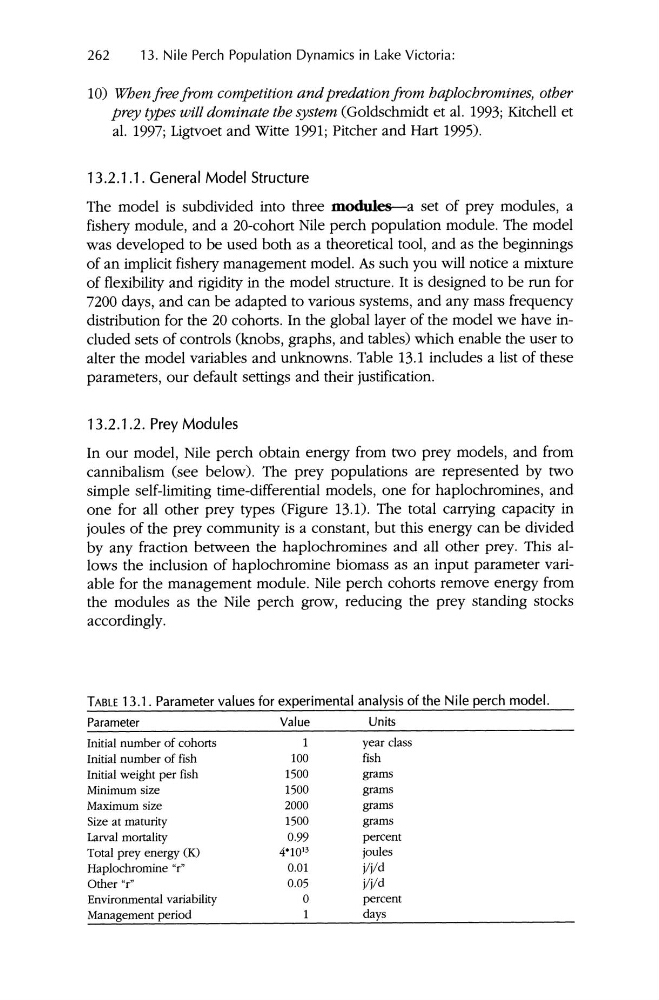
alter the model variables and unknowns. Table 13.1 includes a list of these
parameters, our default settings and their justification.
13.2.1.2. Prey Modules
In our model , Nile perch obtain energy from two prey model s, and from
cannibalism (see below). The prey populations are represented by two
simple self-limiting time-differenti al models, one for hapl ochromines, and
one for all other prey types (Figure 13.n. The total carrying capacity in
joule s of the prey community is a constant , but this energy can be divided
by any fraction between the haplochromines and all othe r prey. This allows the inclusion of hapl ochromine biomass as an input parameter variable for the management module. Nile perch cohorts remove en ergy from
the modules as the Nile perch grow, reducing the prey standing stocks
accordingl y.
TABLE 13.1. Parametervalues for experimental analysis of the Nile perch model.
Parameter
Value
Units
Initial number of cohorts
Initial number of fish
Initial weight per fish
Minimum size
Maximum size
Size at maturity
Larval mortality
Total prey ene rgy (K)
Haplochromine "r
n
Othe r "r"
Environmental variability
Management period
year class
fish
grams
grams
grams
grams
percent
joules
j/ j/d
j/j/d
percent
days
1
100
1500
1500
2000
1500
0.99
4"10 13
om
0.05
o
1
13. Nile Perch Population Dynamics in Lake Victoria :
10) When fre efrom competition and predation from haplochromines, other
prey types will dominate the system (Goldschmidt et al. 1993; Kitchell et
al. 1997; Ligtvoet and Witte 1991; Pitcher and Hart 1995).
13.2.1.1. General Model Structure
The model is subdivided into three modules-a set of prey modules, a
fishery module, and a 20-cohort Nile perch population module. The model
was developed to be used both as a theoretical tool, and as the beginnings
of an implicit fishery management model. As such you will notice a mixture
of flexibility and rigidity in the model structure. It is designed to be run for
7200 days, and can be adapted to various systems, and any mass frequency
distribution for the 20 cohorts. In the global layer of the model we have included sets of controls (knobs, graphs , and tables) which enable the user to
alter the model variables and unknowns. Table 13.1 includes a list of these
parameters, our default settings and their justification.
13.2.1.2. Prey Modules
In our model , Nile perch obtain energy from two prey model s, and from
cannibalism (see below). The prey populations are represented by two
simple self-limiting time-differenti al models, one for hapl ochromines, and
one for all other prey types (Figure 13.n. The total carrying capacity in
joule s of the prey community is a constant , but this energy can be divided
by any fraction between the haplochromines and all othe r prey. This allows the inclusion of hapl ochromine biomass as an input parameter variable for the management module. Nile perch cohorts remove en ergy from
the modules as the Nile perch grow, reducing the prey standing stocks
accordingl y.
TABLE 13.1. Parametervalues for experimental analysis of the Nile perch model.
Parameter
Value
Units
Initial number of cohorts
Initial number of fish
Initial weight per fish
Minimum size
Maximum size
Size at maturity
Larval mortality
Total prey ene rgy (K)
Haplochromine "r
n
Othe r "r"
Environmental variability
Management period
year class
fish
grams
grams
grams
grams
percent
joules
j/ j/d
j/j/d
percent
days
1
100
1500
1500
2000
1500
0.99
4"10 13
om
0.05
o
1