

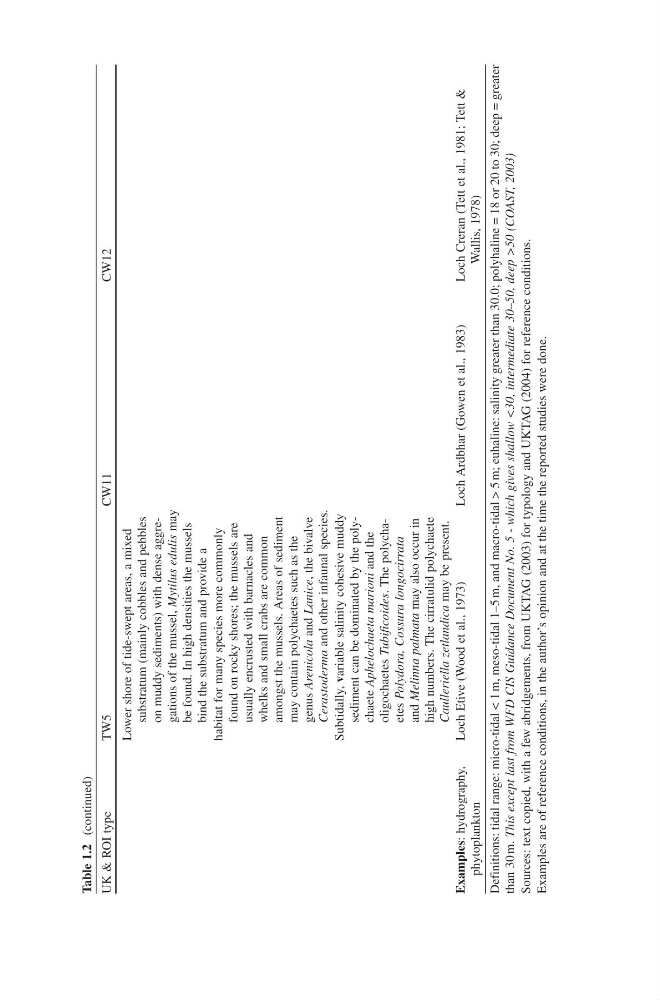
Table 1.2
(continued)
UK & ROI type
TW5
CW11
CW12
Lower shore of tide-swept areas, a mixed
substratum (mainly cobbles and pebbles
on muddy sediments) with dense aggregations of the mussel, Mytilus edulis
may
be found. In high densities the mussels
bind the substratum and provide a
habitat for many species more commonly
found on rocky shores; the mussels are
usually encrusted with barnacles and
whelks and small crabs are common
amongst the mussels. Areas of sediment
may contain polychaetes such as the
genus Arenicola
and Lanice,
the bivalve
Cerastoderma
and other infaunal species.
Subtidally, variable
salinity cohesive muddy
sediment can be dominated by the polychaete Aphelochaeta marioni
and the
oligochaetes Tubificoides.
The polychaetes Polydora, Cossura longocirrata
and Melinna palmata
may also occur in
high numbers. The cirratulid polychaete
Caulleriella zetlandica
may be present.
Examples:
hydrography,
phytoplankton
Loch Etive (Wood et al., 1973)
Loch Ardbhar (Gowen et al., 1983)
Loch Creran (Tett et al., 1981; Tett &
Wallis, 1978)
Definitions: tidal range: micro-tidal < 1 m, meso-tidal 1–5 m, and macro-tidal > 5 m; euhaline: salinity greater than 30.0; polyhaline = 18 or 20 to 30; deep = greater
than 30 m. This except last from WFD CIS Guidance Document No. 5 - which gives shallow <30, intermediate 30–50, deep >50 (COAST, 2003)
Sources: text copied, with a few abridgements, from UKTAG (2003) for typology and UKTAG (2004) for reference conditions.
Examples are of reference conditions, in the author’s opinion and at the time the reported studies were done.
(continued)
UK & ROI type
TW5
CW11
CW12
Lower shore of tide-swept areas, a mixed
substratum (mainly cobbles and pebbles
on muddy sediments) with dense aggregations of the mussel, Mytilus edulis
may
be found. In high densities the mussels
bind the substratum and provide a
habitat for many species more commonly
found on rocky shores; the mussels are
usually encrusted with barnacles and
whelks and small crabs are common
amongst the mussels. Areas of sediment
may contain polychaetes such as the
genus Arenicola
and Lanice,
the bivalve
Cerastoderma
and other infaunal species.
Subtidally, variable
salinity cohesive muddy
sediment can be dominated by the polychaete Aphelochaeta marioni
and the
oligochaetes Tubificoides.
The polychaetes Polydora, Cossura longocirrata
and Melinna palmata
may also occur in
high numbers. The cirratulid polychaete
Caulleriella zetlandica
may be present.
Examples:
hydrography,
phytoplankton
Loch Etive (Wood et al., 1973)
Loch Ardbhar (Gowen et al., 1983)
Loch Creran (Tett et al., 1981; Tett &
Wallis, 1978)
Definitions: tidal range: micro-tidal < 1 m, meso-tidal 1–5 m, and macro-tidal > 5 m; euhaline: salinity greater than 30.0; polyhaline = 18 or 20 to 30; deep = greater
than 30 m. This except last from WFD CIS Guidance Document No. 5 - which gives shallow <30, intermediate 30–50, deep >50 (COAST, 2003)
Sources: text copied, with a few abridgements, from UKTAG (2003) for typology and UKTAG (2004) for reference conditions.
Examples are of reference conditions, in the author’s opinion and at the time the reported studies were done.