

1 Fish Farm Wastes in the Ecosystem
31
Much of the substance of these plans will no doubt become part of the “programme
of measures” and the sampling networks required to monitor their effect. However,
there is not much here relevant to the impact of the salmon farm on Creran, and so
I must make an informed guess as to what the “environmental objectives” set for
the loch will be. Although there are likely to be some changes in SEPA’s regulation
of benthic AZEs, I am assuming that changes brought about by the implementation
of the WFD will increase emphasis on the phytoplankton biological quality element. The “reference condition” for this element in the CW12 type was given in
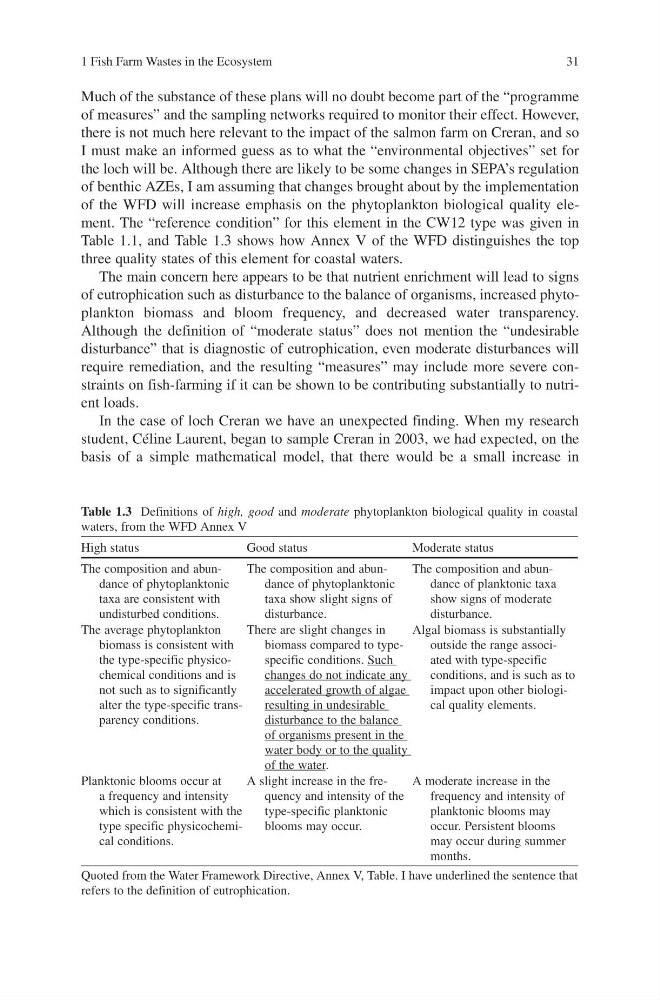
Table 1.1, and Table 1.3 shows how Annex V of the WFD distinguishes the top
three quality states of this element for coastal waters.
The main concern here appears to be that nutrient enrichment will lead to signs
of eutrophication such as disturbance to the balance of organisms, increased phytoplankton biomass and bloom frequency, and decreased water transparency.
Although the definition of “moderate status” does not mention the “undesirable
disturbance” that is diagnostic of eutrophication, even moderate disturbances will
require remediation, and the resulting “measures” may include more severe constraints on fish-farming if it can be shown to be contributing substantially to nutrient loads.
In the case of loch Creran we have an unexpected finding. When my research
student, Céline Laurent, began to sample Creran in 2003, we had expected, on the
basis of a simple mathematical model, that there would be a small increase in
Table 1.3 Definitions of high, good and moderate phytoplankton biological quality in coastal
waters, from the WFD Annex V
High status
Good status
Moderate status
The composition and abundance of phytoplanktonic
taxa are consistent with
undisturbed conditions.
The composition and abundance of phytoplanktonic
taxa show slight signs of
disturbance.
The composition and abundance of planktonic taxa
show signs of moderate
disturbance.
The average phytoplankton
biomass is consistent with
the type-specific physicochemical conditions and is
not such as to significantly
alter the type-specific transparency conditions.
There are slight changes in
biomass compared to typespecific conditions. Such
changes do not indicate any
accelerated growth of algae
resulting in undesirable
disturbance to the balance
of organisms present in the
water body or to the quality
of the water.
Algal biomass is substantially
outside the range associated with type-specific
conditions, and is such as to
impact upon other biological quality elements.
Planktonic blooms occur at
a frequency and intensity
which is consistent with the
type specific physicochemical conditions.
A slight increase in the frequency and intensity of the
type-specific planktonic
blooms may occur.
A moderate increase in the
frequency and intensity of
planktonic blooms may
occur. Persistent blooms
may occur during summer
months.
Quoted from the Water Framework Directive, Annex V, Table. I have underlined the sentence that
refers to the definition of eutrophication.
31
Much of the substance of these plans will no doubt become part of the “programme
of measures” and the sampling networks required to monitor their effect. However,
there is not much here relevant to the impact of the salmon farm on Creran, and so
I must make an informed guess as to what the “environmental objectives” set for
the loch will be. Although there are likely to be some changes in SEPA’s regulation
of benthic AZEs, I am assuming that changes brought about by the implementation
of the WFD will increase emphasis on the phytoplankton biological quality element. The “reference condition” for this element in the CW12 type was given in
Table 1.1, and Table 1.3 shows how Annex V of the WFD distinguishes the top
three quality states of this element for coastal waters.
The main concern here appears to be that nutrient enrichment will lead to signs
of eutrophication such as disturbance to the balance of organisms, increased phytoplankton biomass and bloom frequency, and decreased water transparency.
Although the definition of “moderate status” does not mention the “undesirable
disturbance” that is diagnostic of eutrophication, even moderate disturbances will
require remediation, and the resulting “measures” may include more severe constraints on fish-farming if it can be shown to be contributing substantially to nutrient loads.
In the case of loch Creran we have an unexpected finding. When my research
student, Céline Laurent, began to sample Creran in 2003, we had expected, on the
basis of a simple mathematical model, that there would be a small increase in
Table 1.3 Definitions of high, good and moderate phytoplankton biological quality in coastal
waters, from the WFD Annex V
High status
Good status
Moderate status
The composition and abundance of phytoplanktonic
taxa are consistent with
undisturbed conditions.
The composition and abundance of phytoplanktonic
taxa show slight signs of
disturbance.
The composition and abundance of planktonic taxa
show signs of moderate
disturbance.
The average phytoplankton
biomass is consistent with
the type-specific physicochemical conditions and is
not such as to significantly
alter the type-specific transparency conditions.
There are slight changes in
biomass compared to typespecific conditions. Such
changes do not indicate any
accelerated growth of algae
resulting in undesirable
disturbance to the balance
of organisms present in the
water body or to the quality
of the water.
Algal biomass is substantially
outside the range associated with type-specific
conditions, and is such as to
impact upon other biological quality elements.
Planktonic blooms occur at
a frequency and intensity
which is consistent with the
type specific physicochemical conditions.
A slight increase in the frequency and intensity of the
type-specific planktonic
blooms may occur.
A moderate increase in the
frequency and intensity of
planktonic blooms may
occur. Persistent blooms
may occur during summer
months.
Quoted from the Water Framework Directive, Annex V, Table. I have underlined the sentence that
refers to the definition of eutrophication.