

296
Y. Olsen et al.
long tradition in some regions of the world, particularly in South-East Asia. The
historical and economic importance of mariculture has, however, been low compared with freshwater aquaculture. It is remarkable that the increase in mariculture
with time has quantitatively replaced the earlier increases in captured resources
yielding a pattern of steady increase in total harvesting at 1.5–2.0 million tonnes
per year in the period 1990–2003 despite the stagnation of wild-stock catches. This
clear trend in captured and cultured marine organisms clearly indicates that a future
increase in seafood production must come from culture.
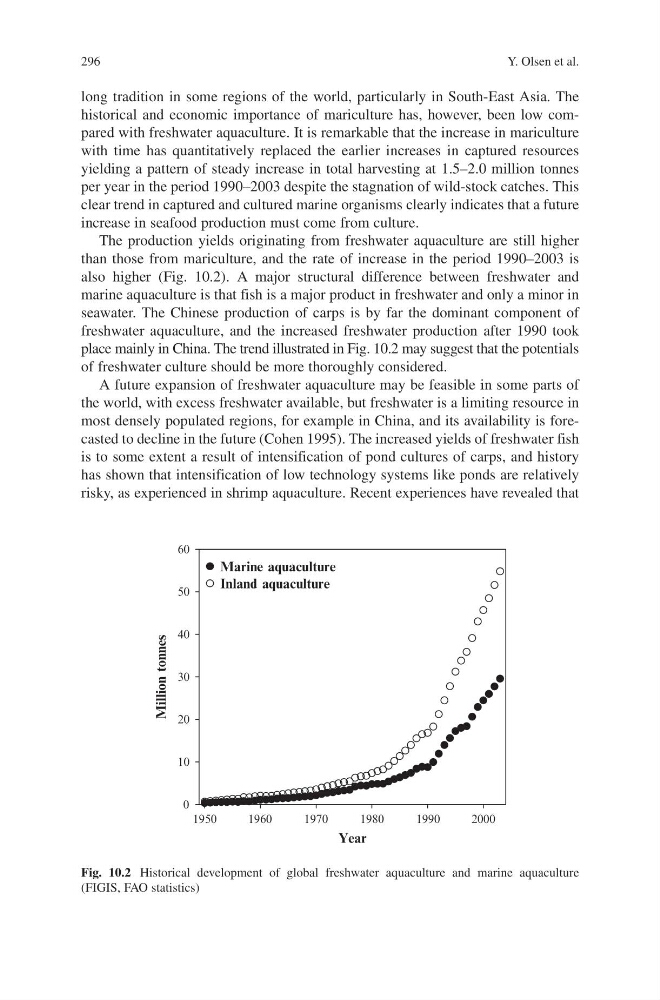
The production yields originating from freshwater aquaculture are still higher
than those from mariculture, and the rate of increase in the period 1990–2003 is
also higher (Fig. 10.2). A major structural difference between freshwater and
marine aquaculture is that fish is a major product in freshwater and only a minor in
seawater. The Chinese production of carps is by far the dominant component of
freshwater aquaculture, and the increased freshwater production after 1990 took
place mainly in China. The trend illustrated in Fig. 10.2 may suggest that the potentials
of freshwater culture should be more thoroughly considered.
A future expansion of freshwater aquaculture may be feasible in some parts of
the world, with excess freshwater available, but freshwater is a limiting resource in
most densely populated regions, for example in China, and its availability is forecasted to decline in the future (Cohen 1995). The increased yields of freshwater fish
is to some extent a result of intensification of pond cultures of carps, and history
has shown that intensification of low technology systems like ponds are relatively
risky, as experienced in shrimp aquaculture. Recent experiences have revealed that
Fig. 10.2 Historical development of global freshwater aquaculture and marine aquaculture
(FIGIS, FAO statistics)
Year
1950
1960
1970
1980
1990
2000
Million tonnes
0
10
20
30
40
50
60
Marine aquaculture
Inland aquaculture
Y. Olsen et al.
long tradition in some regions of the world, particularly in South-East Asia. The
historical and economic importance of mariculture has, however, been low compared with freshwater aquaculture. It is remarkable that the increase in mariculture
with time has quantitatively replaced the earlier increases in captured resources
yielding a pattern of steady increase in total harvesting at 1.5–2.0 million tonnes
per year in the period 1990–2003 despite the stagnation of wild-stock catches. This
clear trend in captured and cultured marine organisms clearly indicates that a future
increase in seafood production must come from culture.
The production yields originating from freshwater aquaculture are still higher
than those from mariculture, and the rate of increase in the period 1990–2003 is
also higher (Fig. 10.2). A major structural difference between freshwater and
marine aquaculture is that fish is a major product in freshwater and only a minor in
seawater. The Chinese production of carps is by far the dominant component of
freshwater aquaculture, and the increased freshwater production after 1990 took
place mainly in China. The trend illustrated in Fig. 10.2 may suggest that the potentials
of freshwater culture should be more thoroughly considered.
A future expansion of freshwater aquaculture may be feasible in some parts of
the world, with excess freshwater available, but freshwater is a limiting resource in
most densely populated regions, for example in China, and its availability is forecasted to decline in the future (Cohen 1995). The increased yields of freshwater fish
is to some extent a result of intensification of pond cultures of carps, and history
has shown that intensification of low technology systems like ponds are relatively
risky, as experienced in shrimp aquaculture. Recent experiences have revealed that
Fig. 10.2 Historical development of global freshwater aquaculture and marine aquaculture
(FIGIS, FAO statistics)
Year
1950
1960
1970
1980
1990
2000
Million tonnes
0
10
20
30
40
50
60
Marine aquaculture
Inland aquaculture