

10 Status and Future Perspectives in Aquaculture
295
(FIGIS
1
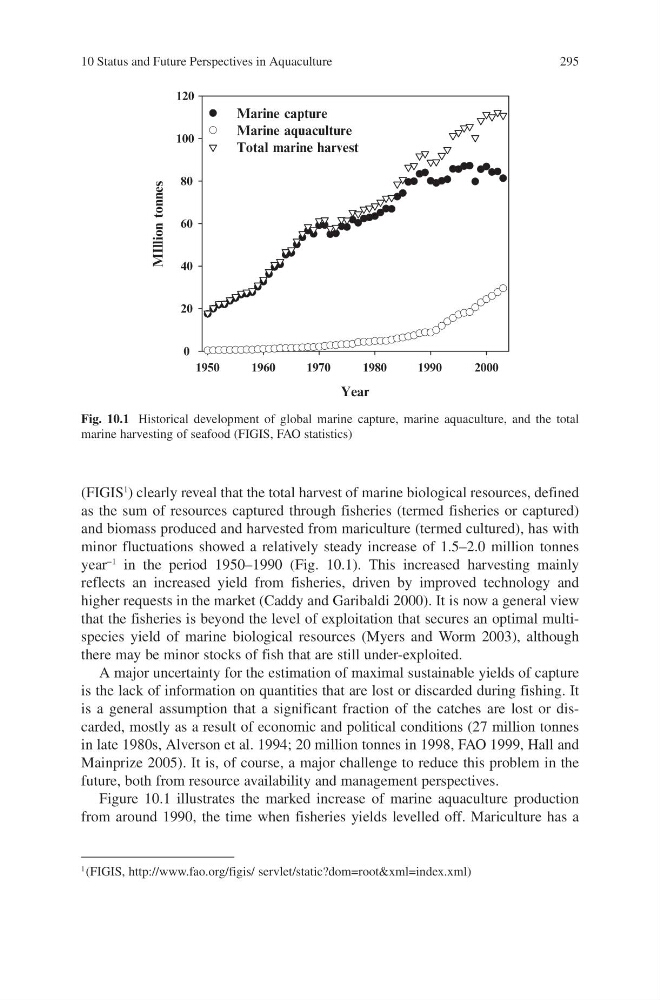
) clearly reveal that the total harvest of marine biological resources, defined
as the sum of resources captured through fisheries (termed fisheries or captured)
and biomass produced and harvested from mariculture (termed cultured), has with
minor fluctuations showed a relatively steady increase of 1.5–2.0 million tonnes
year
−1 in the period 1950–1990 (Fig. 10.1). This increased harvesting mainly
reflects an increased yield from fisheries, driven by improved technology and
higher requests in the market (Caddy and Garibaldi 2000). It is now a general view
that the fisheries is beyond the level of exploitation that secures an optimal multispecies yield of marine biological resources (Myers and Worm 2003), although
there may be minor stocks of fish that are still under-exploited.
A major uncertainty for the estimation of maximal sustainable yields of capture
is the lack of information on quantities that are lost or discarded during fishing. It
is a general assumption that a significant fraction of the catches are lost or discarded, mostly as a result of economic and political conditions (27 million tonnes
in late 1980s, Alverson et al. 1994; 20 million tonnes in 1998, FAO 1999, Hall and
Mainprize 2005). It is, of course, a major challenge to reduce this problem in the
future, both from resource availability and management perspectives.
Figure 10.1 illustrates the marked increase of marine aquaculture production
from around 1990, the time when fisheries yields levelled off. Mariculture has a
Fig. 10.1 Historical development of global marine capture, marine aquaculture, and the total
marine harvesting of seafood (FIGIS, FAO statistics)
1 (FIGIS, http://www.fao.org/figis/ servlet/static?dom=root&xml=index.xml)
Year
1950
1960
1970
1980
1990
2000
MIllion tonnes
0
20
40
60
80
100
120
Marine capture
Marine aquaculture
Total marine harvest
295
(FIGIS
1
) clearly reveal that the total harvest of marine biological resources, defined
as the sum of resources captured through fisheries (termed fisheries or captured)
and biomass produced and harvested from mariculture (termed cultured), has with
minor fluctuations showed a relatively steady increase of 1.5–2.0 million tonnes
year
−1 in the period 1950–1990 (Fig. 10.1). This increased harvesting mainly
reflects an increased yield from fisheries, driven by improved technology and
higher requests in the market (Caddy and Garibaldi 2000). It is now a general view
that the fisheries is beyond the level of exploitation that secures an optimal multispecies yield of marine biological resources (Myers and Worm 2003), although
there may be minor stocks of fish that are still under-exploited.
A major uncertainty for the estimation of maximal sustainable yields of capture
is the lack of information on quantities that are lost or discarded during fishing. It
is a general assumption that a significant fraction of the catches are lost or discarded, mostly as a result of economic and political conditions (27 million tonnes
in late 1980s, Alverson et al. 1994; 20 million tonnes in 1998, FAO 1999, Hall and
Mainprize 2005). It is, of course, a major challenge to reduce this problem in the
future, both from resource availability and management perspectives.
Figure 10.1 illustrates the marked increase of marine aquaculture production
from around 1990, the time when fisheries yields levelled off. Mariculture has a
Fig. 10.1 Historical development of global marine capture, marine aquaculture, and the total
marine harvesting of seafood (FIGIS, FAO statistics)
1 (FIGIS, http://www.fao.org/figis/ servlet/static?dom=root&xml=index.xml)
Year
1950
1960
1970
1980
1990
2000
MIllion tonnes
0
20
40
60
80
100
120
Marine capture
Marine aquaculture
Total marine harvest