

10 Status and Future Perspectives in Aquaculture
297
sustainable ponds yields for shrimp production are lower than expected (Fast and
Leung 2003), and negative effects caused by extensive phytoplankton blooms (AlonsoRodriguez and Paez-Osuna 2003) and chemicals added to mitigate ecological
problems (Graslund and Bengtsson 2001) are well documented problems during
intensification. The general prospect for freshwater aquaculture is promising, but
the global potentials seem all together to be more restricted than for mariculture
because of the limited supply of freshwater.
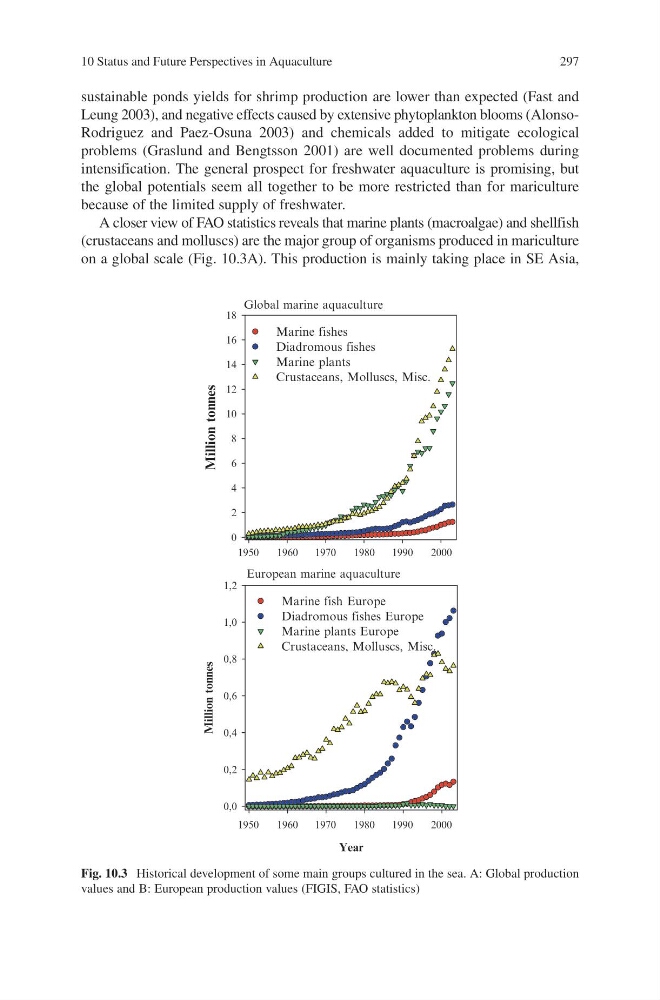
A closer view of FAO statistics reveals that marine plants (macroalgae) and shellfish
(crustaceans and molluscs) are the major group of organisms produced in mariculture
on a global scale (Fig. 10.3A). This production is mainly taking place in SE Asia,
Fig. 10.3 Historical development of some main groups cultured in the sea. A: Global production
values and B: European production values (FIGIS, FAO statistics)
Global marine aquaculture
1950
1960
1970
1980
1990
2000
1950
1960
1970
1980
1990
2000
Million tonnes
0
2
4
6
8
10
12
14
16
18
Marine fishes
Diadromous fishes
Marine plants
Crustaceans, Molluscs, Misc.
European marine aquaculture
Year
Million tonnes
0,0
0,2
0,4
0,6
0,8
1,0
1,2
Marine fish Europe
Diadromous fishes Europe
Marine plants Europe
Crustaceans, Molluscs, Misc.
297
sustainable ponds yields for shrimp production are lower than expected (Fast and
Leung 2003), and negative effects caused by extensive phytoplankton blooms (AlonsoRodriguez and Paez-Osuna 2003) and chemicals added to mitigate ecological
problems (Graslund and Bengtsson 2001) are well documented problems during
intensification. The general prospect for freshwater aquaculture is promising, but
the global potentials seem all together to be more restricted than for mariculture
because of the limited supply of freshwater.
A closer view of FAO statistics reveals that marine plants (macroalgae) and shellfish
(crustaceans and molluscs) are the major group of organisms produced in mariculture
on a global scale (Fig. 10.3A). This production is mainly taking place in SE Asia,
Fig. 10.3 Historical development of some main groups cultured in the sea. A: Global production
values and B: European production values (FIGIS, FAO statistics)
Global marine aquaculture
1950
1960
1970
1980
1990
2000
1950
1960
1970
1980
1990
2000
Million tonnes
0
2
4
6
8
10
12
14
16
18
Marine fishes
Diadromous fishes
Marine plants
Crustaceans, Molluscs, Misc.
European marine aquaculture
Year
Million tonnes
0,0
0,2
0,4
0,6
0,8
1,0
1,2
Marine fish Europe
Diadromous fishes Europe
Marine plants Europe
Crustaceans, Molluscs, Misc.