

274
F. Asche et al.
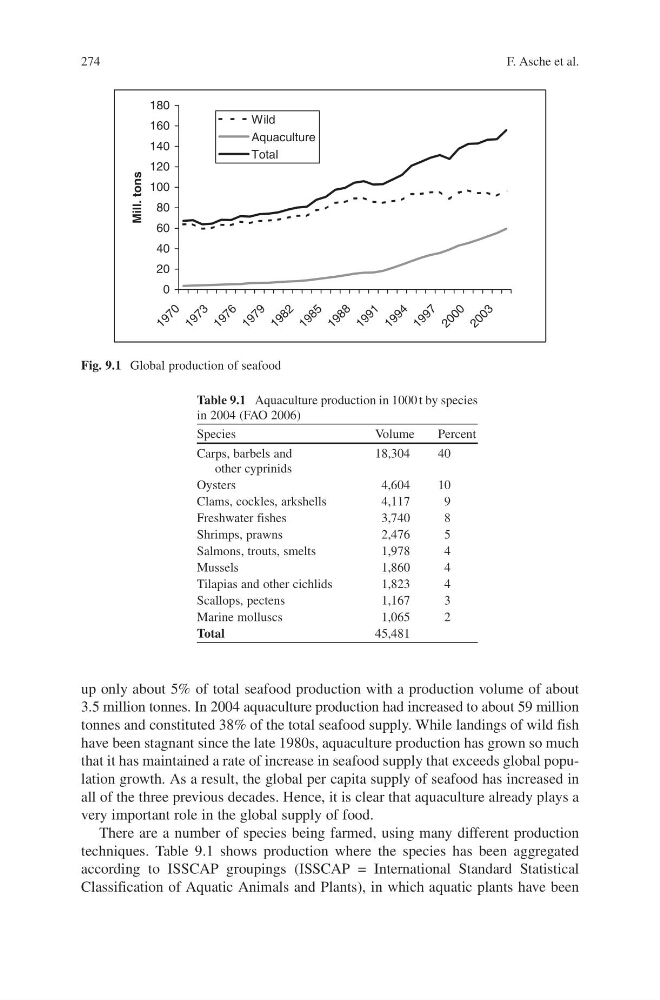
up only about 5% of total seafood production with a production volume of about
3.5 million tonnes. In 2004 aquaculture production had increased to about 59 million
tonnes and constituted 38% of the total seafood supply. While landings of wild fish
have been stagnant since the late 1980s, aquaculture production has grown so much
that it has maintained a rate of increase in seafood supply that exceeds global population growth. As a result, the global per capita supply of seafood has increased in
all of the three previous decades. Hence, it is clear that aquaculture already plays a
very important role in the global supply of food.
There are a number of species being farmed, using many different production
techniques. Table 9.1 shows production where the species has been aggregated
according to ISSCAP groupings (ISSCAP = International Standard Statistical
Classification of Aquatic Animals and Plants), in which aquatic plants have been
0
20
40
60
80
100
120
140
160
180
1 9 7 0
1 9 7 3
1 9 7 6
1 9 7 9
1 9 8 2
1 9 8 5
1 9 8 8 1 9 9 1 1 9 9 4 1 9 9 7 2 0 0 0 2 0 0 3
Mill. tons
Wild
Aquaculture
Total
Fig. 9.1 Global production of seafood
Table 9.1 Aquaculture production in 1000 t by species
in 2004 (FAO 2006)
Species
Volume
Percent
Carps, barbels and
18,304
40
other cyprinids
Oysters
4,604
10
Clams, cockles, arkshells
4,117
9
Freshwater fishes
3,740
8
Shrimps, prawns
2,476
5
Salmons, trouts, smelts
1,978
4
Mussels
1,860
4
Tilapias and other cichlids
1,823
4
Scallops, pectens
1,167
3
Marine molluscs
1,065
2
Total
45,481
F. Asche et al.
up only about 5% of total seafood production with a production volume of about
3.5 million tonnes. In 2004 aquaculture production had increased to about 59 million
tonnes and constituted 38% of the total seafood supply. While landings of wild fish
have been stagnant since the late 1980s, aquaculture production has grown so much
that it has maintained a rate of increase in seafood supply that exceeds global population growth. As a result, the global per capita supply of seafood has increased in
all of the three previous decades. Hence, it is clear that aquaculture already plays a
very important role in the global supply of food.
There are a number of species being farmed, using many different production
techniques. Table 9.1 shows production where the species has been aggregated
according to ISSCAP groupings (ISSCAP = International Standard Statistical
Classification of Aquatic Animals and Plants), in which aquatic plants have been
0
20
40
60
80
100
120
140
160
180
1 9 7 0
1 9 7 3
1 9 7 6
1 9 7 9
1 9 8 2
1 9 8 5
1 9 8 8 1 9 9 1 1 9 9 4 1 9 9 7 2 0 0 0 2 0 0 3
Mill. tons
Wild
Aquaculture
Total
Fig. 9.1 Global production of seafood
Table 9.1 Aquaculture production in 1000 t by species
in 2004 (FAO 2006)
Species
Volume
Percent
Carps, barbels and
18,304
40
other cyprinids
Oysters
4,604
10
Clams, cockles, arkshells
4,117
9
Freshwater fishes
3,740
8
Shrimps, prawns
2,476
5
Salmons, trouts, smelts
1,978
4
Mussels
1,860
4
Tilapias and other cichlids
1,823
4
Scallops, pectens
1,167
3
Marine molluscs
1,065
2
Total
45,481