

35
2 Ecosystem Aspects of Species That Aggregate to Spawn
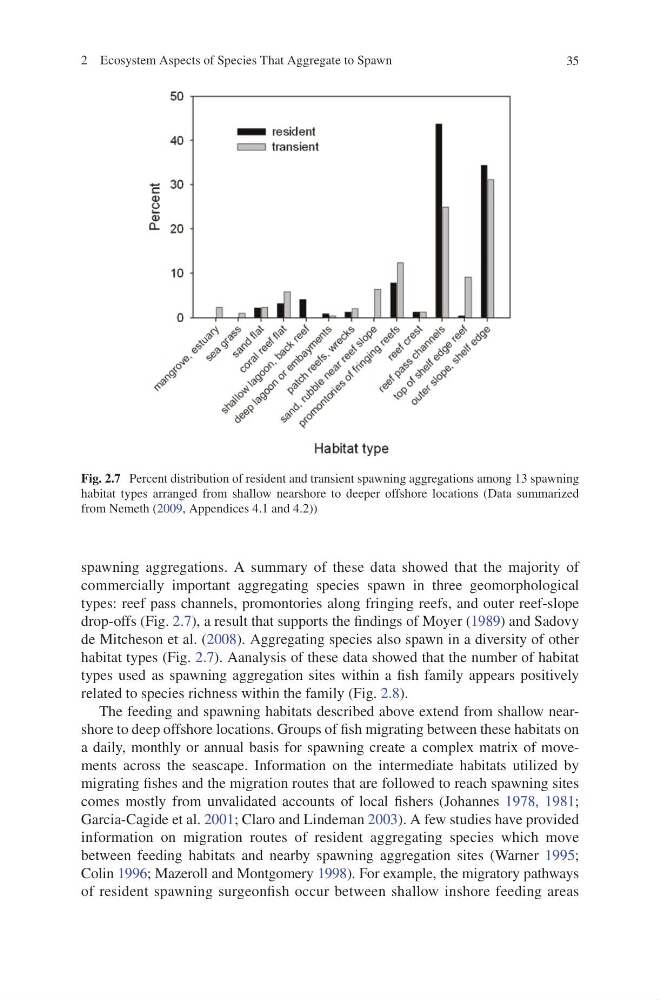
spawning aggregations. A summary of these data showed that the majority of
commercially important aggregating species spawn in three geomorphological
types: reef pass channels, promontories along fringing reefs, and outer reef-slope
drop-offs (Fig. 2.7 ), a result that supports the fi ndings of Moyer ( 1989 ) and Sadovy
de Mitcheson et al. ( 2008 ) . Aggregating species also spawn in a diversity of other
habitat types (Fig. 2.7 ). Aanalysis of these data showed that the number of habitat
types used as spawning aggregation sites within a fi sh family appears positively
related to species richness within the family (Fig. 2.8 ).
The feeding and spawning habitats described above extend from shallow nearshore to deep offshore locations. Groups of fi sh migrating between these habitats on
a daily, monthly or annual basis for spawning create a complex matrix of movements across the seascape. Information on the intermediate habitats utilized by
migrating fi shes and the migration routes that are followed to reach spawning sites
comes mostly from unvalidated accounts of local fi shers (Johannes 1978, 1981 ;
Garcia-Cagide et al. 2001 ; Claro and Lindeman 2003 ) . A few studies have provided
information on migration routes of resident aggregating species which move
between feeding habitats and nearby spawning aggregation sites (Warner 1995 ;
Colin 1996 ; Mazeroll and Montgomery 1998 ) . For example, the migratory pathways
of resident spawning surgeonfi sh occur between shallow inshore feeding areas
Fig. 2.7 Percent distribution of resident and transient spawning aggregations among 13 spawning
habitat types arranged from shallow nearshore to deeper offshore locations (Data summarized
from Nemeth ( 2009 , Appendices 4.1 and 4.2))
2 Ecosystem Aspects of Species That Aggregate to Spawn
spawning aggregations. A summary of these data showed that the majority of
commercially important aggregating species spawn in three geomorphological
types: reef pass channels, promontories along fringing reefs, and outer reef-slope
drop-offs (Fig. 2.7 ), a result that supports the fi ndings of Moyer ( 1989 ) and Sadovy
de Mitcheson et al. ( 2008 ) . Aggregating species also spawn in a diversity of other
habitat types (Fig. 2.7 ). Aanalysis of these data showed that the number of habitat
types used as spawning aggregation sites within a fi sh family appears positively
related to species richness within the family (Fig. 2.8 ).
The feeding and spawning habitats described above extend from shallow nearshore to deep offshore locations. Groups of fi sh migrating between these habitats on
a daily, monthly or annual basis for spawning create a complex matrix of movements across the seascape. Information on the intermediate habitats utilized by
migrating fi shes and the migration routes that are followed to reach spawning sites
comes mostly from unvalidated accounts of local fi shers (Johannes 1978, 1981 ;
Garcia-Cagide et al. 2001 ; Claro and Lindeman 2003 ) . A few studies have provided
information on migration routes of resident aggregating species which move
between feeding habitats and nearby spawning aggregation sites (Warner 1995 ;
Colin 1996 ; Mazeroll and Montgomery 1998 ) . For example, the migratory pathways
of resident spawning surgeonfi sh occur between shallow inshore feeding areas
Fig. 2.7 Percent distribution of resident and transient spawning aggregations among 13 spawning
habitat types arranged from shallow nearshore to deeper offshore locations (Data summarized
from Nemeth ( 2009 , Appendices 4.1 and 4.2))