

36
R.S. Nemeth
and the nearest part of the reef edge, or fi sh travel along the reef edge to specifi c
spawning sites (Robertson 1983 ; Colin 1996 ; Mazeroll and Montgomery 1998 ) .
In a detailed study of brown tang, Acanthurus nigrofuscus , Mazeroll and
Montgomery ( 1998 ) found that migrating fi sh used at least 15 different routes at the
beginning of the spawning season but only 3 routes by the end, suggesting that some
socially mediated behaviours may be operating to consolidate pathways. Direct
observations of spawning migrations of transient aggregating species are limited to
Nassau grouper which was seen migrating in various sized groups along the edges
of drop offs to spawning sites in the Bahamas, Belize and Cayman Islands (Colin
1992 ; Carter et al. 1994 ; Whaylen et al. 2004 ) .
More recent studies have used acoustic telemetry to document generalized movement patterns of squaretail coralgrouper and red hind which are believed to migrate
along similar pathways each year to spawning aggregation sites (Zeller 1998 ;
Nemeth 2005 ; Rhodes and Tupper 2008 ) . Data on habitat use during migration are
more diffi cult to acquire but can be determined if movement patterns are coupled
with detailed benthic habitat maps over the entire catchment area. For example, a
recent acoustic tagging study in the USVI found that fi ve of eight tagged yellowfi n
grouper (63%) and fi ve of nine Nassau grouper (56%) consistently used two deep
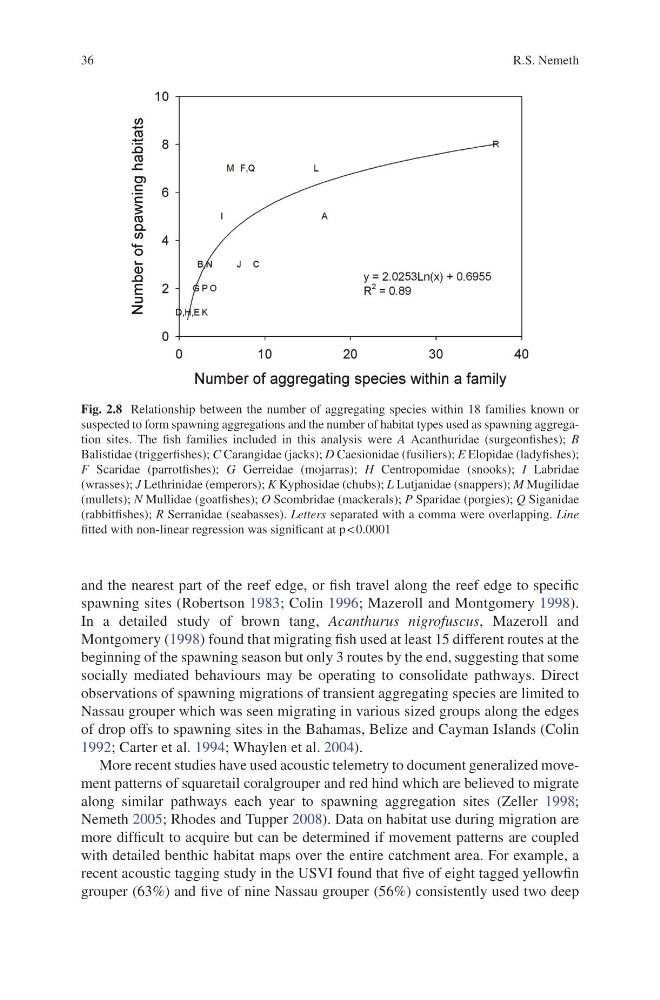
Fig. 2.8 Relationship between the number of aggregating species within 18 families known or
suspected to form spawning aggregations and the number of habitat types used as spawning aggregation sites. The fi sh families included in this analysis were A Acanthuridae (surgeonfi shes); B
Balistidae (triggerfi shes); C Carangidae (jacks); D Caesionidae (fusiliers); E Elopidae (ladyfi shes);
F Scaridae (parrotfi shes); G Gerreidae (mojarras); H Centropomidae (snooks); I Labridae
(wrasses); J Lethrinidae (emperors); K Kyphosidae (chubs); L Lutjanidae (snappers); M Mugilidae
(mullets); N Mullidae (goatfi shes); O Scombridae (mackerals); P Sparidae (porgies); Q Siganidae
(rabbitfi shes); R Serranidae (seabasses). Letters separated with a comma were overlapping. Line
fi tted with non-linear regression was signifi cant at p < 0.0001
R.S. Nemeth
and the nearest part of the reef edge, or fi sh travel along the reef edge to specifi c
spawning sites (Robertson 1983 ; Colin 1996 ; Mazeroll and Montgomery 1998 ) .
In a detailed study of brown tang, Acanthurus nigrofuscus , Mazeroll and
Montgomery ( 1998 ) found that migrating fi sh used at least 15 different routes at the
beginning of the spawning season but only 3 routes by the end, suggesting that some
socially mediated behaviours may be operating to consolidate pathways. Direct
observations of spawning migrations of transient aggregating species are limited to
Nassau grouper which was seen migrating in various sized groups along the edges
of drop offs to spawning sites in the Bahamas, Belize and Cayman Islands (Colin
1992 ; Carter et al. 1994 ; Whaylen et al. 2004 ) .
More recent studies have used acoustic telemetry to document generalized movement patterns of squaretail coralgrouper and red hind which are believed to migrate
along similar pathways each year to spawning aggregation sites (Zeller 1998 ;
Nemeth 2005 ; Rhodes and Tupper 2008 ) . Data on habitat use during migration are
more diffi cult to acquire but can be determined if movement patterns are coupled
with detailed benthic habitat maps over the entire catchment area. For example, a
recent acoustic tagging study in the USVI found that fi ve of eight tagged yellowfi n
grouper (63%) and fi ve of nine Nassau grouper (56%) consistently used two deep
Fig. 2.8 Relationship between the number of aggregating species within 18 families known or
suspected to form spawning aggregations and the number of habitat types used as spawning aggregation sites. The fi sh families included in this analysis were A Acanthuridae (surgeonfi shes); B
Balistidae (triggerfi shes); C Carangidae (jacks); D Caesionidae (fusiliers); E Elopidae (ladyfi shes);
F Scaridae (parrotfi shes); G Gerreidae (mojarras); H Centropomidae (snooks); I Labridae
(wrasses); J Lethrinidae (emperors); K Kyphosidae (chubs); L Lutjanidae (snappers); M Mugilidae
(mullets); N Mullidae (goatfi shes); O Scombridae (mackerals); P Sparidae (porgies); Q Siganidae
(rabbitfi shes); R Serranidae (seabasses). Letters separated with a comma were overlapping. Line
fi tted with non-linear regression was signifi cant at p < 0.0001