

533
12 Species Case Studies
Unicornfi sh ( Naso spp.) – Whether members of the unicornfi shes, genus Naso , which
school above coral reefs, have true spawning aggregations is uncertain. The genus
includes zooplankton feeders as well as species that feed on drifting algae and benthic
materials. Pair spawning has been reported in several instances, but not confi rmed
group-spawning. They typically swim high in the water column, are often diffi cult to
approach and, being favourites of spearfi shermen in some areas, often wary.
Large schools of orangespine unicornfi sh, Naso literatus , are potentially spawning aggregations and are a well-known phenomenon on many outer reef slopes of
Palau during spring (Etpison 2004 ) . Schools of many hundreds to thousands appear
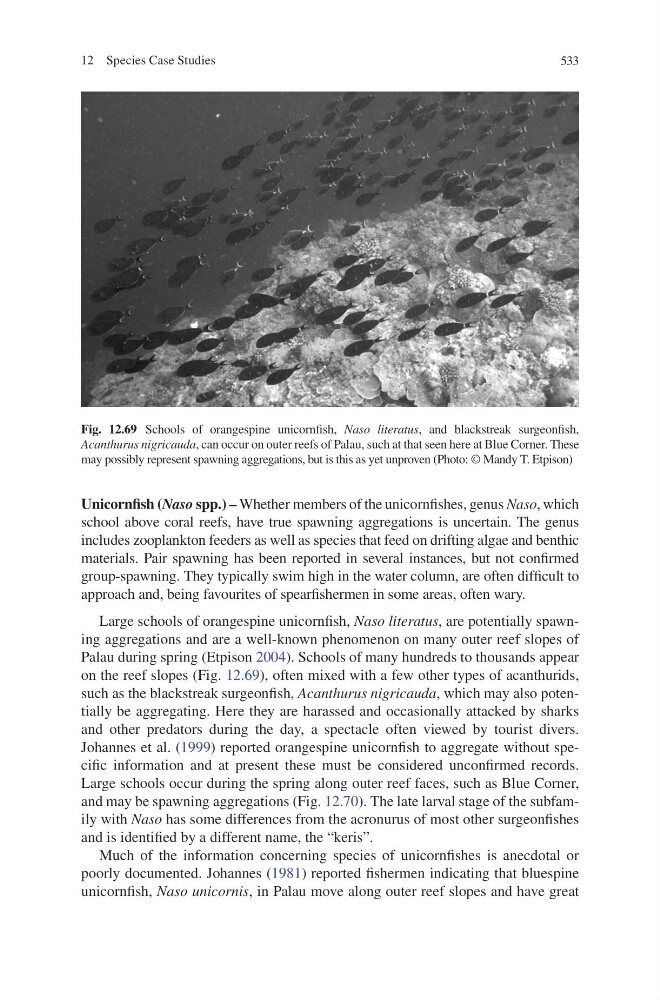
on the reef slopes (Fig. 12.69 ), often mixed with a few other types of acanthurids,
such as the blackstreak surgeonfi sh, Acanthurus nigricauda , which may also potentially be aggregating. Here they are harassed and occasionally attacked by sharks
and other predators during the day, a spectacle often viewed by tourist divers.
Johannes et al. ( 1999 ) reported orangespine unicornfi sh to aggregate without specifi c information and at present these must be considered unconfi rmed records.
Large schools occur during the spring along outer reef faces, such as Blue Corner,
and may be spawning aggregations (Fig. 12.70 ). The late larval stage of the subfamily with Naso has some differences from the acronurus of most other surgeonfi shes
and is identifi ed by a different name, the “keris”.
Much of the information concerning species of unicornfi shes is anecdotal or
poorly documented. Johannes ( 1981 ) reported fi shermen indicating that bluespine
unicornfi sh, Naso unicornis , in Palau move along outer reef slopes and have great
Fig. 12.69 Schools of orangespine unicornfi sh, Naso literatus , and blackstreak surgeonfi sh,
Acanthurus nigricauda , can occur on outer reefs of Palau, such at that seen here at Blue Corner. These
may possibly represent spawning aggregations, but is this as yet unproven (Photo: © Mandy T. Etpison)
12 Species Case Studies
Unicornfi sh ( Naso spp.) – Whether members of the unicornfi shes, genus Naso , which
school above coral reefs, have true spawning aggregations is uncertain. The genus
includes zooplankton feeders as well as species that feed on drifting algae and benthic
materials. Pair spawning has been reported in several instances, but not confi rmed
group-spawning. They typically swim high in the water column, are often diffi cult to
approach and, being favourites of spearfi shermen in some areas, often wary.
Large schools of orangespine unicornfi sh, Naso literatus , are potentially spawning aggregations and are a well-known phenomenon on many outer reef slopes of
Palau during spring (Etpison 2004 ) . Schools of many hundreds to thousands appear
on the reef slopes (Fig. 12.69 ), often mixed with a few other types of acanthurids,
such as the blackstreak surgeonfi sh, Acanthurus nigricauda , which may also potentially be aggregating. Here they are harassed and occasionally attacked by sharks
and other predators during the day, a spectacle often viewed by tourist divers.
Johannes et al. ( 1999 ) reported orangespine unicornfi sh to aggregate without specifi c information and at present these must be considered unconfi rmed records.
Large schools occur during the spring along outer reef faces, such as Blue Corner,
and may be spawning aggregations (Fig. 12.70 ). The late larval stage of the subfamily with Naso has some differences from the acronurus of most other surgeonfi shes
and is identifi ed by a different name, the “keris”.
Much of the information concerning species of unicornfi shes is anecdotal or
poorly documented. Johannes ( 1981 ) reported fi shermen indicating that bluespine
unicornfi sh, Naso unicornis , in Palau move along outer reef slopes and have great
Fig. 12.69 Schools of orangespine unicornfi sh, Naso literatus , and blackstreak surgeonfi sh,
Acanthurus nigricauda , can occur on outer reefs of Palau, such at that seen here at Blue Corner. These
may possibly represent spawning aggregations, but is this as yet unproven (Photo: © Mandy T. Etpison)