

532
12 Species Case Studies
outfl owing currents during the period of observations. Based on more limited observations, Lobel ( 1978 ) earlier had reported group spawning in Hawaii.
Acanthurus guttatus – white-spotted surgeonfi sh . Another very common
Acanthurus that has received little attention is the white-spotted surgeonfi sh. Craig
( 1998 ) documented early morning spawning by A. guttatus in reef channels in
American Samoa, where it co-occurs with aggregations of convict surgeonfi sh
(Fig. 12.68 ), but no other records of spawning were found.
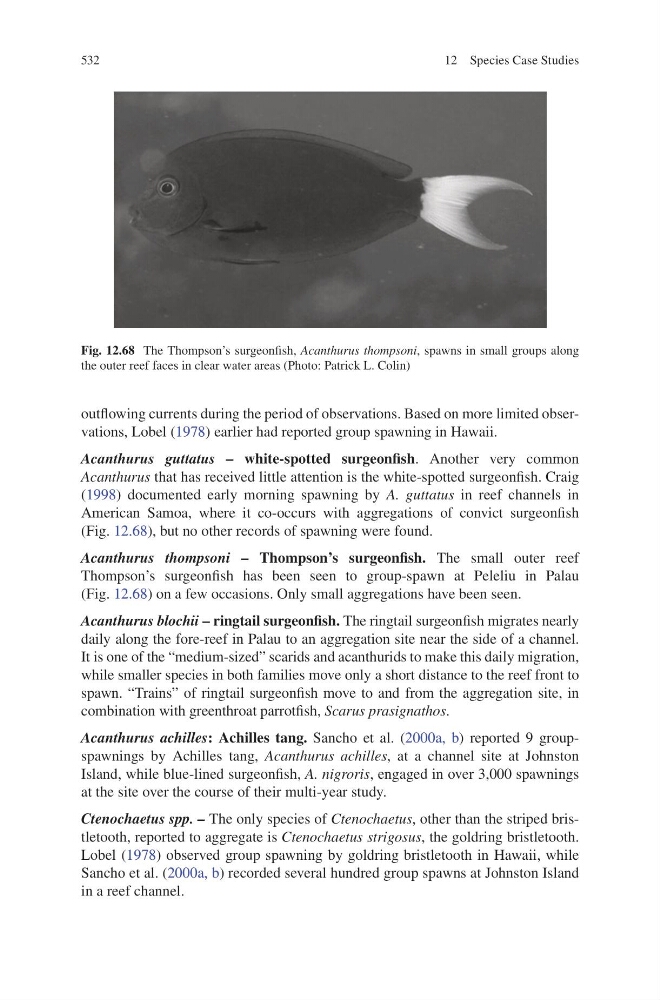
Acanthurus thompsoni – Thompson’s surgeonfi sh. The small outer reef
Thompson’s surgeonfi sh has been seen to group-spawn at Peleliu in Palau
(Fig. 12.68 ) on a few occasions. Only small aggregations have been seen.
Acanthurus blochii – ringtail surgeonfi sh. The ringtail surgeonfi sh migrates nearly
daily along the fore-reef in Palau to an aggregation site near the side of a channel.
It is one of the “medium-sized” scarids and acanthurids to make this daily migration,
while smaller species in both families move only a short distance to the reef front to
spawn. “Trains” of ringtail surgeonfi sh move to and from the aggregation site, in
combination with greenthroat parrotfi sh, Scarus prasignathos .
Acanthurus achilles : Achilles tang. Sancho et al. ( 2000a, b ) reported 9 groupspawnings by Achilles tang, Acanthurus achilles , at a channel site at Johnston
Island, while blue-lined surgeonfi sh, A. nigroris , engaged in over 3,000 spawnings
at the site over the course of their multi-year study.
Ctenochaetus spp. – The only species of Ctenochaetus , other than the striped bristletooth, reported to aggregate is Ctenochaetus strigosus , the goldring bristletooth.
Lobel ( 1978 ) observed group spawning by goldring bristletooth in Hawaii, while
Sancho et al. ( 2000a, b ) recorded several hundred group spawns at Johnston Island
in a reef channel.
Fig. 12.68 The Thompson’s surgeonfi sh, Acanthurus thompsoni , spawns in small groups along
the outer reef faces in clear water areas (Photo: Patrick L. Colin)
12 Species Case Studies
outfl owing currents during the period of observations. Based on more limited observations, Lobel ( 1978 ) earlier had reported group spawning in Hawaii.
Acanthurus guttatus – white-spotted surgeonfi sh . Another very common
Acanthurus that has received little attention is the white-spotted surgeonfi sh. Craig
( 1998 ) documented early morning spawning by A. guttatus in reef channels in
American Samoa, where it co-occurs with aggregations of convict surgeonfi sh
(Fig. 12.68 ), but no other records of spawning were found.
Acanthurus thompsoni – Thompson’s surgeonfi sh. The small outer reef
Thompson’s surgeonfi sh has been seen to group-spawn at Peleliu in Palau
(Fig. 12.68 ) on a few occasions. Only small aggregations have been seen.
Acanthurus blochii – ringtail surgeonfi sh. The ringtail surgeonfi sh migrates nearly
daily along the fore-reef in Palau to an aggregation site near the side of a channel.
It is one of the “medium-sized” scarids and acanthurids to make this daily migration,
while smaller species in both families move only a short distance to the reef front to
spawn. “Trains” of ringtail surgeonfi sh move to and from the aggregation site, in
combination with greenthroat parrotfi sh, Scarus prasignathos .
Acanthurus achilles : Achilles tang. Sancho et al. ( 2000a, b ) reported 9 groupspawnings by Achilles tang, Acanthurus achilles , at a channel site at Johnston
Island, while blue-lined surgeonfi sh, A. nigroris , engaged in over 3,000 spawnings
at the site over the course of their multi-year study.
Ctenochaetus spp. – The only species of Ctenochaetus , other than the striped bristletooth, reported to aggregate is Ctenochaetus strigosus , the goldring bristletooth.
Lobel ( 1978 ) observed group spawning by goldring bristletooth in Hawaii, while
Sancho et al. ( 2000a, b ) recorded several hundred group spawns at Johnston Island
in a reef channel.
Fig. 12.68 The Thompson’s surgeonfi sh, Acanthurus thompsoni , spawns in small groups along
the outer reef faces in clear water areas (Photo: Patrick L. Colin)