

534
12 Species Case Studies
seasonal variation in numbers with different timing in different areas. Locally called
“chum”, the bluespine unicornfi sh is one of the most prized fi shes in Palau and fi shers have paid considerable attention to its habits. Based on gonads fi shermen
believed fi sh to spawn around both new and full moons. In more recent interviews
in Palau, fi shers noted the species to be found in large groupings when it has eggs
and when it can be caught in large numbers, 250 kg or more in a single fi shing trip.
Many were once taken using the leaf sweep, a method little used today having been
replaced with gillnets. Fish are found with eggs in many months and, although
accounts between fi shers varied, months often identifi ed were February and August,
at both full and new moon times (Sadovy 2007 ) . Rhodes ( 2003 ) similarly reported
the slender unicornfi sh, Naso lopezi , to group-spawn and again this needs confi rmation. Finally, based on information from fi shers Johannes ( 1981 ) reported whitemargin unicornfi sh, N. annulatus , to live and spawn along the inner barrier reef edge
and slope near Ngeremlengui, Palau and to spawn on new and full moons in May.
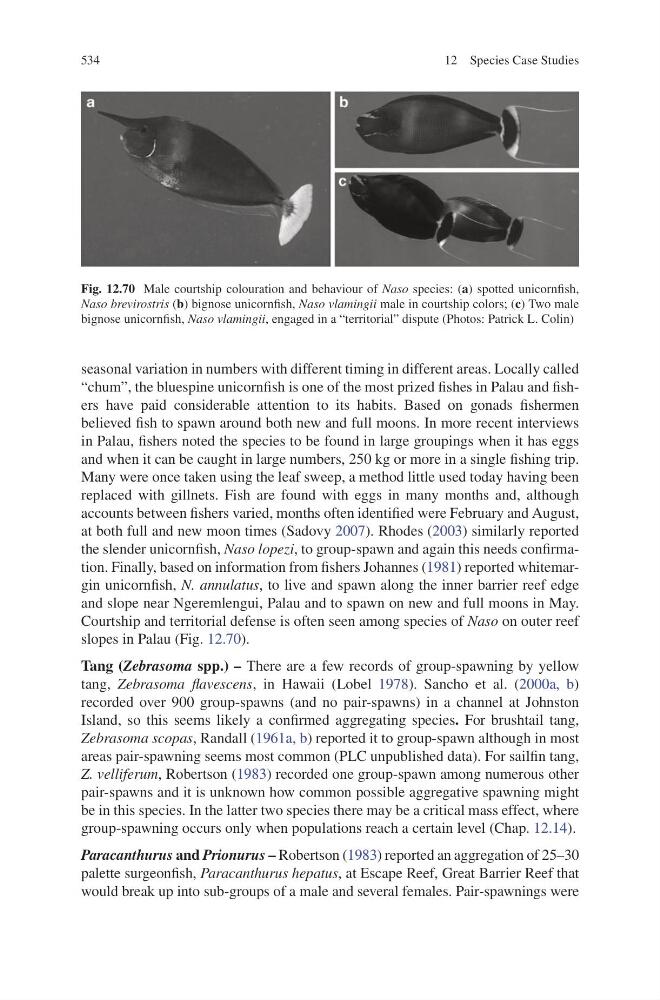
Courtship and territorial defense is often seen among species of Naso on outer reef
slopes in Palau (Fig. 12.70 ).
Tang ( Zebrasoma spp.) – There are a few records of group-spawning by yellow
tang, Zebrasoma fl avescens , in Hawaii (Lobel 1978 ) . Sancho et al. ( 2000a, b )
recorded over 900 group-spawns (and no pair-spawns) in a channel at Johnston
Island, so this seems likely a confi rmed aggregating species . For brushtail tang,
Zebrasoma scopas , Randall ( 1961a, b ) reported it to group-spawn although in most
areas pair-spawning seems most common (PLC unpublished data). For sailfi n tang,
Z. velliferum , Robertson ( 1983 ) recorded one group-spawn among numerous other
pair-spawns and it is unknown how common possible aggregative spawning might
be in this species. In the latter two species there may be a critical mass effect, where
group-spawning occurs only when populations reach a certain level (Chap. 12.14 ).
Paracanthurus and Prionurus – Robertson ( 1983 ) reported an aggregation of 25–30
palette surgeonfi sh, Paracanthurus hepatus , at Escape Reef, Great Barrier Reef that
would break up into sub-groups of a male and several females. Pair-spawnings were
Fig. 12.70 Male courtship colouration and behaviour of Naso species: ( a ) spotted unicornfi sh,
Naso brevirostris ( b ) bignose unicornfi sh, Naso vlamingii male in courtship colors; ( c ) Two male
bignose unicornfi sh, Naso vlamingii , engaged in a “territorial” dispute (Photos: Patrick L. Colin)
12 Species Case Studies
seasonal variation in numbers with different timing in different areas. Locally called
“chum”, the bluespine unicornfi sh is one of the most prized fi shes in Palau and fi shers have paid considerable attention to its habits. Based on gonads fi shermen
believed fi sh to spawn around both new and full moons. In more recent interviews
in Palau, fi shers noted the species to be found in large groupings when it has eggs
and when it can be caught in large numbers, 250 kg or more in a single fi shing trip.
Many were once taken using the leaf sweep, a method little used today having been
replaced with gillnets. Fish are found with eggs in many months and, although
accounts between fi shers varied, months often identifi ed were February and August,
at both full and new moon times (Sadovy 2007 ) . Rhodes ( 2003 ) similarly reported
the slender unicornfi sh, Naso lopezi , to group-spawn and again this needs confi rmation. Finally, based on information from fi shers Johannes ( 1981 ) reported whitemargin unicornfi sh, N. annulatus , to live and spawn along the inner barrier reef edge
and slope near Ngeremlengui, Palau and to spawn on new and full moons in May.
Courtship and territorial defense is often seen among species of Naso on outer reef
slopes in Palau (Fig. 12.70 ).
Tang ( Zebrasoma spp.) – There are a few records of group-spawning by yellow
tang, Zebrasoma fl avescens , in Hawaii (Lobel 1978 ) . Sancho et al. ( 2000a, b )
recorded over 900 group-spawns (and no pair-spawns) in a channel at Johnston
Island, so this seems likely a confi rmed aggregating species . For brushtail tang,
Zebrasoma scopas , Randall ( 1961a, b ) reported it to group-spawn although in most
areas pair-spawning seems most common (PLC unpublished data). For sailfi n tang,
Z. velliferum , Robertson ( 1983 ) recorded one group-spawn among numerous other
pair-spawns and it is unknown how common possible aggregative spawning might
be in this species. In the latter two species there may be a critical mass effect, where
group-spawning occurs only when populations reach a certain level (Chap. 12.14 ).
Paracanthurus and Prionurus – Robertson ( 1983 ) reported an aggregation of 25–30
palette surgeonfi sh, Paracanthurus hepatus , at Escape Reef, Great Barrier Reef that
would break up into sub-groups of a male and several females. Pair-spawnings were
Fig. 12.70 Male courtship colouration and behaviour of Naso species: ( a ) spotted unicornfi sh,
Naso brevirostris ( b ) bignose unicornfi sh, Naso vlamingii male in courtship colors; ( c ) Two male
bignose unicornfi sh, Naso vlamingii , engaged in a “territorial” dispute (Photos: Patrick L. Colin)