

485
12 Species Case Studies
a special place in the Live Reef Fish Trade, being highly sought after and commanding
an extravagant price (sometimes more than US$120 per kg) at the restaurant table in
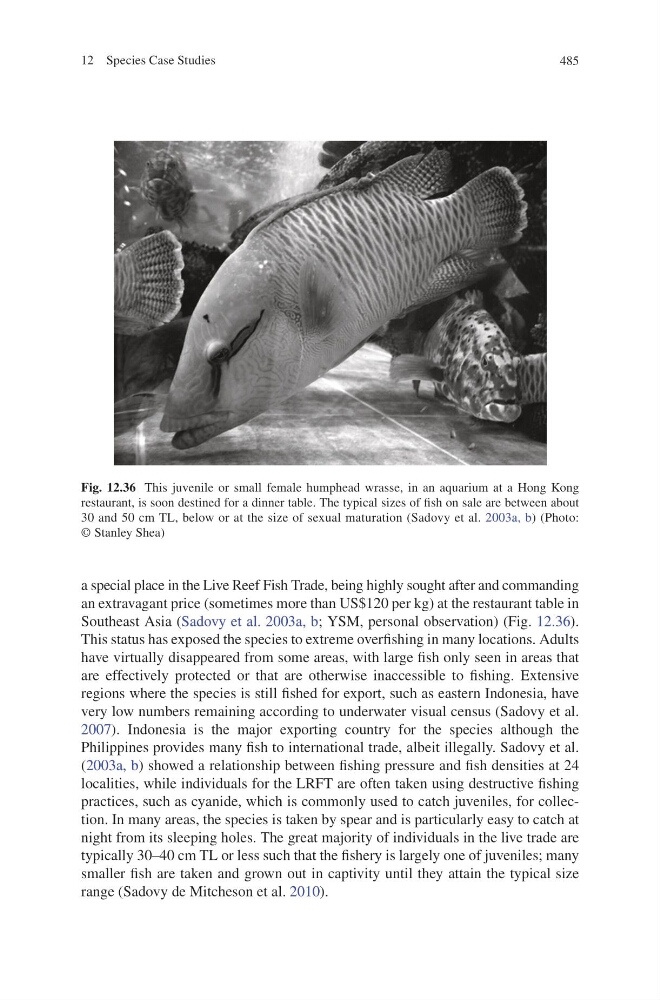
Southeast Asia ( Sadovy et al. 2003a, b ; YSM, personal observation) (Fig. 12.36 ).
This status has exposed the species to extreme overfi shing in many locations. Adults
have virtually disappeared from some areas, with large fi sh only seen in areas that
are effectively protected or that are otherwise inaccessible to fi shing. Extensive
regions where the species is still fi shed for export, such as eastern Indonesia, have
very low numbers remaining according to underwater visual census (Sadovy et al.
2007 ) . Indonesia is the major exporting country for the species although the
Philippines provides many fi sh to international trade, albeit illegally. Sadovy et al.
( 2003a, b ) showed a relationship between fi shing pressure and fi sh densities at 24
localities, while individuals for the LRFT are often taken using destructive fi shing
practices, such as cyanide, which is commonly used to catch juveniles, for collection. In many areas, the species is taken by spear and is particularly easy to catch at
night from its sleeping holes. The great majority of individuals in the live trade are
typically 30–40 cm TL or less such that the fi shery is largely one of juveniles; many
smaller fi sh are taken and grown out in captivity until they attain the typical size
range (Sadovy de Mitcheson et al. 2010 ) .
Fig. 12.36 This juvenile or small female humphead wrasse, in an aquarium at a Hong Kong
restaurant, is soon destined for a dinner table. The typical sizes of fi sh on sale are between about
30 and 50 cm TL, below or at the size of sexual maturation (Sadovy et al. 2003a, b ) (Photo:
© Stanley Shea)
12 Species Case Studies
a special place in the Live Reef Fish Trade, being highly sought after and commanding
an extravagant price (sometimes more than US$120 per kg) at the restaurant table in
Southeast Asia ( Sadovy et al. 2003a, b ; YSM, personal observation) (Fig. 12.36 ).
This status has exposed the species to extreme overfi shing in many locations. Adults
have virtually disappeared from some areas, with large fi sh only seen in areas that
are effectively protected or that are otherwise inaccessible to fi shing. Extensive
regions where the species is still fi shed for export, such as eastern Indonesia, have
very low numbers remaining according to underwater visual census (Sadovy et al.
2007 ) . Indonesia is the major exporting country for the species although the
Philippines provides many fi sh to international trade, albeit illegally. Sadovy et al.
( 2003a, b ) showed a relationship between fi shing pressure and fi sh densities at 24
localities, while individuals for the LRFT are often taken using destructive fi shing
practices, such as cyanide, which is commonly used to catch juveniles, for collection. In many areas, the species is taken by spear and is particularly easy to catch at
night from its sleeping holes. The great majority of individuals in the live trade are
typically 30–40 cm TL or less such that the fi shery is largely one of juveniles; many
smaller fi sh are taken and grown out in captivity until they attain the typical size
range (Sadovy de Mitcheson et al. 2010 ) .
Fig. 12.36 This juvenile or small female humphead wrasse, in an aquarium at a Hong Kong
restaurant, is soon destined for a dinner table. The typical sizes of fi sh on sale are between about
30 and 50 cm TL, below or at the size of sexual maturation (Sadovy et al. 2003a, b ) (Photo:
© Stanley Shea)