

486
12 Species Case Studies
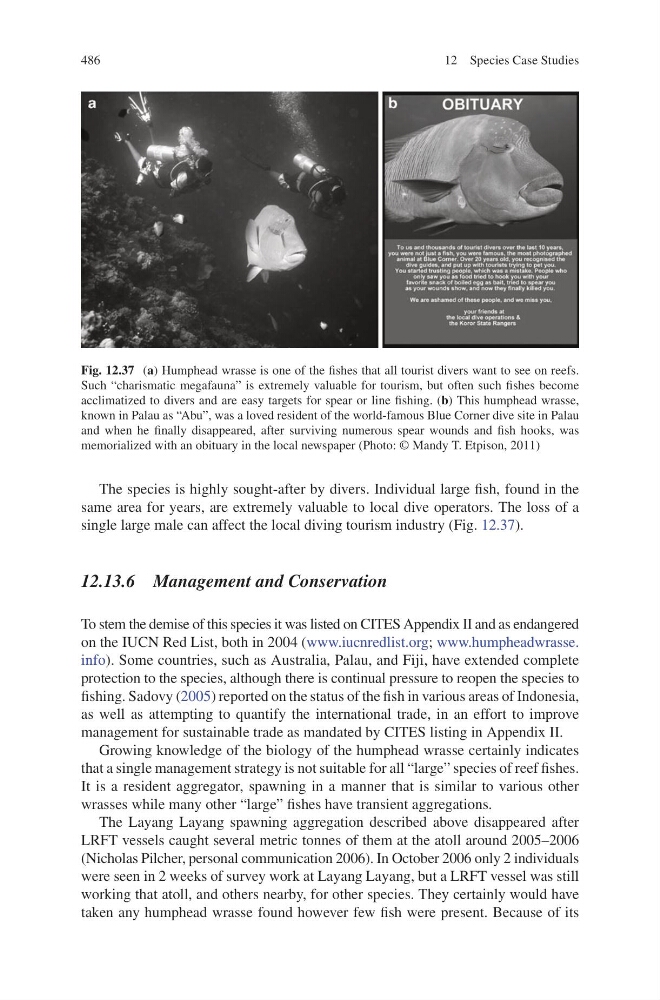
The species is highly sought-after by divers. Individual large fi sh, found in the
same area for years, are extremely valuable to local dive operators. The loss of a
single large male can affect the local diving tourism industry (Fig. 12.37 ).
12.13.6 Management and Conservation
To stem the demise of this species it was listed on CITES Appendix II and as endangered
on the IUCN Red List, both in 2004 ( www.iucnredlist.org ; www.humpheadwrasse.
info ). Some countries, such as Australia, Palau, and Fiji, have extended complete
protection to the species, although there is continual pressure to reopen the species to
fi shing. Sadovy ( 2005 ) reported on the status of the fi sh in various areas of Indonesia,
as well as attempting to quantify the international trade, in an effort to improve
management for sustainable trade as mandated by CITES listing in Appendix II.
Growing knowledge of the biology of the humphead wrasse certainly indicates
that a single management strategy is not suitable for all “large” species of reef fi shes.
It is a resident aggregator, spawning in a manner that is similar to various other
wrasses while many other “large” fi shes have transient aggregations.
The Layang Layang spawning aggregation described above disappeared after
LRFT vessels caught several metric tonnes of them at the atoll around 2005–2006
(Nicholas Pilcher, personal communication 2006). In October 2006 only 2 individuals
were seen in 2 weeks of survey work at Layang Layang, but a LRFT vessel was still
working that atoll, and others nearby, for other species. They certainly would have
taken any humphead wrasse found however few fi sh were present. Because of its
Fig. 12.37 ( a ) Humphead wrasse is one of the fi shes that all tourist divers want to see on reefs.
Such “charismatic megafauna” is extremely valuable for tourism, but often such fi shes become
acclimatized to divers and are easy targets for spear or line fi shing. ( b ) This humphead wrasse,
known in Palau as “Abu”, was a loved resident of the world-famous Blue Corner dive site in Palau
and when he fi nally disappeared, after surviving numerous spear wounds and fi sh hooks, was
memorialized with an obituary in the local newspaper (Photo: © Mandy T. Etpison, 2011)
12 Species Case Studies
The species is highly sought-after by divers. Individual large fi sh, found in the
same area for years, are extremely valuable to local dive operators. The loss of a
single large male can affect the local diving tourism industry (Fig. 12.37 ).
12.13.6 Management and Conservation
To stem the demise of this species it was listed on CITES Appendix II and as endangered
on the IUCN Red List, both in 2004 ( www.iucnredlist.org ; www.humpheadwrasse.
info ). Some countries, such as Australia, Palau, and Fiji, have extended complete
protection to the species, although there is continual pressure to reopen the species to
fi shing. Sadovy ( 2005 ) reported on the status of the fi sh in various areas of Indonesia,
as well as attempting to quantify the international trade, in an effort to improve
management for sustainable trade as mandated by CITES listing in Appendix II.
Growing knowledge of the biology of the humphead wrasse certainly indicates
that a single management strategy is not suitable for all “large” species of reef fi shes.
It is a resident aggregator, spawning in a manner that is similar to various other
wrasses while many other “large” fi shes have transient aggregations.
The Layang Layang spawning aggregation described above disappeared after
LRFT vessels caught several metric tonnes of them at the atoll around 2005–2006
(Nicholas Pilcher, personal communication 2006). In October 2006 only 2 individuals
were seen in 2 weeks of survey work at Layang Layang, but a LRFT vessel was still
working that atoll, and others nearby, for other species. They certainly would have
taken any humphead wrasse found however few fi sh were present. Because of its
Fig. 12.37 ( a ) Humphead wrasse is one of the fi shes that all tourist divers want to see on reefs.
Such “charismatic megafauna” is extremely valuable for tourism, but often such fi shes become
acclimatized to divers and are easy targets for spear or line fi shing. ( b ) This humphead wrasse,
known in Palau as “Abu”, was a loved resident of the world-famous Blue Corner dive site in Palau
and when he fi nally disappeared, after surviving numerous spear wounds and fi sh hooks, was
memorialized with an obituary in the local newspaper (Photo: © Mandy T. Etpison, 2011)