

484
12 Species Case Studies
faint. In Palau Colin ( 2010 ) found up to 15 males and an estimated 100–150 females
in a single aggregation (the exact number of females present was impossible to
determine).
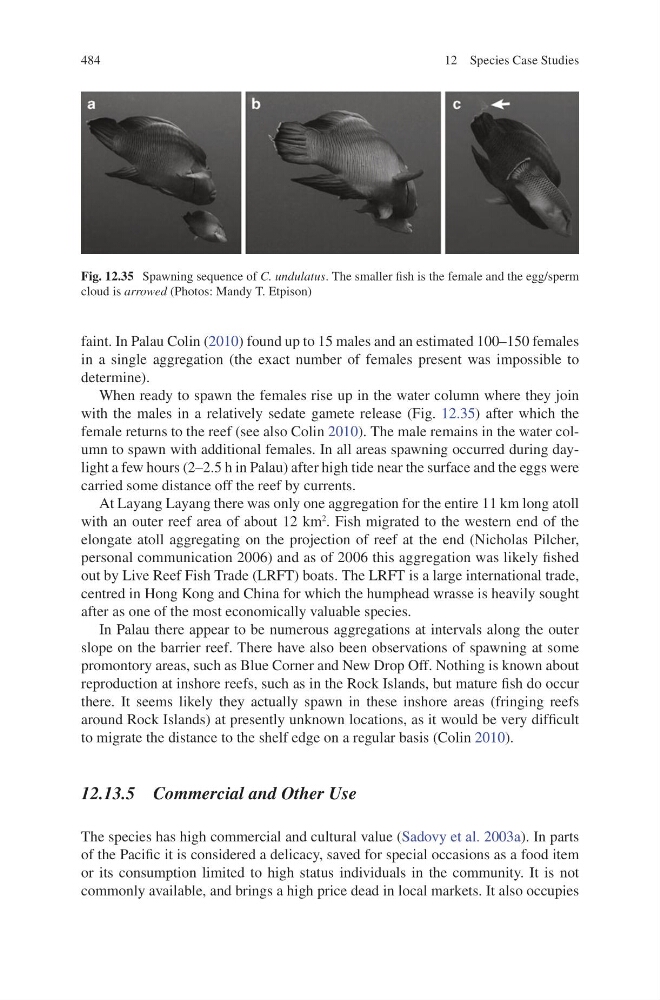
When ready to spawn the females rise up in the water column where they join
with the males in a relatively sedate gamete release (Fig. 12.35 ) after which the
female returns to the reef (see also Colin 2010 ) . The male remains in the water column to spawn with additional females. In all areas spawning occurred during daylight a few hours (2–2.5 h in Palau) after high tide near the surface and the eggs were
carried some distance off the reef by currents.
At Layang Layang there was only one aggregation for the entire 11 km long atoll
with an outer reef area of about 12 km
2 . Fish migrated to the western end of the
elongate atoll aggregating on the projection of reef at the end (Nicholas Pilcher,
personal communication 2006) and as of 2006 this aggregation was likely fi shed
out by Live Reef Fish Trade (LRFT) boats. The LRFT is a large international trade,
centred in Hong Kong and China for which the humphead wrasse is heavily sought
after as one of the most economically valuable species.
In Palau there appear to be numerous aggregations at intervals along the outer
slope on the barrier reef. There have also been observations of spawning at some
promontory areas, such as Blue Corner and New Drop Off. Nothing is known about
reproduction at inshore reefs, such as in the Rock Islands, but mature fi sh do occur
there. It seems likely they actually spawn in these inshore areas (fringing reefs
around Rock Islands) at presently unknown locations, as it would be very diffi cult
to migrate the distance to the shelf edge on a regular basis (Colin 2010 ) .
12.13.5 Commercial and Other Use
The species has high commercial and cultural value ( Sadovy et al. 2003a ) . In parts
of the Pacifi c it is considered a delicacy, saved for special occasions as a food item
or its consumption limited to high status individuals in the community. It is not
commonly available, and brings a high price dead in local markets. It also occupies
Fig. 12.35 Spawning sequence of C. undulatus . The smaller fi sh is the female and the egg/sperm
cloud is arrowed (Photos: Mandy T. Etpison)
12 Species Case Studies
faint. In Palau Colin ( 2010 ) found up to 15 males and an estimated 100–150 females
in a single aggregation (the exact number of females present was impossible to
determine).
When ready to spawn the females rise up in the water column where they join
with the males in a relatively sedate gamete release (Fig. 12.35 ) after which the
female returns to the reef (see also Colin 2010 ) . The male remains in the water column to spawn with additional females. In all areas spawning occurred during daylight a few hours (2–2.5 h in Palau) after high tide near the surface and the eggs were
carried some distance off the reef by currents.
At Layang Layang there was only one aggregation for the entire 11 km long atoll
with an outer reef area of about 12 km
2 . Fish migrated to the western end of the
elongate atoll aggregating on the projection of reef at the end (Nicholas Pilcher,
personal communication 2006) and as of 2006 this aggregation was likely fi shed
out by Live Reef Fish Trade (LRFT) boats. The LRFT is a large international trade,
centred in Hong Kong and China for which the humphead wrasse is heavily sought
after as one of the most economically valuable species.
In Palau there appear to be numerous aggregations at intervals along the outer
slope on the barrier reef. There have also been observations of spawning at some
promontory areas, such as Blue Corner and New Drop Off. Nothing is known about
reproduction at inshore reefs, such as in the Rock Islands, but mature fi sh do occur
there. It seems likely they actually spawn in these inshore areas (fringing reefs
around Rock Islands) at presently unknown locations, as it would be very diffi cult
to migrate the distance to the shelf edge on a regular basis (Colin 2010 ) .
12.13.5 Commercial and Other Use
The species has high commercial and cultural value ( Sadovy et al. 2003a ) . In parts
of the Pacifi c it is considered a delicacy, saved for special occasions as a food item
or its consumption limited to high status individuals in the community. It is not
commonly available, and brings a high price dead in local markets. It also occupies
Fig. 12.35 Spawning sequence of C. undulatus . The smaller fi sh is the female and the egg/sperm
cloud is arrowed (Photos: Mandy T. Etpison)