

453
12 Species Case Studies
response to a total allowable catch (TAC) introduced in 2004 (see below). In 2000
the commercial harvest had a wholesale value of US$ 16.3 million. The leopard
coralgrouper is also taken on the GBR by private recreational fi shers and by commercial recreational fi shing charters. The leopard coralgrouper is also caught commercially and recreationally from the Houtman Albrolhos islands in Western
Australia (WA). The WA fi shery is managed through minimum size limits, recreational bag limits and area closures and is not considered overexploited (Nardi
et al. 2004 ) .
In the mid 1990s the trade in live leopard coralgrouper, primarily to Hong Kong,
grew in Australia. The portion of live fi sh in the commercial catch increased to around
25% initially and by 2007 to 80%. By 1998 live coral trout fetched up to eight times
the price of whole or fi lleted coral trout (Samoilys et al. 2002a ; DPI&F 2009 ) .
The export of live leopard coralgrouper is a signifi cant commercial fi shery in the
Asia-Pacifi c region, with fi sh taken primarily from Indonesia and the Philippines,
0
10000
20000
30000
40000
50000
60000
70000
80000
90000
0
500
1000
1500
2000
2500
Days Fished
Tonnes
Financial Year
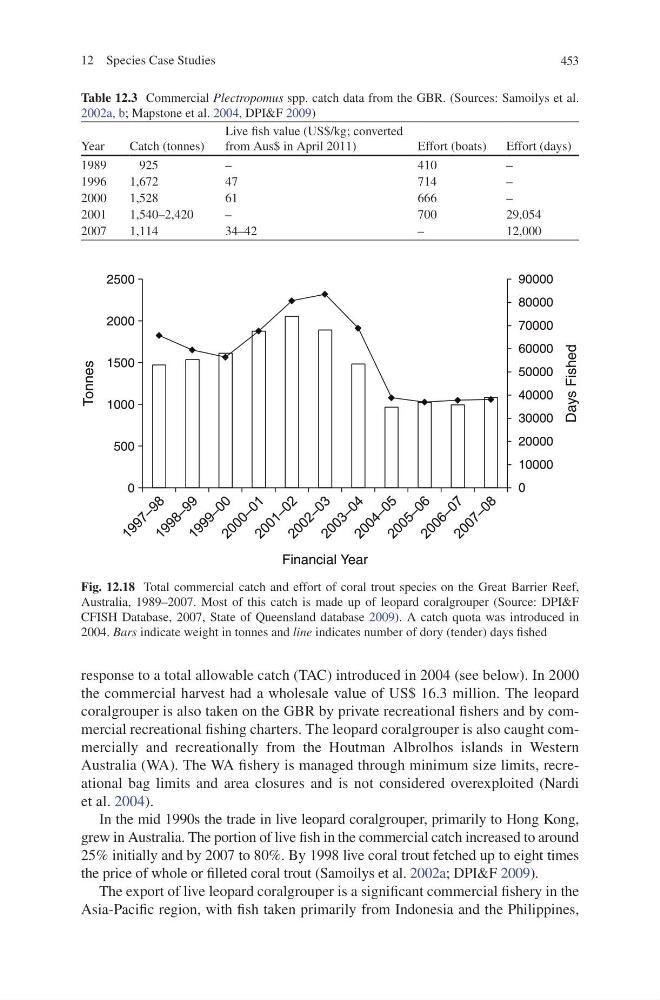
Fig. 12.18 Total commercial catch and effort of coral trout species on the Great Barrier Reef,
Australia, 1989–2007. Most of this catch is made up of leopard coralgrouper (Source: DPI&F
CFISH Database, 2007, State of Queensland database 2009 ) . A catch quota was introduced in
2004. Bars indicate weight in tonnes and line indicates number of dory (tender) days fi shed
Table 12.3 Commercial Plectropomus spp. catch data from the GBR. (Sources: Samoilys et al.
2002a, b ; Mapstone et al. 2004 , DPI&F 2009 )
Year
Catch (tonnes)
Live fi sh value (US$/kg; converted
from Aus$ in April 2011)
Effort (boats)
Effort (days)
1989
925
–
410
–
1996
1,672
47
714
–
2000
1,528
61
666
–
2001
1,540–2,420
–
700
29,054
2007
1,114
34–42
–
12,000
12 Species Case Studies
response to a total allowable catch (TAC) introduced in 2004 (see below). In 2000
the commercial harvest had a wholesale value of US$ 16.3 million. The leopard
coralgrouper is also taken on the GBR by private recreational fi shers and by commercial recreational fi shing charters. The leopard coralgrouper is also caught commercially and recreationally from the Houtman Albrolhos islands in Western
Australia (WA). The WA fi shery is managed through minimum size limits, recreational bag limits and area closures and is not considered overexploited (Nardi
et al. 2004 ) .
In the mid 1990s the trade in live leopard coralgrouper, primarily to Hong Kong,
grew in Australia. The portion of live fi sh in the commercial catch increased to around
25% initially and by 2007 to 80%. By 1998 live coral trout fetched up to eight times
the price of whole or fi lleted coral trout (Samoilys et al. 2002a ; DPI&F 2009 ) .
The export of live leopard coralgrouper is a signifi cant commercial fi shery in the
Asia-Pacifi c region, with fi sh taken primarily from Indonesia and the Philippines,
0
10000
20000
30000
40000
50000
60000
70000
80000
90000
0
500
1000
1500
2000
2500
Days Fished
Tonnes
Financial Year
Fig. 12.18 Total commercial catch and effort of coral trout species on the Great Barrier Reef,
Australia, 1989–2007. Most of this catch is made up of leopard coralgrouper (Source: DPI&F
CFISH Database, 2007, State of Queensland database 2009 ) . A catch quota was introduced in
2004. Bars indicate weight in tonnes and line indicates number of dory (tender) days fi shed
Table 12.3 Commercial Plectropomus spp. catch data from the GBR. (Sources: Samoilys et al.
2002a, b ; Mapstone et al. 2004 , DPI&F 2009 )
Year
Catch (tonnes)
Live fi sh value (US$/kg; converted
from Aus$ in April 2011)
Effort (boats)
Effort (days)
1989
925
–
410
–
1996
1,672
47
714
–
2000
1,528
61
666
–
2001
1,540–2,420
–
700
29,054
2007
1,114
34–42
–
12,000