

454
12 Species Case Studies
with limited amounts from the Pacifi c Ocean (Sadovy and Vincent 2002 ; Sadovy
et al. 2003 ; SCRFA 2004 ) , and fresh (dead) fi sh are also traded in many countries.
Imports into Hong Kong increased by 58% from 1999 to 2002, coming largely from
Australia and the Philippines as other countries’ exports declined. Although the
majority of leopard coralgrouper in Hong Kong’s live fi sh markets are above the
size at fi rst reproduction, this is misleading regarding size of capture because many
were wild-caught as juveniles and grown out in captivity to attain market-preferred
sizes, then exported, particularly from the Philippines (Sadovy et al. 2003a ) .
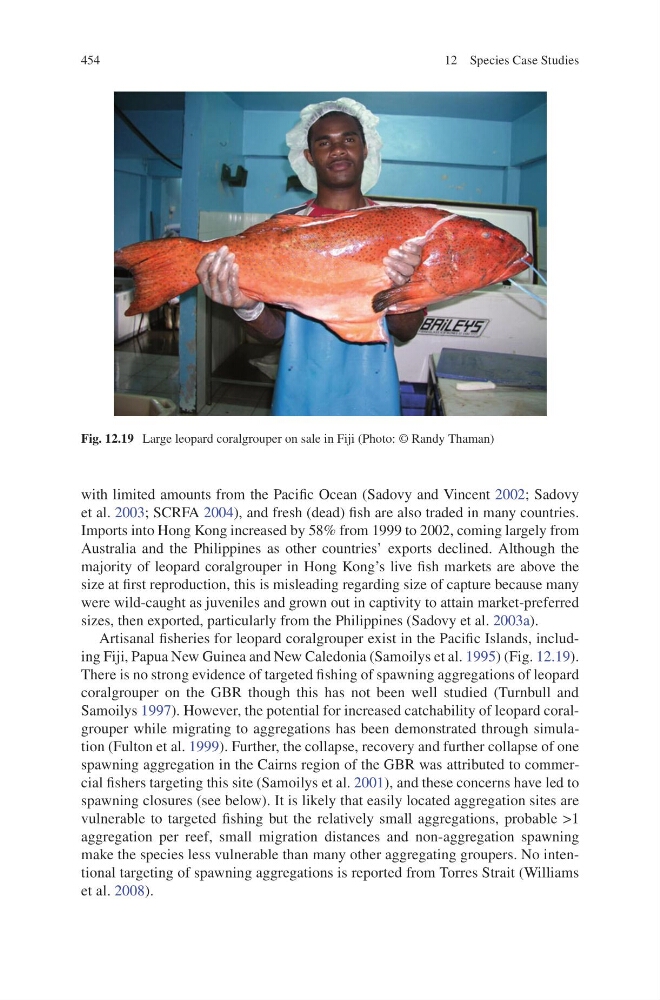
Artisanal fi sheries for leopard coralgrouper exist in the Pacifi c Islands, including Fiji, Papua New Guinea and New Caledonia (Samoilys et al. 1995 ) (Fig. 12.19 ).
There is no strong evidence of targeted fi shing of spawning aggregations of leopard
coralgrouper on the GBR though this has not been well studied (Turnbull and
Samoilys 1997 ) . However, the potential for increased catchability of leopard coralgrouper while migrating to aggregations has been demonstrated through simulation (Fulton et al. 1999 ) . Further, the collapse, recovery and further collapse of one
spawning aggregation in the Cairns region of the GBR was attributed to commercial fi shers targeting this site (Samoilys et al. 2001 ) , and these concerns have led to
spawning closures (see below). It is likely that easily located aggregation sites are
vulnerable to targeted fi shing but the relatively small aggregations, probable >1
aggregation per reef, small migration distances and non-aggregation spawning
make the species less vulnerable than many other aggregating groupers. No intentional targeting of spawning aggregations is reported from Torres Strait (Williams
et al. 2008 ) .
Fig. 12.19 Large leopard coralgrouper on sale in Fiji (Photo: © Randy Thaman)
12 Species Case Studies
with limited amounts from the Pacifi c Ocean (Sadovy and Vincent 2002 ; Sadovy
et al. 2003 ; SCRFA 2004 ) , and fresh (dead) fi sh are also traded in many countries.
Imports into Hong Kong increased by 58% from 1999 to 2002, coming largely from
Australia and the Philippines as other countries’ exports declined. Although the
majority of leopard coralgrouper in Hong Kong’s live fi sh markets are above the
size at fi rst reproduction, this is misleading regarding size of capture because many
were wild-caught as juveniles and grown out in captivity to attain market-preferred
sizes, then exported, particularly from the Philippines (Sadovy et al. 2003a ) .
Artisanal fi sheries for leopard coralgrouper exist in the Pacifi c Islands, including Fiji, Papua New Guinea and New Caledonia (Samoilys et al. 1995 ) (Fig. 12.19 ).
There is no strong evidence of targeted fi shing of spawning aggregations of leopard
coralgrouper on the GBR though this has not been well studied (Turnbull and
Samoilys 1997 ) . However, the potential for increased catchability of leopard coralgrouper while migrating to aggregations has been demonstrated through simulation (Fulton et al. 1999 ) . Further, the collapse, recovery and further collapse of one
spawning aggregation in the Cairns region of the GBR was attributed to commercial fi shers targeting this site (Samoilys et al. 2001 ) , and these concerns have led to
spawning closures (see below). It is likely that easily located aggregation sites are
vulnerable to targeted fi shing but the relatively small aggregations, probable >1
aggregation per reef, small migration distances and non-aggregation spawning
make the species less vulnerable than many other aggregating groupers. No intentional targeting of spawning aggregations is reported from Torres Strait (Williams
et al. 2008 ) .
Fig. 12.19 Large leopard coralgrouper on sale in Fiji (Photo: © Randy Thaman)