

452
12 Species Case Studies
other groupers which may be the reason that P. leopardus is a relatively abundant
serranid on the GBR and perhaps more resistant to fi shing pressure.
12.9.3 Commercial Fisheries
The members of the genus Plectropomus (‘coral trout’ or coralgrouper) are major
commercial fi nfi shes taken in Australia, predominantly on the GBR. In commercial
catches they comprise three dominant species (leopard coralgrouper – P. leopardus ,
blacksaddle coral grouper – P. laevis and spotted coralgrouper – P. maculatus) , and
four lesser species. Commercial log books do not distinguish among the Plectropomus
species, but independent research shows that the leopard coralgrouper comprises at
least 80% of the Plectropomus commercial catch (Samoilys et al. 2002a ; Mapstone
et al. 2004 ) . It is also the most abundant Plectropomus species on the GBR (Ayling
and Ayling 1992 ) .
Commercial fi shers in Australia use simple hook and line, generally with one
hook, and frozen pilchard as bait, fi shing from small tender boats to a mother vessel.
Recreational fi shers use handlines, rods and spearguns. Mother vessels have large
freezer and live holding tank capacity and may stay at sea for 3–4 weeks. Artisanal
fi sheries in Fiji and New Caledonia take leopard coralgrouper by hook and line and
spear gun, and incidentally by trap and net. Leopard coralgrouper is sometimes
taken using cyanide in the Philippines and Indonesia.
Commercial log book data since 1989 show increases in catch and effort of
Plectropomus spp. on the GBR, followed by declines (Table 12.3 , Fig. 12.18 ) in
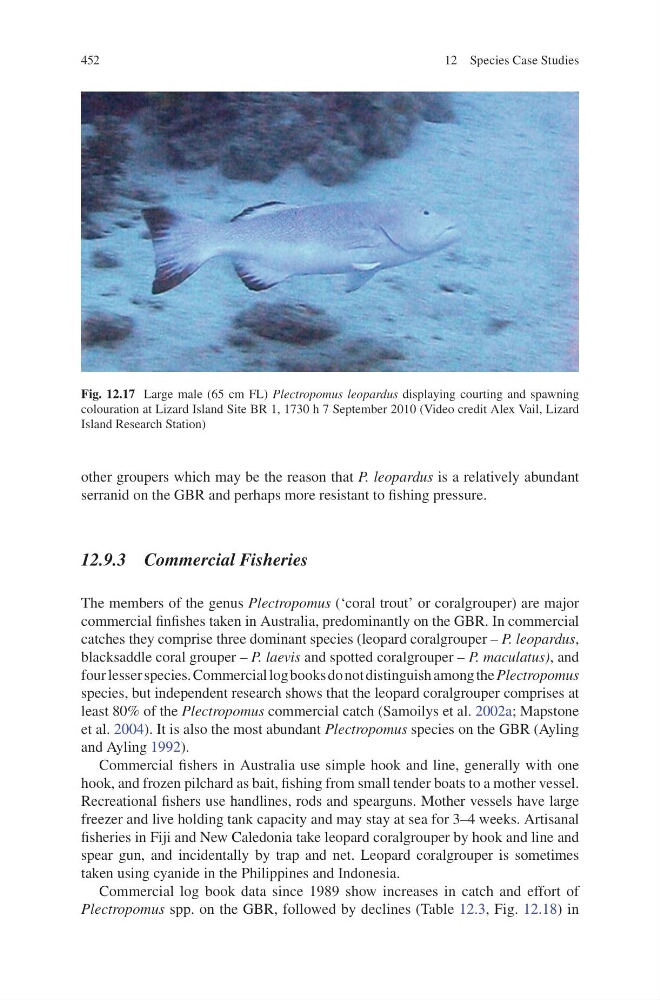
Fig. 12.17 Large male (65 cm FL) Plectropomus leopardus displaying courting and spawning
colouration at Lizard Island Site BR 1, 1730 h 7 September 2010 (Video credit Alex Vail, Lizard
Island Research Station)
12 Species Case Studies
other groupers which may be the reason that P. leopardus is a relatively abundant
serranid on the GBR and perhaps more resistant to fi shing pressure.
12.9.3 Commercial Fisheries
The members of the genus Plectropomus (‘coral trout’ or coralgrouper) are major
commercial fi nfi shes taken in Australia, predominantly on the GBR. In commercial
catches they comprise three dominant species (leopard coralgrouper – P. leopardus ,
blacksaddle coral grouper – P. laevis and spotted coralgrouper – P. maculatus) , and
four lesser species. Commercial log books do not distinguish among the Plectropomus
species, but independent research shows that the leopard coralgrouper comprises at
least 80% of the Plectropomus commercial catch (Samoilys et al. 2002a ; Mapstone
et al. 2004 ) . It is also the most abundant Plectropomus species on the GBR (Ayling
and Ayling 1992 ) .
Commercial fi shers in Australia use simple hook and line, generally with one
hook, and frozen pilchard as bait, fi shing from small tender boats to a mother vessel.
Recreational fi shers use handlines, rods and spearguns. Mother vessels have large
freezer and live holding tank capacity and may stay at sea for 3–4 weeks. Artisanal
fi sheries in Fiji and New Caledonia take leopard coralgrouper by hook and line and
spear gun, and incidentally by trap and net. Leopard coralgrouper is sometimes
taken using cyanide in the Philippines and Indonesia.
Commercial log book data since 1989 show increases in catch and effort of
Plectropomus spp. on the GBR, followed by declines (Table 12.3 , Fig. 12.18 ) in
Fig. 12.17 Large male (65 cm FL) Plectropomus leopardus displaying courting and spawning
colouration at Lizard Island Site BR 1, 1730 h 7 September 2010 (Video credit Alex Vail, Lizard
Island Research Station)