

384
M.W. Russell et al.
Below are examples illustrating approaches and challenges of addressing short-term
problems following management.
A history of cooperation, collaboration and careful planning in Belize led to the
introduction of alternative livelihoods following the closure of aggregations. Local
fi shers who once targeted aggregations have been trained as fl y-fi shing or SCUBA
diving guides. Belize is now a major fl y-fi shing tourist destination, principally for
permit ( Trachinotus falcatus ) (Graham and Castellanos 2005 ) . Also, a complete
transition from fi shing to tourism occurred at Gladden Spit on the Belize barrier
reef; where once large numbers of cubera snapper ( Lutjanus cyanopterus ) were
caught during spawning, fi shers now take tourist divers to witness the spawning
event and the appearance of whale sharks ( Rhincodon typus ) feeding on the eggs
released during spawning (Heyman et al. 2001 ) . To reduce the possible negative
impact of divers on the aggregations, there are limits on the numbers of divers, boats
and on dive times.
An example of a fi sher-to-tourism conversion exists in south-central Cuba, the
Cayo Doce Leguas area of the Gardens of the Queen Archipelago. A small, fl oating
hotel in a marine reserve caters to diving and catch-and-release fl y-fi shing. Many
hotel employees were fi shers displaced by the creation of the reserve over 10 years
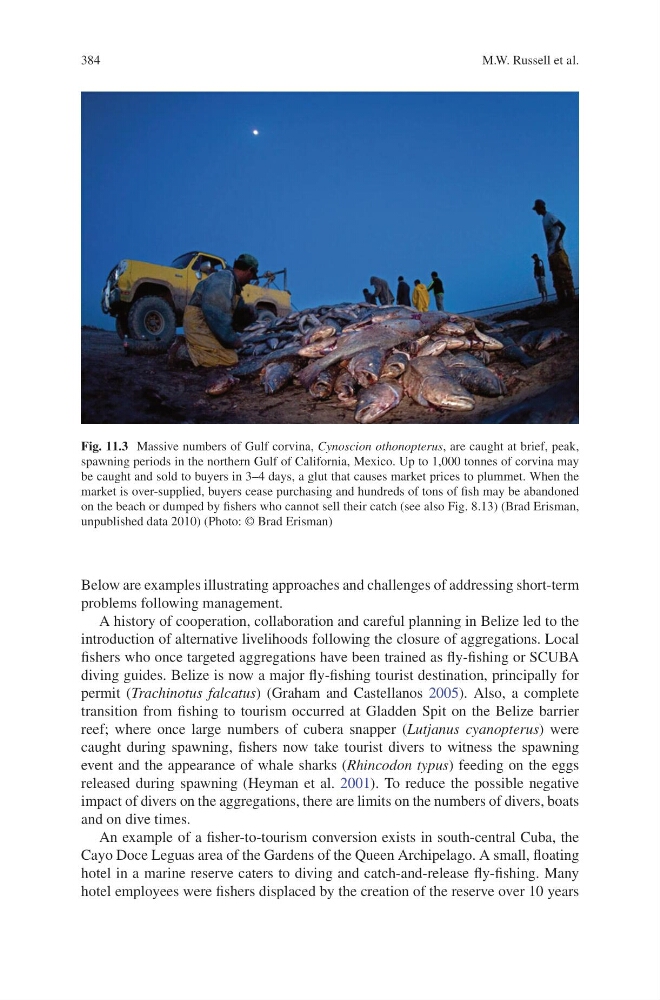
Fig. 11.3 Massive numbers of Gulf corvina, Cynoscion othonopterus , are caught at brief, peak,
spawning periods in the northern Gulf of California, Mexico. Up to 1,000 tonnes of corvina may
be caught and sold to buyers in 3–4 days, a glut that causes market prices to plummet. When the
market is over-supplied, buyers cease purchasing and hundreds of tons of fi sh may be abandoned
on the beach or dumped by fi shers who cannot sell their catch (see also Fig. 8.13) (Brad Erisman,
unpublished data 2010) (Photo: © Brad Erisman)
M.W. Russell et al.
Below are examples illustrating approaches and challenges of addressing short-term
problems following management.
A history of cooperation, collaboration and careful planning in Belize led to the
introduction of alternative livelihoods following the closure of aggregations. Local
fi shers who once targeted aggregations have been trained as fl y-fi shing or SCUBA
diving guides. Belize is now a major fl y-fi shing tourist destination, principally for
permit ( Trachinotus falcatus ) (Graham and Castellanos 2005 ) . Also, a complete
transition from fi shing to tourism occurred at Gladden Spit on the Belize barrier
reef; where once large numbers of cubera snapper ( Lutjanus cyanopterus ) were
caught during spawning, fi shers now take tourist divers to witness the spawning
event and the appearance of whale sharks ( Rhincodon typus ) feeding on the eggs
released during spawning (Heyman et al. 2001 ) . To reduce the possible negative
impact of divers on the aggregations, there are limits on the numbers of divers, boats
and on dive times.
An example of a fi sher-to-tourism conversion exists in south-central Cuba, the
Cayo Doce Leguas area of the Gardens of the Queen Archipelago. A small, fl oating
hotel in a marine reserve caters to diving and catch-and-release fl y-fi shing. Many
hotel employees were fi shers displaced by the creation of the reserve over 10 years
Fig. 11.3 Massive numbers of Gulf corvina, Cynoscion othonopterus , are caught at brief, peak,
spawning periods in the northern Gulf of California, Mexico. Up to 1,000 tonnes of corvina may
be caught and sold to buyers in 3–4 days, a glut that causes market prices to plummet. When the
market is over-supplied, buyers cease purchasing and hundreds of tons of fi sh may be abandoned
on the beach or dumped by fi shers who cannot sell their catch (see also Fig. 8.13) (Brad Erisman,
unpublished data 2010) (Photo: © Brad Erisman)