

385
11 Management of Spawning Aggregations
ago but now work as fi shing guides, divemasters, cooks, and mechanics. There have
been major reductions in fi shing effort overall and on spawning aggregations, and
substantial social and economic benefi ts have accrued to the displaced fi shers
(Giuseppe Omegna personal communication 2008, Pina Amargós 2008 ) .
A few large aggregations have potential for diving tourism, but most are only of
short-term interest each year for sport divers, and many are diffi cult to reach because
they are off-shore and may occur in challenging diving conditions. For example, in
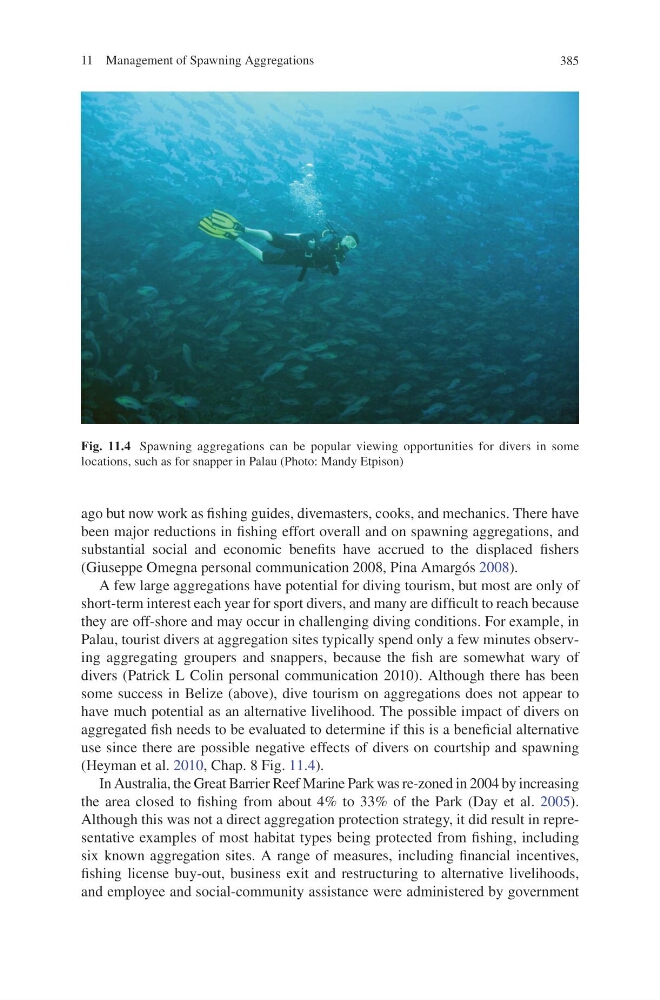
Palau, tourist divers at aggregation sites typically spend only a few minutes observing aggregating groupers and snappers, because the fi sh are somewhat wary of
divers (Patrick L Colin personal communication 2010). Although there has been
some success in Belize (above), dive tourism on aggregations does not appear to
have much potential as an alternative livelihood. The possible impact of divers on
aggregated fi sh needs to be evaluated to determine if this is a benefi cial alternative
use since there are possible negative effects of divers on courtship and spawning
(Heyman et al. 2010 , Chap. 8 Fig. 11.4 ).
In Australia, the Great Barrier Reef Marine Park was re-zoned in 2004 by increasing
the area closed to fi shing from about 4% to 33% of the Park (Day et al. 2005 ) .
Although this was not a direct aggregation protection strategy, it did result in representative examples of most habitat types being protected from fi shing, including
six known aggregation sites. A range of measures, including fi nancial incentives,
fi shing license buy-out, business exit and restructuring to alternative livelihoods,
and employee and social-community assistance were administered by government
Fig. 11.4 Spawning aggregations can be popular viewing opportunities for divers in some
locations, such as for snapper in Palau (Photo: Mandy Etpison)
11 Management of Spawning Aggregations
ago but now work as fi shing guides, divemasters, cooks, and mechanics. There have
been major reductions in fi shing effort overall and on spawning aggregations, and
substantial social and economic benefi ts have accrued to the displaced fi shers
(Giuseppe Omegna personal communication 2008, Pina Amargós 2008 ) .
A few large aggregations have potential for diving tourism, but most are only of
short-term interest each year for sport divers, and many are diffi cult to reach because
they are off-shore and may occur in challenging diving conditions. For example, in
Palau, tourist divers at aggregation sites typically spend only a few minutes observing aggregating groupers and snappers, because the fi sh are somewhat wary of
divers (Patrick L Colin personal communication 2010). Although there has been
some success in Belize (above), dive tourism on aggregations does not appear to
have much potential as an alternative livelihood. The possible impact of divers on
aggregated fi sh needs to be evaluated to determine if this is a benefi cial alternative
use since there are possible negative effects of divers on courtship and spawning
(Heyman et al. 2010 , Chap. 8 Fig. 11.4 ).
In Australia, the Great Barrier Reef Marine Park was re-zoned in 2004 by increasing
the area closed to fi shing from about 4% to 33% of the Park (Day et al. 2005 ) .
Although this was not a direct aggregation protection strategy, it did result in representative examples of most habitat types being protected from fi shing, including
six known aggregation sites. A range of measures, including fi nancial incentives,
fi shing license buy-out, business exit and restructuring to alternative livelihoods,
and employee and social-community assistance were administered by government
Fig. 11.4 Spawning aggregations can be popular viewing opportunities for divers in some
locations, such as for snapper in Palau (Photo: Mandy Etpison)