

Location and species
Method(s) for
collecting LEK
Assumption(s) of LEK
tested using validation
Method(s) for
validating LEK
Outcome
Source
Solomon Islands.
Lethrinus
erythropterus
Semi-structured
interview with
one fi sherman
Large aggregations
(100s–1000s) of
L. erythropterus
form at
a specifi c site in shallow
water around the new
moon for the purpose
of spawning
Dived at the
aggregation site on
the new moon in
1 month (March) to
make observations
and sample fi sh
Results consistent with LEK. 300–500
L. erythropterus
were aggregated in
shallow water; 26 fi sh caught with
ripe ovaries and running ripe testes
Hamilton ( 2005 )
Kadavu Island, Fiji,
E. polyphekadion,
E. fuscoguttatus
and P. areolatus
Semi-structured
interviews in
multiple
communities in
northern
Kadavu
Aggregations of groupers
occur at three reef
passages between July
-September with no
obvious lunar cycle.
Leaves of the local tree
turn red/yellow and start
to fall at time that fi sh
appear at aggregations
Single ‘snapshot’
SCUBA surveys at
two sites July
followed by
intensive diving (i.e.
daily for 10 days
and on both sides of
indicated passage)
at the site reported
to be the most
productive. Visited
fi sh markets to
identify and
squeeze fi sh taken
from Kadavu for
eggs/sperm. Fish
sampled on site
Where intensive diving was undertaken all
three species aggregated in July and
August, gravid females were sighted
and chasing behaviour observed. Fish
sold in markets had running sperm in
early August and Tavola leaves started
to go red and fall. Single dives
conducted on other sites did not
confi rm fi sh aggregating but probably
were conducted a little early according
to men fi shing at sites; this would be
consistent with gonad inspection.
Interestingly the dominance of different
species varied with side of the passage
monitored.
Sadovy de Mitcheson
et al. ( 2008 ) and
YSM and Aisake
Batibasaga,
unpublished data
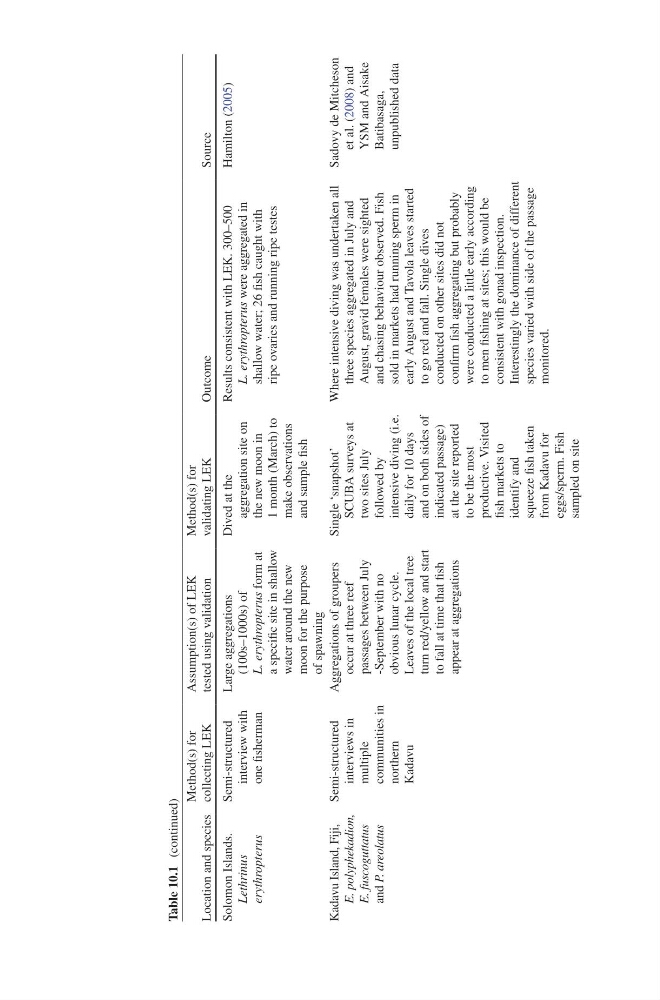
Table 10.1
(continued)
Method(s) for
collecting LEK
Assumption(s) of LEK
tested using validation
Method(s) for
validating LEK
Outcome
Source
Solomon Islands.
Lethrinus
erythropterus
Semi-structured
interview with
one fi sherman
Large aggregations
(100s–1000s) of
L. erythropterus
form at
a specifi c site in shallow
water around the new
moon for the purpose
of spawning
Dived at the
aggregation site on
the new moon in
1 month (March) to
make observations
and sample fi sh
Results consistent with LEK. 300–500
L. erythropterus
were aggregated in
shallow water; 26 fi sh caught with
ripe ovaries and running ripe testes
Hamilton ( 2005 )
Kadavu Island, Fiji,
E. polyphekadion,
E. fuscoguttatus
and P. areolatus
Semi-structured
interviews in
multiple
communities in
northern
Kadavu
Aggregations of groupers
occur at three reef
passages between July
-September with no
obvious lunar cycle.
Leaves of the local tree
turn red/yellow and start
to fall at time that fi sh
appear at aggregations
Single ‘snapshot’
SCUBA surveys at
two sites July
followed by
intensive diving (i.e.
daily for 10 days
and on both sides of
indicated passage)
at the site reported
to be the most
productive. Visited
fi sh markets to
identify and
squeeze fi sh taken
from Kadavu for
eggs/sperm. Fish
sampled on site
Where intensive diving was undertaken all
three species aggregated in July and
August, gravid females were sighted
and chasing behaviour observed. Fish
sold in markets had running sperm in
early August and Tavola leaves started
to go red and fall. Single dives
conducted on other sites did not
confi rm fi sh aggregating but probably
were conducted a little early according
to men fi shing at sites; this would be
consistent with gonad inspection.
Interestingly the dominance of different
species varied with side of the passage
monitored.
Sadovy de Mitcheson
et al. ( 2008 ) and
YSM and Aisake
Batibasaga,
unpublished data
Table 10.1
(continued)