

Location and species
Method(s) for
collecting LEK
Assumption(s) of LEK
tested using validation
Method(s) for
validating LEK
Outcome
Source
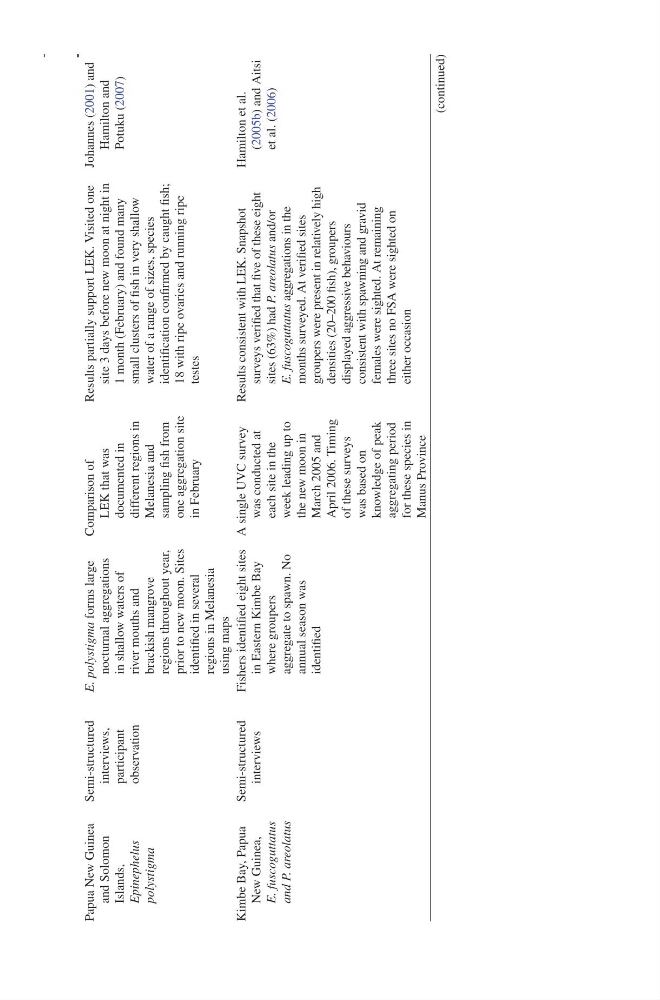
Papua New Guinea
and Solomon
Islands,
Epinephelus
polystigma
Semi-structured
interviews,
participant
observation
E. polystigma
forms large
nocturnal aggregations
in shallow waters of
river mouths and
brackish mangrove
regions throughout year,
prior to new moon. Sites
identifi ed in several
regions in Melanesia
using maps
Comparison of
LEK that was
documented in
different regions in
Melanesia and
sampling fi sh from
one aggregation site
in February
Results partially support LEK. Visited one
site 3 days before new moon at night in
1 month (February) and found many
small clusters of fi sh in very shallow
water of a range of sizes, species
identifi cation confi rmed by caught fi sh;
18 with ripe ovaries and running ripe
testes
Johannes ( 2001 ) and
Hamilton and
Potuku ( 2007 )
Kimbe Bay, Papua
New Guinea,
E. fuscoguttatus
and P. areolatus
Semi-structured
interviews
Fishers identifi ed eight sites
in Eastern Kimbe Bay
where groupers
aggregate to spawn. No
annual season was
identifi ed
A single UVC survey
was conducted at
each site in the
week leading up to
the new moon in
March 2005 and
April 2006. Timing
of these surveys
was based on
knowledge of peak
aggregating period
for these species in
Manus Province
Results consistent with LEK. Snapshot
surveys verifi ed that fi ve of these eight
sites (63%) had P. areolatus
and/or
E. fuscoguttatus
aggregations in the
months surveyed. At verifi ed sites
groupers were present in relatively high
densities (20–200 fi sh), groupers
displayed aggressive behaviours
consistent with spawning and gravid
females were sighted. At remaining
three sites no FSA were sighted on
either occasion
Hamilton et al.
( 2005b ) and Aitsi
et al. ( 2006 )
(continued)
Method(s) for
collecting LEK
Assumption(s) of LEK
tested using validation
Method(s) for
validating LEK
Outcome
Source
Papua New Guinea
and Solomon
Islands,
Epinephelus
polystigma
Semi-structured
interviews,
participant
observation
E. polystigma
forms large
nocturnal aggregations
in shallow waters of
river mouths and
brackish mangrove
regions throughout year,
prior to new moon. Sites
identifi ed in several
regions in Melanesia
using maps
Comparison of
LEK that was
documented in
different regions in
Melanesia and
sampling fi sh from
one aggregation site
in February
Results partially support LEK. Visited one
site 3 days before new moon at night in
1 month (February) and found many
small clusters of fi sh in very shallow
water of a range of sizes, species
identifi cation confi rmed by caught fi sh;
18 with ripe ovaries and running ripe
testes
Johannes ( 2001 ) and
Hamilton and
Potuku ( 2007 )
Kimbe Bay, Papua
New Guinea,
E. fuscoguttatus
and P. areolatus
Semi-structured
interviews
Fishers identifi ed eight sites
in Eastern Kimbe Bay
where groupers
aggregate to spawn. No
annual season was
identifi ed
A single UVC survey
was conducted at
each site in the
week leading up to
the new moon in
March 2005 and
April 2006. Timing
of these surveys
was based on
knowledge of peak
aggregating period
for these species in
Manus Province
Results consistent with LEK. Snapshot
surveys verifi ed that fi ve of these eight
sites (63%) had P. areolatus
and/or
E. fuscoguttatus
aggregations in the
months surveyed. At verifi ed sites
groupers were present in relatively high
densities (20–200 fi sh), groupers
displayed aggressive behaviours
consistent with spawning and gravid
females were sighted. At remaining
three sites no FSA were sighted on
either occasion
Hamilton et al.
( 2005b ) and Aitsi
et al. ( 2006 )
(continued)