

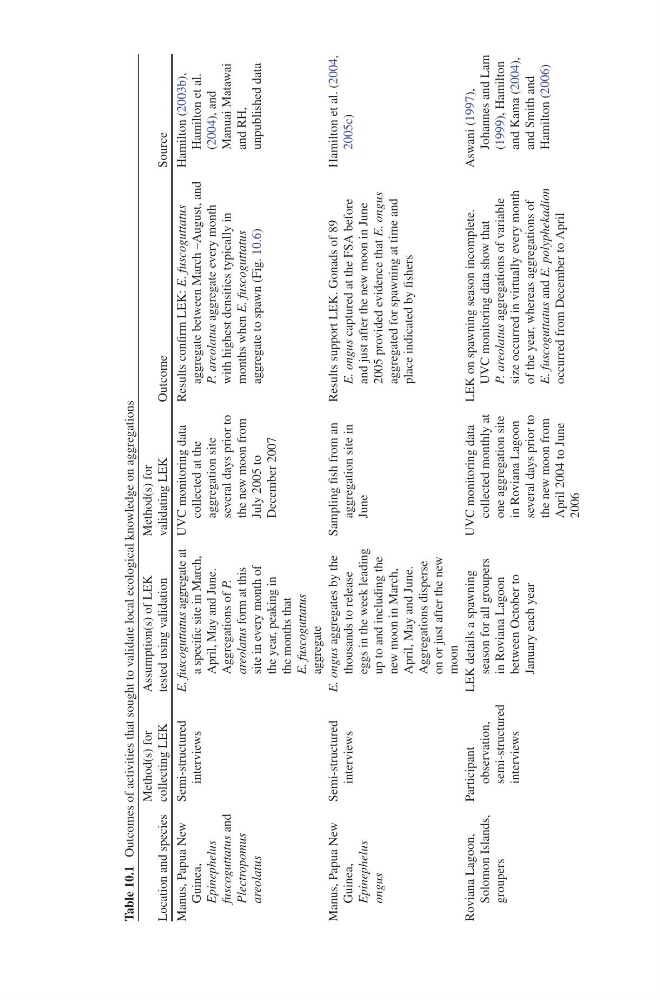
Table 10.1
Outcomes of activities that sought to validate local ecological knowledge on aggregations
Location and species
Method(s) for
collecting LEK
Assumption(s) of LEK
tested using validation
Method(s) for
validating LEK
Outcome
Source
Manus, Papua New
Guinea,
Epinephelus
fuscoguttatus
and
Plectropomus
areolatus
Semi-structured
interviews
E. fuscoguttatus
aggregate at
a specifi c site in March,
April, May and June.
Aggregations of P.
areolatus
form at this
site in every month of
the year, peaking in
the months that
E. fuscoguttatus
aggregate
UVC monitoring data
collected at the
aggregation site
several days prior to
the new moon from
July 2005 to
December 2007
Results confi rm LEK: E
. fuscoguttatus
aggregate between March –August, and
P. areolatus
aggregate every month
with highest densities typically in
months when E. fuscoguttatus
aggregate to spawn (Fig. 10.6 )
Hamilton (
2003b ) ,
Hamilton et al.
( 2004 ) , and
Manuai Matawai
and RH,
unpublished data
Manus, Papua New
Guinea,
Epinephelus
ongus
Semi-structured
interviews
E. ongus
aggregates by the
thousands to release
eggs in the week leading
up to and including the
new moon in March,
April, May and June.
Aggregations disperse
on or just after the new
moon
Sampling fi sh from an
aggregation site in
June
Results support LEK. Gonads of 89
E. ongus
captured at the FSA before
and just after the new moon in June
2005 provided evidence that E. ongus
aggregated for spawning at time and
place indicated by fi shers
Hamilton et al. ( 2004,
2005c )
Roviana Lagoon,
Solomon Islands,
groupers
Participant
observation,
semi-structured
interviews
LEK details a spawning
season for all groupers
in Roviana Lagoon
between October to
January each year
UVC monitoring data
collected monthly at
one aggregation site
in Roviana Lagoon
several days prior to
the new moon from
April 2004 to June
2006
LEK on spawning season incomplete.
UVC monitoring data show that
P. areolatus
aggregations of variable
size occurred in virtually every month
of the year, whereas aggregations of
E. fuscoguttatus
and E. polyphekadion
occurred from December to April
Aswani ( 1997 ) ,
Johannes and Lam
( 1999 ) , Hamilton
and Kama ( 2004 ) ,
and Smith and
Hamilton ( 2006 )
Outcomes of activities that sought to validate local ecological knowledge on aggregations
Location and species
Method(s) for
collecting LEK
Assumption(s) of LEK
tested using validation
Method(s) for
validating LEK
Outcome
Source
Manus, Papua New
Guinea,
Epinephelus
fuscoguttatus
and
Plectropomus
areolatus
Semi-structured
interviews
E. fuscoguttatus
aggregate at
a specifi c site in March,
April, May and June.
Aggregations of P.
areolatus
form at this
site in every month of
the year, peaking in
the months that
E. fuscoguttatus
aggregate
UVC monitoring data
collected at the
aggregation site
several days prior to
the new moon from
July 2005 to
December 2007
Results confi rm LEK: E
. fuscoguttatus
aggregate between March –August, and
P. areolatus
aggregate every month
with highest densities typically in
months when E. fuscoguttatus
aggregate to spawn (Fig. 10.6 )
Hamilton (
2003b ) ,
Hamilton et al.
( 2004 ) , and
Manuai Matawai
and RH,
unpublished data
Manus, Papua New
Guinea,
Epinephelus
ongus
Semi-structured
interviews
E. ongus
aggregates by the
thousands to release
eggs in the week leading
up to and including the
new moon in March,
April, May and June.
Aggregations disperse
on or just after the new
moon
Sampling fi sh from an
aggregation site in
June
Results support LEK. Gonads of 89
E. ongus
captured at the FSA before
and just after the new moon in June
2005 provided evidence that E. ongus
aggregated for spawning at time and
place indicated by fi shers
Hamilton et al. ( 2004,
2005c )
Roviana Lagoon,
Solomon Islands,
groupers
Participant
observation,
semi-structured
interviews
LEK details a spawning
season for all groupers
in Roviana Lagoon
between October to
January each year
UVC monitoring data
collected monthly at
one aggregation site
in Roviana Lagoon
several days prior to
the new moon from
April 2004 to June
2006
LEK on spawning season incomplete.
UVC monitoring data show that
P. areolatus
aggregations of variable
size occurred in virtually every month
of the year, whereas aggregations of
E. fuscoguttatus
and E. polyphekadion
occurred from December to April
Aswani ( 1997 ) ,
Johannes and Lam
( 1999 ) , Hamilton
and Kama ( 2004 ) ,
and Smith and
Hamilton ( 2006 )