

342
R. Hamilton et al.
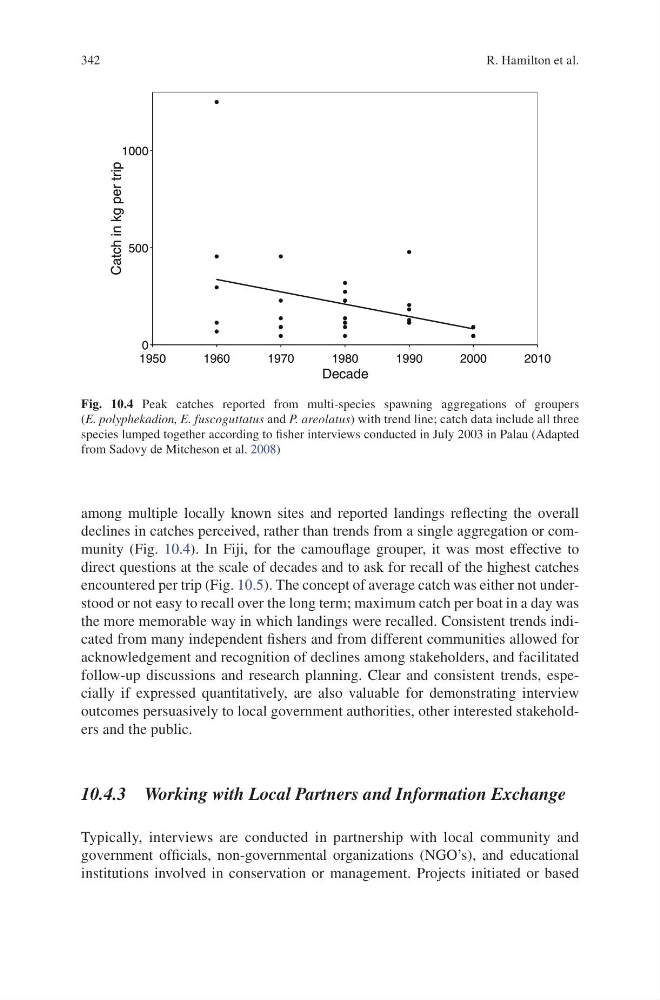
among multiple locally known sites and reported landings refl ecting the overall
declines in catches perceived, rather than trends from a single aggregation or community (Fig. 10.4 ). In Fiji, for the camoufl age grouper, it was most effective to
direct questions at the scale of decades and to ask for recall of the highest catches
encountered per trip (Fig. 10.5 ). The concept of average catch was either not understood or not easy to recall over the long term; maximum catch per boat in a day was
the more memorable way in which landings were recalled. Consistent trends indicated from many independent fi shers and from different communities allowed for
acknowledgement and recognition of declines among stakeholders, and facilitated
follow-up discussions and research planning. Clear and consistent trends, especially if expressed quantitatively, are also valuable for demonstrating interview
outcomes persuasively to local government authorities, other interested stakeholders and the public.
10.4.3 Working with Local Partners and Information Exchange
Typically, interviews are conducted in partnership with local community and
government offi cials, non-governmental organizations (NGO’s), and educational
institutions involved in conservation or management. Projects initiated or based
0
500
1000
1950
1960
1970
1980
1990
2000
2010
Catch in kg per trip
Decade
Fig. 10.4 Peak catches reported from multi-species spawning aggregations of groupers
( E. polyphekadion, E. fuscoguttatus and P. areolatus ) with trend line; catch data include all three
species lumped together according to fi sher interviews conducted in July 2003 in Palau (Adapted
from Sadovy de Mitcheson et al. 2008 )
R. Hamilton et al.
among multiple locally known sites and reported landings refl ecting the overall
declines in catches perceived, rather than trends from a single aggregation or community (Fig. 10.4 ). In Fiji, for the camoufl age grouper, it was most effective to
direct questions at the scale of decades and to ask for recall of the highest catches
encountered per trip (Fig. 10.5 ). The concept of average catch was either not understood or not easy to recall over the long term; maximum catch per boat in a day was
the more memorable way in which landings were recalled. Consistent trends indicated from many independent fi shers and from different communities allowed for
acknowledgement and recognition of declines among stakeholders, and facilitated
follow-up discussions and research planning. Clear and consistent trends, especially if expressed quantitatively, are also valuable for demonstrating interview
outcomes persuasively to local government authorities, other interested stakeholders and the public.
10.4.3 Working with Local Partners and Information Exchange
Typically, interviews are conducted in partnership with local community and
government offi cials, non-governmental organizations (NGO’s), and educational
institutions involved in conservation or management. Projects initiated or based
0
500
1000
1950
1960
1970
1980
1990
2000
2010
Catch in kg per trip
Decade
Fig. 10.4 Peak catches reported from multi-species spawning aggregations of groupers
( E. polyphekadion, E. fuscoguttatus and P. areolatus ) with trend line; catch data include all three
species lumped together according to fi sher interviews conducted in July 2003 in Palau (Adapted
from Sadovy de Mitcheson et al. 2008 )