

343
10 The Role of Local Ecological Knowledge in the Conservation and Management...
outside of target countries should be closely aligned with the work of local partners
to ensure that studies are appropriately designed and that signifi cant outcomes are
communicated and understood. Such steps build a platform for future management
or conservation initiatives that generate understanding, interest and trust, identify
educational and management needs, and avoid duplication of effort.
A big advantage of working with spawning aggregations is that they are easy to
explain and understand. Everybody knows and appreciates the importance of reproduction, and most people are naturally interested to learn more about the resources
on which they depend, especially when odd or interesting behaviours are concerned;
some aggregations can be quite spectacular to see or fi sh. This provides excellent
opportunities for two-way transfer of information; the interviewee responding to the
questionnaire, and the interviewer able to discuss and explain the collective outcomes of interviews in light of experiences and relevant information from outside.
This allows further opportunities for discussion after interviews and again highlights the need for well-prepared and knowledgeable interviewers who know something of fi shery and marine resources of the area as well as the general biology and
ecology of the species being reported (Sect. 10.2.2 ).
Local collaborators may or may not be knowledgeable about fi shing communities in their own countries. In the Solomon Islands and Papua New Guinea many
fi sheries offi cers grew up in small fi shing communities and have an excellent
knowledge of and genuine interest in the fi shery and fi shing communities (RH
personal observations 1996–2011). In some areas of Indonesia and parts of the
0
20
40
60
80
100
120
1970s
1980s
1990s
2000s
Estimated daily landings per boat (kg)
Decade
?
?
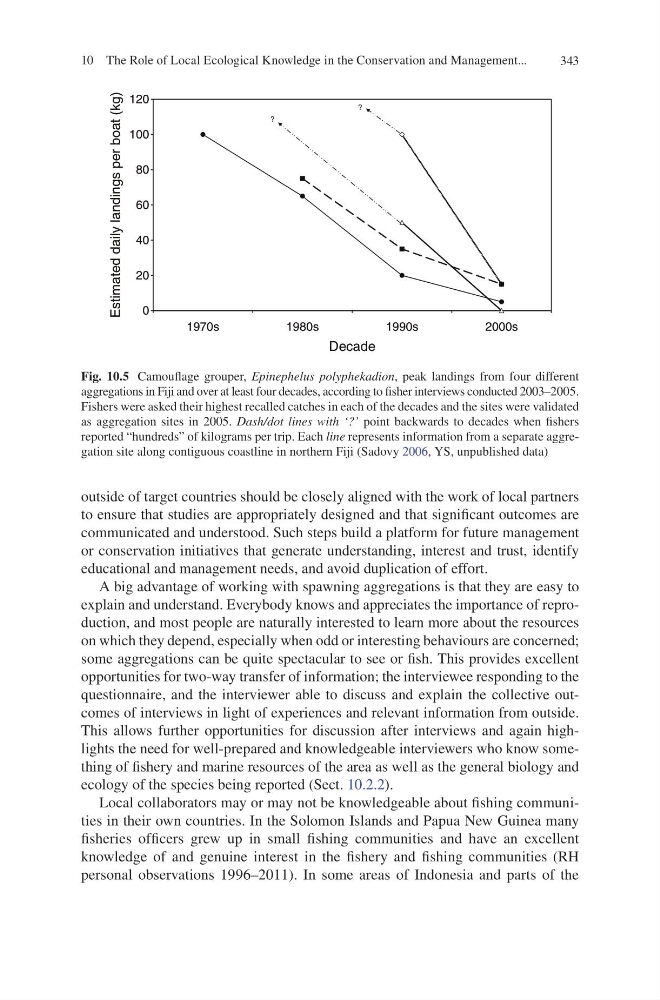
Fig. 10.5 Camoufl age grouper, Epinephelus polyphekadion , peak landings from four different
aggregations in Fiji and over at least four decades, according to fi sher interviews conducted 2003–2005.
Fishers were asked their highest recalled catches in each of the decades and the sites were validated
as aggregation sites in 2005. Dash/dot lines with ‘?’ point backwards to decades when fi shers
reported “hundreds” of kilograms per trip. Each line represents information from a separate aggregation site along contiguous coastline in northern Fiji (Sadovy 2006 , YS, unpublished data)
10 The Role of Local Ecological Knowledge in the Conservation and Management...
outside of target countries should be closely aligned with the work of local partners
to ensure that studies are appropriately designed and that signifi cant outcomes are
communicated and understood. Such steps build a platform for future management
or conservation initiatives that generate understanding, interest and trust, identify
educational and management needs, and avoid duplication of effort.
A big advantage of working with spawning aggregations is that they are easy to
explain and understand. Everybody knows and appreciates the importance of reproduction, and most people are naturally interested to learn more about the resources
on which they depend, especially when odd or interesting behaviours are concerned;
some aggregations can be quite spectacular to see or fi sh. This provides excellent
opportunities for two-way transfer of information; the interviewee responding to the
questionnaire, and the interviewer able to discuss and explain the collective outcomes of interviews in light of experiences and relevant information from outside.
This allows further opportunities for discussion after interviews and again highlights the need for well-prepared and knowledgeable interviewers who know something of fi shery and marine resources of the area as well as the general biology and
ecology of the species being reported (Sect. 10.2.2 ).
Local collaborators may or may not be knowledgeable about fi shing communities in their own countries. In the Solomon Islands and Papua New Guinea many
fi sheries offi cers grew up in small fi shing communities and have an excellent
knowledge of and genuine interest in the fi shery and fi shing communities (RH
personal observations 1996–2011). In some areas of Indonesia and parts of the
0
20
40
60
80
100
120
1970s
1980s
1990s
2000s
Estimated daily landings per boat (kg)
Decade
?
?
Fig. 10.5 Camoufl age grouper, Epinephelus polyphekadion , peak landings from four different
aggregations in Fiji and over at least four decades, according to fi sher interviews conducted 2003–2005.
Fishers were asked their highest recalled catches in each of the decades and the sites were validated
as aggregation sites in 2005. Dash/dot lines with ‘?’ point backwards to decades when fi shers
reported “hundreds” of kilograms per trip. Each line represents information from a separate aggregation site along contiguous coastline in northern Fiji (Sadovy 2006 , YS, unpublished data)