

417
22 Octopus minor
As a potential aquaculture species, some researches on its ecology, reproductive
biology, physiology as well as genetics have been done (Taki 1944; Iwakoshi et al.
2000; Seol et al. 2007; Zuo et al. 2011; Cheng et al. 2012; Kang et al. 2012; Qian
et al. 2013), but very few documents have reported on its life history or culture in
captivity. The culture of the species has been developed in China in the current decade. Meanwhile, the artificial releasing of hatchery-produced octopus has become
the main objective of resource protection and stock enhancement programmes especially in the coastal waters of Shandong Province.
22.2 Capture Methods
The main way to capture mature individuals of O� minor is by the bottom trawl in
the northeast coastal waters of China during the period from May to June. In shallow
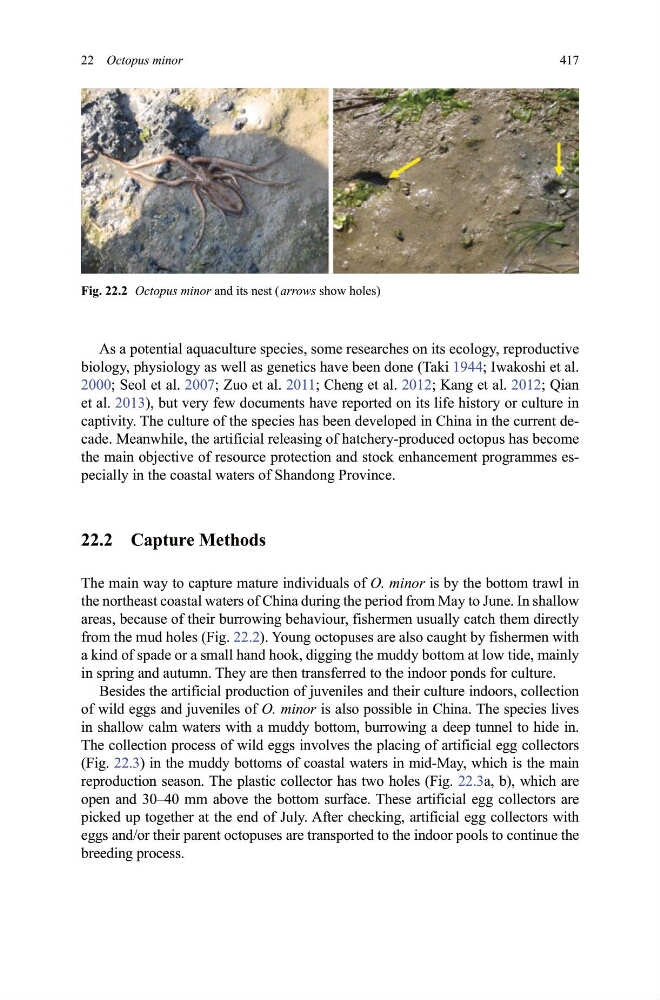
areas, because of their burrowing behaviour, fishermen usually catch them directly
from the mud holes (Fig. 22.2). Young octopuses are also caught by fishermen with
a kind of spade or a small hand hook, digging the muddy bottom at low tide, mainly
in spring and autumn. They are then transferred to the indoor ponds for culture.
Besides the artificial production of juveniles and their culture indoors, collection
of wild eggs and juveniles of O� minor is also possible in China. The species lives
in shallow calm waters with a muddy bottom, burrowing a deep tunnel to hide in.
The collection process of wild eggs involves the placing of artificial egg collectors
(Fig. 22.3) in the muddy bottoms of coastal waters in mid-May, which is the main
reproduction season. The plastic collector has two holes (Fig. 22.3a, b), which are
open and 30–40 mm above the bottom surface. These artificial egg collectors are
picked up together at the end of July. After checking, artificial egg collectors with
eggs and/or their parent octopuses are transported to the indoor pools to continue the
breeding process.
Fig. 22.2 Octopus minor and its nest ( arrows show holes)
22 Octopus minor
As a potential aquaculture species, some researches on its ecology, reproductive
biology, physiology as well as genetics have been done (Taki 1944; Iwakoshi et al.
2000; Seol et al. 2007; Zuo et al. 2011; Cheng et al. 2012; Kang et al. 2012; Qian
et al. 2013), but very few documents have reported on its life history or culture in
captivity. The culture of the species has been developed in China in the current decade. Meanwhile, the artificial releasing of hatchery-produced octopus has become
the main objective of resource protection and stock enhancement programmes especially in the coastal waters of Shandong Province.
22.2 Capture Methods
The main way to capture mature individuals of O� minor is by the bottom trawl in
the northeast coastal waters of China during the period from May to June. In shallow
areas, because of their burrowing behaviour, fishermen usually catch them directly
from the mud holes (Fig. 22.2). Young octopuses are also caught by fishermen with
a kind of spade or a small hand hook, digging the muddy bottom at low tide, mainly
in spring and autumn. They are then transferred to the indoor ponds for culture.
Besides the artificial production of juveniles and their culture indoors, collection
of wild eggs and juveniles of O� minor is also possible in China. The species lives
in shallow calm waters with a muddy bottom, burrowing a deep tunnel to hide in.
The collection process of wild eggs involves the placing of artificial egg collectors
(Fig. 22.3) in the muddy bottoms of coastal waters in mid-May, which is the main
reproduction season. The plastic collector has two holes (Fig. 22.3a, b), which are
open and 30–40 mm above the bottom surface. These artificial egg collectors are
picked up together at the end of July. After checking, artificial egg collectors with
eggs and/or their parent octopuses are transported to the indoor pools to continue the
breeding process.
Fig. 22.2 Octopus minor and its nest ( arrows show holes)