

416
X. D. Zheng et al.
22.1 Importance of this Species in the Market
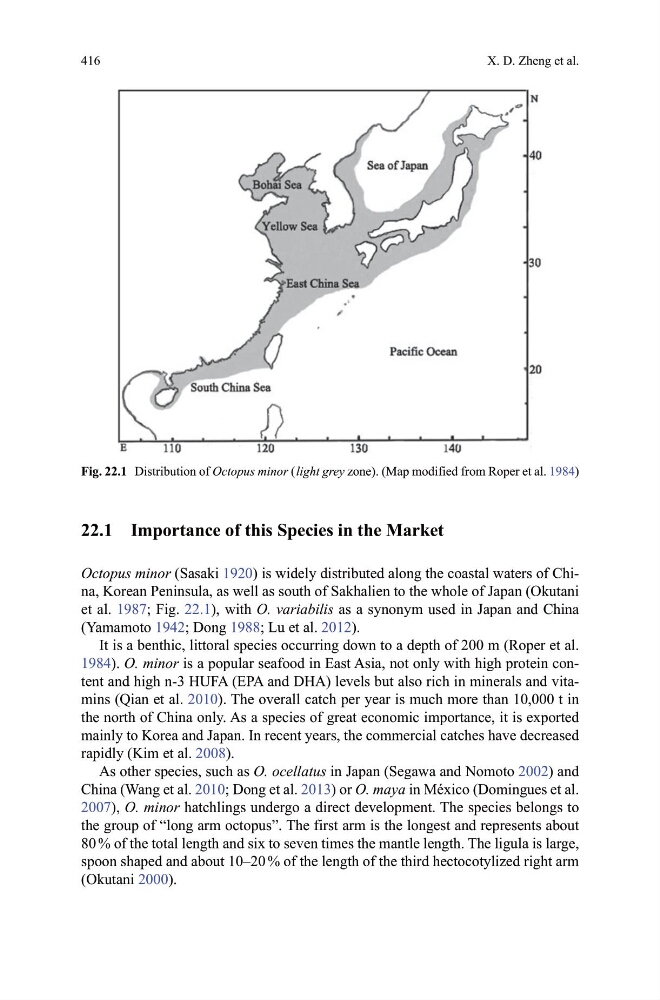
Octopus minor (Sasaki 1920) is widely distributed along the coastal waters of China, Korean Peninsula, as well as south of Sakhalien to the whole of Japan (Okutani
et al. 1987; Fig. 22.1), with O� variabilis as a synonym used in Japan and China
(Yamamoto 1942; Dong 1988; Lu et al. 2012).
It is a benthic, littoral species occurring down to a depth of 200 m (Roper et al.
1984). O� minor is a popular seafood in East Asia, not only with high protein content and high n-3 HUFA (EPA and DHA) levels but also rich in minerals and vitamins (Qian et al. 2010). The overall catch per year is much more than 10,000 t in
the north of China only. As a species of great economic importance, it is exported
mainly to Korea and Japan. In recent years, the commercial catches have decreased
rapidly (Kim et al. 2008).
As other species, such as O� ocellatus in Japan (Segawa and Nomoto 2002) and
China (Wang et al. 2010; Dong et al. 2013) or O� maya in México (Domingues et al.
2007), O� minor hatchlings undergo a direct development. The species belongs to
the group of “long arm octopus”. The first arm is the longest and represents about
80 % of the total length and six to seven times the mantle length. The ligula is large,
spoon shaped and about 10–20 % of the length of the third hectocotylized right arm
(Okutani 2000).
Fig. 22.1 Distribution of Octopus minor ( light grey zone). (Map modified from Roper et al. 1984)
X. D. Zheng et al.
22.1 Importance of this Species in the Market
Octopus minor (Sasaki 1920) is widely distributed along the coastal waters of China, Korean Peninsula, as well as south of Sakhalien to the whole of Japan (Okutani
et al. 1987; Fig. 22.1), with O� variabilis as a synonym used in Japan and China
(Yamamoto 1942; Dong 1988; Lu et al. 2012).
It is a benthic, littoral species occurring down to a depth of 200 m (Roper et al.
1984). O� minor is a popular seafood in East Asia, not only with high protein content and high n-3 HUFA (EPA and DHA) levels but also rich in minerals and vitamins (Qian et al. 2010). The overall catch per year is much more than 10,000 t in
the north of China only. As a species of great economic importance, it is exported
mainly to Korea and Japan. In recent years, the commercial catches have decreased
rapidly (Kim et al. 2008).
As other species, such as O� ocellatus in Japan (Segawa and Nomoto 2002) and
China (Wang et al. 2010; Dong et al. 2013) or O� maya in México (Domingues et al.
2007), O� minor hatchlings undergo a direct development. The species belongs to
the group of “long arm octopus”. The first arm is the longest and represents about
80 % of the total length and six to seven times the mantle length. The ligula is large,
spoon shaped and about 10–20 % of the length of the third hectocotylized right arm
(Okutani 2000).
Fig. 22.1 Distribution of Octopus minor ( light grey zone). (Map modified from Roper et al. 1984)