

21 Octopus mimus
407
Like in other invertebrates, oxygen consumption rates indicate that O� mimus
embryos have a high sensitivity to temperature. The Arrhenius plot, showing the
relationship between ln of oxygen consumption and temperature inverse in °K (1/
kt), is a good description of the connection between metabolism and temperature.
This allows comparisons between species or development stages in the same species or family (Clarke 2004). Uriarte et al. (2012) showed a−14.4 1/kt slope in the
Arrhenius plot for O� mimus embryos reared at 12 and 21 °C. This slope is greater
than that estimated in the analysis of the relationship between oxygen consumption
and temperature in 13 octopus species (Farías et al. 2009; − 5.8 1/kt), suggesting
that O� mimus embryos are more sensitive to temperature than adults of the family
Octopodidae. Further studies must be conducted for establishing a general slope on
the Arrhenius relationship for octopus’ embryos, like those proposed for fish larvae
or adult octopuses (Clarke and Johnston 1999; Farías et al. 2009).
21.4 Paralarvae Culture
21.4.1 Characteristics of O. mimus Paralarvae
Similar to other experiences in octopus aquaculture, the lack of proper procedures
for successfully rearing O� mimus paralarvae has limited the production of juveniles. At present, studies have reported some features on post-hatched paralarvae
but no success-producing benthic juveniles. O� mimus paralarvae are planktonic
(Villanueva and Norman 2008), swimming actively in the opposite direction of propulsion generated by the funnel. O� mimus hatchling paralarvae have eight arms
with three suckers in each arm. The mean diameter of each sucker is 0.14 mm. The
eye diameter is 0.5 mm and the funnel length is 0.7 mm. O� mimus paralarvae’s
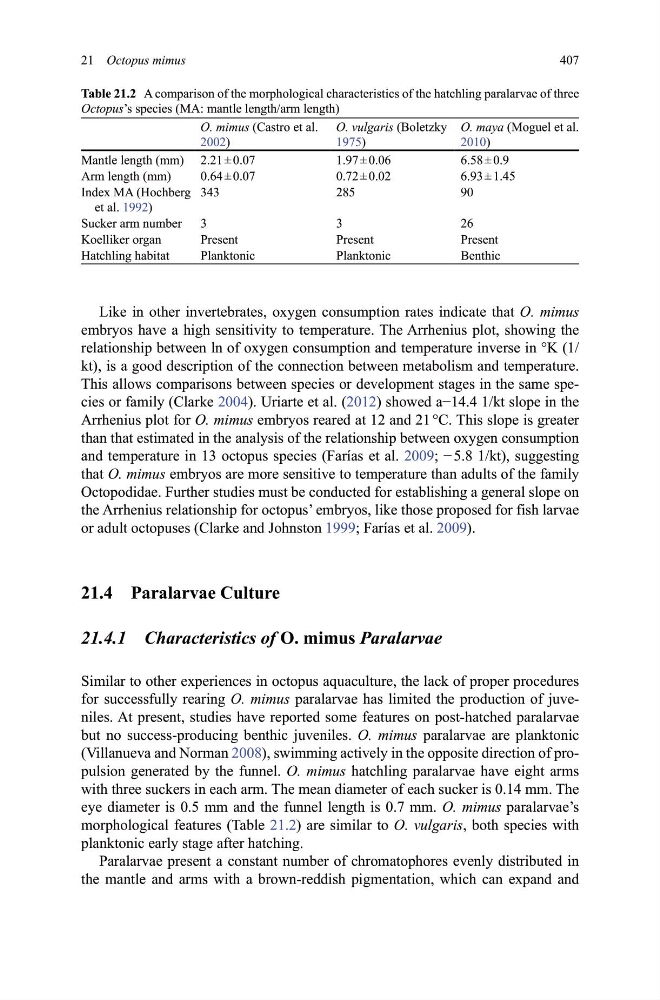
morphological features (Table 21.2) are similar to O� vulgaris, both species with
planktonic early stage after hatching.
Paralarvae present a constant number of chromatophores evenly distributed in
the mantle and arms with a brown-reddish pigmentation, which can expand and
Table 21.2 A comparison of the morphological characteristics of the hatchling paralarvae of three
Octopus’s species (MA: mantle length/arm length)
O� mimus (Castro et al.
2002)
O� vulgaris (Boletzky
1975)
O� maya (Moguel et al.
2010)
Mantle length (mm) 2.21 ± 0.07
1.97 ± 0.06
6.58 ± 0.9
Arm length (mm)
0.64 ± 0.07
0.72 ± 0.02
6.93 ± 1.45
Index MA (Hochberg
et al. 1992)
343
285
90
Sucker arm number 3
3
26
Koelliker organ
Present
Present
Present
Hatchling habitat
Planktonic
Planktonic
Benthic
407
Like in other invertebrates, oxygen consumption rates indicate that O� mimus
embryos have a high sensitivity to temperature. The Arrhenius plot, showing the
relationship between ln of oxygen consumption and temperature inverse in °K (1/
kt), is a good description of the connection between metabolism and temperature.
This allows comparisons between species or development stages in the same species or family (Clarke 2004). Uriarte et al. (2012) showed a−14.4 1/kt slope in the
Arrhenius plot for O� mimus embryos reared at 12 and 21 °C. This slope is greater
than that estimated in the analysis of the relationship between oxygen consumption
and temperature in 13 octopus species (Farías et al. 2009; − 5.8 1/kt), suggesting
that O� mimus embryos are more sensitive to temperature than adults of the family
Octopodidae. Further studies must be conducted for establishing a general slope on
the Arrhenius relationship for octopus’ embryos, like those proposed for fish larvae
or adult octopuses (Clarke and Johnston 1999; Farías et al. 2009).
21.4 Paralarvae Culture
21.4.1 Characteristics of O. mimus Paralarvae
Similar to other experiences in octopus aquaculture, the lack of proper procedures
for successfully rearing O� mimus paralarvae has limited the production of juveniles. At present, studies have reported some features on post-hatched paralarvae
but no success-producing benthic juveniles. O� mimus paralarvae are planktonic
(Villanueva and Norman 2008), swimming actively in the opposite direction of propulsion generated by the funnel. O� mimus hatchling paralarvae have eight arms
with three suckers in each arm. The mean diameter of each sucker is 0.14 mm. The
eye diameter is 0.5 mm and the funnel length is 0.7 mm. O� mimus paralarvae’s
morphological features (Table 21.2) are similar to O� vulgaris, both species with
planktonic early stage after hatching.
Paralarvae present a constant number of chromatophores evenly distributed in
the mantle and arms with a brown-reddish pigmentation, which can expand and
Table 21.2 A comparison of the morphological characteristics of the hatchling paralarvae of three
Octopus’s species (MA: mantle length/arm length)
O� mimus (Castro et al.
2002)
O� vulgaris (Boletzky
1975)
O� maya (Moguel et al.
2010)
Mantle length (mm) 2.21 ± 0.07
1.97 ± 0.06
6.58 ± 0.9
Arm length (mm)
0.64 ± 0.07
0.72 ± 0.02
6.93 ± 1.45
Index MA (Hochberg
et al. 1992)
343
285
90
Sucker arm number 3
3
26
Koelliker organ
Present
Present
Present
Hatchling habitat
Planktonic
Planktonic
Benthic