

406
The effects of temperature on embryonic development of O� mimus were first
addressed by Warnke (1999). In that study, the time of embryo development was
inversely related to water temperature. At 17 ± 0.2 °C, embryonic development was
between 61 and 66 days; at 18.5 ± 0.1 °C, it lasted between 55 and 57 days, while
at 19.7 ± 0.1 °C the time interval ranged from 39 to 41 days. In a recent study, Uriarte et al. (2012) created a predictive model for temperature effects (12, 15, 18
and 21 °C) on embryonic development of O� mimus. This study also evaluated the
temperature effects on the embryo’s physiology and growth at the time that they
reach XV stage, a moment when cardiac activity starts and eye development is
defined. A third objective of the study was to determine if temperature affects the
time interval for reaching XX stage. They used the physiological time expressed in
degree-days (DD). As observed previously (Warnke 1999), increasing temperature
reduces the time of embryonic development. The time interval for reaching XV
stage at 21 °C was 24, 58 and 75 % shorter than observed on eggs kept at 18, 15
and 12 °C, respectively. Logarithmic models that describe the relationships between
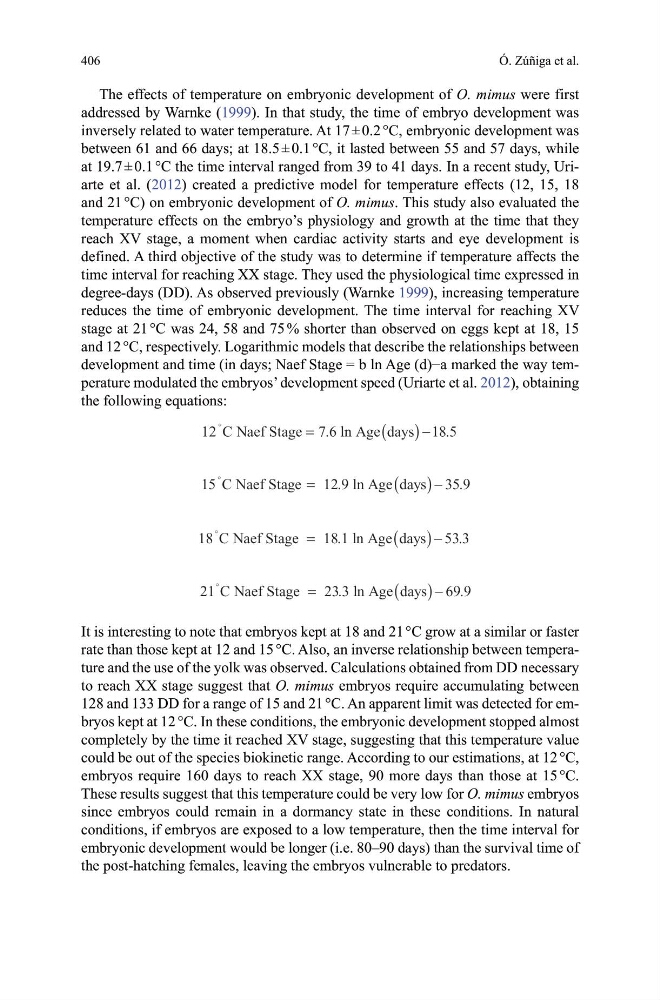
development and time (in days; Naef Stage = b ln Age (d)−a marked the way temperature modulated the embryos’ development speed (Uriarte et al. 2012), obtaining
the following equations:
12 C Naef Stage 7 6 ln Age days 18 5
°
=
( )−
.
.
It is interesting to note that embryos kept at 18 and 21 °C grow at a similar or faster
rate than those kept at 12 and 15 °C. Also, an inverse relationship between temperature and the use of the yolk was observed. Calculations obtained from DD necessary
to reach XX stage suggest that O� mimus embryos require accumulating between
128 and 133 DD for a range of 15 and 21 °C. An apparent limit was detected for embryos kept at 12 °C. In these conditions, the embryonic development stopped almost
completely by the time it reached XV stage, suggesting that this temperature value
could be out of the species biokinetic range. According to our estimations, at 12 °C,
embryos require 160 days to reach XX stage, 90 more days than those at 15 °C.
These results suggest that this temperature could be very low for O� mimus embryos
since embryos could remain in a dormancy state in these conditions. In natural
conditions, if embryos are exposed to a low temperature, then the time interval for
embryonic development would be longer (i.e. 80–90 days) than the survival time of
the post-hatching females, leaving the embryos vulnerable to predators.
15 C Naef Stage 12 9 ln Age days 35 9
°
=
( )−
.
.
18 C Naef Stage
18 1 ln Age days 53 3
°
=
( )−
.
.
21 C Naef Stage
23 3 ln Age days 69 9
°
=
( )−
.
.
Ó. Zúñiga et al.
The effects of temperature on embryonic development of O� mimus were first
addressed by Warnke (1999). In that study, the time of embryo development was
inversely related to water temperature. At 17 ± 0.2 °C, embryonic development was
between 61 and 66 days; at 18.5 ± 0.1 °C, it lasted between 55 and 57 days, while
at 19.7 ± 0.1 °C the time interval ranged from 39 to 41 days. In a recent study, Uriarte et al. (2012) created a predictive model for temperature effects (12, 15, 18
and 21 °C) on embryonic development of O� mimus. This study also evaluated the
temperature effects on the embryo’s physiology and growth at the time that they
reach XV stage, a moment when cardiac activity starts and eye development is
defined. A third objective of the study was to determine if temperature affects the
time interval for reaching XX stage. They used the physiological time expressed in
degree-days (DD). As observed previously (Warnke 1999), increasing temperature
reduces the time of embryonic development. The time interval for reaching XV
stage at 21 °C was 24, 58 and 75 % shorter than observed on eggs kept at 18, 15
and 12 °C, respectively. Logarithmic models that describe the relationships between
development and time (in days; Naef Stage = b ln Age (d)−a marked the way temperature modulated the embryos’ development speed (Uriarte et al. 2012), obtaining
the following equations:
12 C Naef Stage 7 6 ln Age days 18 5
°
=
( )−
.
.
It is interesting to note that embryos kept at 18 and 21 °C grow at a similar or faster
rate than those kept at 12 and 15 °C. Also, an inverse relationship between temperature and the use of the yolk was observed. Calculations obtained from DD necessary
to reach XX stage suggest that O� mimus embryos require accumulating between
128 and 133 DD for a range of 15 and 21 °C. An apparent limit was detected for embryos kept at 12 °C. In these conditions, the embryonic development stopped almost
completely by the time it reached XV stage, suggesting that this temperature value
could be out of the species biokinetic range. According to our estimations, at 12 °C,
embryos require 160 days to reach XX stage, 90 more days than those at 15 °C.
These results suggest that this temperature could be very low for O� mimus embryos
since embryos could remain in a dormancy state in these conditions. In natural
conditions, if embryos are exposed to a low temperature, then the time interval for
embryonic development would be longer (i.e. 80–90 days) than the survival time of
the post-hatching females, leaving the embryos vulnerable to predators.
15 C Naef Stage 12 9 ln Age days 35 9
°
=
( )−
.
.
18 C Naef Stage
18 1 ln Age days 53 3
°
=
( )−
.
.
21 C Naef Stage
23 3 ln Age days 69 9
°
=
( )−
.
.
Ó. Zúñiga et al.