

21 Octopus mimus
405
21.3.4 Embryonic Development
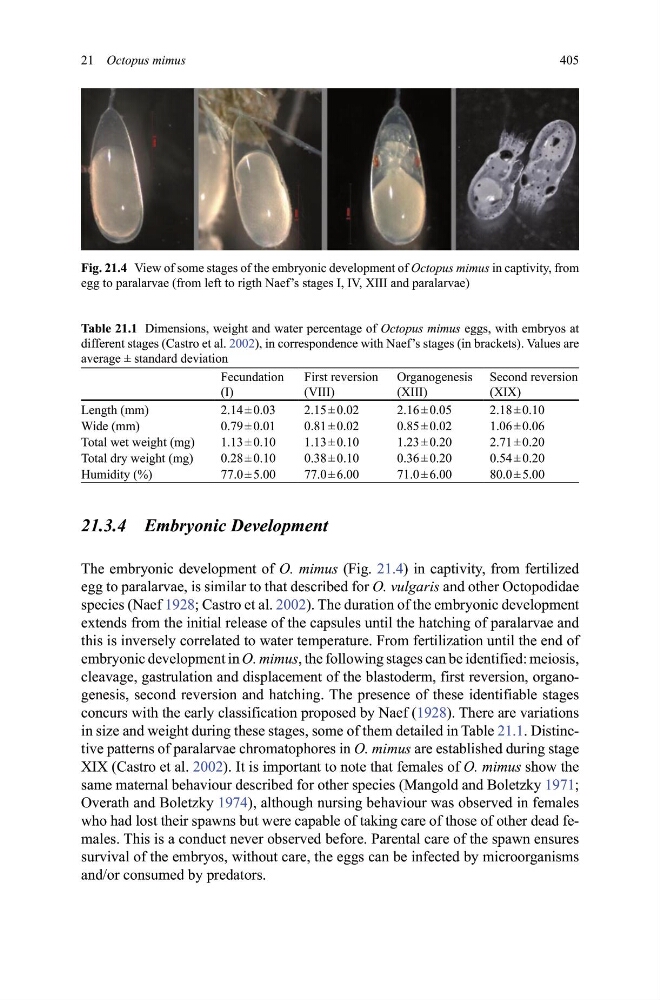
The embryonic development of O� mimus (Fig. 21.4) in captivity, from fertilized
egg to paralarvae, is similar to that described for O� vulgaris and other Octopodidae
species (Naef 1928; Castro et al. 2002). The duration of the embryonic development
extends from the initial release of the capsules until the hatching of paralarvae and
this is inversely correlated to water temperature. From fertilization until the end of
embryonic development in O� mimus, the following stages can be identified: meiosis,
cleavage, gastrulation and displacement of the blastoderm, first reversion, organogenesis, second reversion and hatching. The presence of these identifiable stages
concurs with the early classification proposed by Naef (1928). There are variations
in size and weight during these stages, some of them detailed in Table 21.1. Distinctive patterns of paralarvae chromatophores in O� mimus are established during stage
XIX (Castro et al. 2002). It is important to note that females of O� mimus show the
same maternal behaviour described for other species (Mangold and Boletzky 1971;
Overath and Boletzky 1974), although nursing behaviour was observed in females
who had lost their spawns but were capable of taking care of those of other dead females. This is a conduct never observed before. Parental care of the spawn ensures
survival of the embryos, without care, the eggs can be infected by microorganisms
and/or consumed by predators.
Table 21.1 Dimensions, weight and water percentage of Octopus mimus eggs, with embryos at
different stages (Castro et al. 2002), in correspondence with Naef’s stages (in brackets). Values are
average ± standard deviation
Fecundation
(I)
First reversion
(VIII)
Organogenesis
(XIII)
Second reversion
(XIX)
Length (mm)
2.14 ± 0.03
2.15 ± 0.02
2.16 ± 0.05
2.18 ± 0.10
Wide (mm)
0.79 ± 0.01
0.81 ± 0.02
0.85 ± 0.02
1.06 ± 0.06
Total wet weight (mg)
1.13 ± 0.10
1.13 ± 0.10
1.23 ± 0.20
2.71 ± 0.20
Total dry weight (mg)
0.28 ± 0.10
0.38 ± 0.10
0.36 ± 0.20
0.54 ± 0.20
Humidity (%)
77.0 ± 5.00
77.0 ± 6.00
71.0 ± 6.00
80.0 ± 5.00
Fig. 21.4 View of some stages of the embryonic development of Octopus mimus in captivity, from
egg to paralarvae (from left to rigth Naef’s stages I, IV, XIII and paralarvae)
405
21.3.4 Embryonic Development
The embryonic development of O� mimus (Fig. 21.4) in captivity, from fertilized
egg to paralarvae, is similar to that described for O� vulgaris and other Octopodidae
species (Naef 1928; Castro et al. 2002). The duration of the embryonic development
extends from the initial release of the capsules until the hatching of paralarvae and
this is inversely correlated to water temperature. From fertilization until the end of
embryonic development in O� mimus, the following stages can be identified: meiosis,
cleavage, gastrulation and displacement of the blastoderm, first reversion, organogenesis, second reversion and hatching. The presence of these identifiable stages
concurs with the early classification proposed by Naef (1928). There are variations
in size and weight during these stages, some of them detailed in Table 21.1. Distinctive patterns of paralarvae chromatophores in O� mimus are established during stage
XIX (Castro et al. 2002). It is important to note that females of O� mimus show the
same maternal behaviour described for other species (Mangold and Boletzky 1971;
Overath and Boletzky 1974), although nursing behaviour was observed in females
who had lost their spawns but were capable of taking care of those of other dead females. This is a conduct never observed before. Parental care of the spawn ensures
survival of the embryos, without care, the eggs can be infected by microorganisms
and/or consumed by predators.
Table 21.1 Dimensions, weight and water percentage of Octopus mimus eggs, with embryos at
different stages (Castro et al. 2002), in correspondence with Naef’s stages (in brackets). Values are
average ± standard deviation
Fecundation
(I)
First reversion
(VIII)
Organogenesis
(XIII)
Second reversion
(XIX)
Length (mm)
2.14 ± 0.03
2.15 ± 0.02
2.16 ± 0.05
2.18 ± 0.10
Wide (mm)
0.79 ± 0.01
0.81 ± 0.02
0.85 ± 0.02
1.06 ± 0.06
Total wet weight (mg)
1.13 ± 0.10
1.13 ± 0.10
1.23 ± 0.20
2.71 ± 0.20
Total dry weight (mg)
0.28 ± 0.10
0.38 ± 0.10
0.36 ± 0.20
0.54 ± 0.20
Humidity (%)
77.0 ± 5.00
77.0 ± 6.00
71.0 ± 6.00
80.0 ± 5.00
Fig. 21.4 View of some stages of the embryonic development of Octopus mimus in captivity, from
egg to paralarvae (from left to rigth Naef’s stages I, IV, XIII and paralarvae)