

408
shrink in response to environmental stimuli such as light, sound, tank bottom colour, turbulence and temperature. The number and distribution of chromatophores
are morphological features important in octopus taxonomy (Villanueva and Norman
2008). The pattern of chromatophores’ distribution in O� mimus was first described
by Warnke (1999). Further, Castro et al. (2002) found different characteristics
compared to those described for O� vulgaris. O� mimus paralarvae show a higher
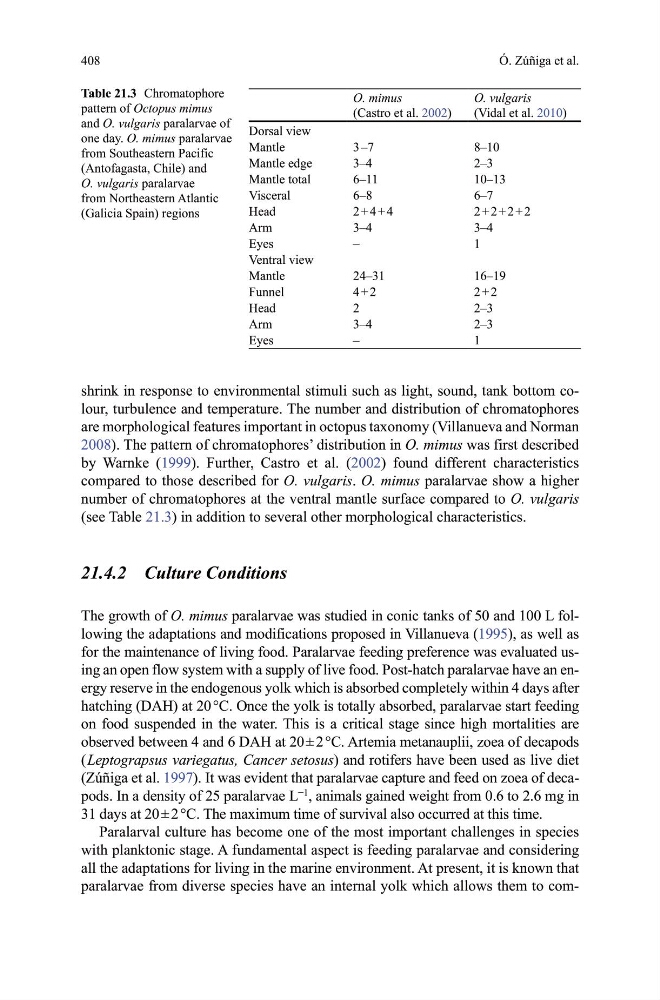
number of chromatophores at the ventral mantle surface compared to O� vulgaris
(see Table 21.3) in addition to several other morphological characteristics.
21.4.2 Culture Conditions
The growth of O� mimus paralarvae was studied in conic tanks of 50 and 100 L following the adaptations and modifications proposed in Villanueva (1995), as well as
for the maintenance of living food. Paralarvae feeding preference was evaluated using an open flow system with a supply of live food. Post-hatch paralarvae have an energy reserve in the endogenous yolk which is absorbed completely within 4 days after
hatching (DAH) at 20 °C. Once the yolk is totally absorbed, paralarvae start feeding
on food suspended in the water. This is a critical stage since high mortalities are
observed between 4 and 6 DAH at 20 ± 2 °C. Artemia metanauplii, zoea of decapods
( Leptograpsus variegatus, Cancer setosus) and rotifers have been used as live diet
(Zúñiga et al. 1997). It was evident that paralarvae capture and feed on zoea of decapods. In a density of 25 paralarvae L
−1
, animals gained weight from 0.6 to 2.6 mg in
31 days at 20 ± 2 °C. The maximum time of survival also occurred at this time.
Paralarval culture has become one of the most important challenges in species
with planktonic stage. A fundamental aspect is feeding paralarvae and considering
all the adaptations for living in the marine environment. At present, it is known that
paralarvae from diverse species have an internal yolk which allows them to comO� mimus
(Castro et al. 2002)
O� vulgaris
(Vidal et al. 2010)
Dorsal view
Mantle
3 –7
8–10
Mantle edge
3–4
2–3
Mantle total
6–11
10–13
Visceral
6–8
6–7
Head
2 + 4 + 4
2 + 2 + 2 + 2
Arm
3–4
3–4
Eyes
–
1
Ventral view
Mantle
24–31
16–19
Funnel
4 + 2
2 + 2
Head
2
2–3
Arm
3–4
2–3
Eyes
–
1
Table 21.3 Chromatophore
pattern of Octopus mimus
and O� vulgaris paralarvae of
one day. O� mimus paralarvae
from Southeastern Pacific
(Antofagasta, Chile) and
O� vulgaris paralarvae
from Northeastern Atlantic
(Galicia Spain) regions
Ó. Zúñiga et al.
shrink in response to environmental stimuli such as light, sound, tank bottom colour, turbulence and temperature. The number and distribution of chromatophores
are morphological features important in octopus taxonomy (Villanueva and Norman
2008). The pattern of chromatophores’ distribution in O� mimus was first described
by Warnke (1999). Further, Castro et al. (2002) found different characteristics
compared to those described for O� vulgaris. O� mimus paralarvae show a higher
number of chromatophores at the ventral mantle surface compared to O� vulgaris
(see Table 21.3) in addition to several other morphological characteristics.
21.4.2 Culture Conditions
The growth of O� mimus paralarvae was studied in conic tanks of 50 and 100 L following the adaptations and modifications proposed in Villanueva (1995), as well as
for the maintenance of living food. Paralarvae feeding preference was evaluated using an open flow system with a supply of live food. Post-hatch paralarvae have an energy reserve in the endogenous yolk which is absorbed completely within 4 days after
hatching (DAH) at 20 °C. Once the yolk is totally absorbed, paralarvae start feeding
on food suspended in the water. This is a critical stage since high mortalities are
observed between 4 and 6 DAH at 20 ± 2 °C. Artemia metanauplii, zoea of decapods
( Leptograpsus variegatus, Cancer setosus) and rotifers have been used as live diet
(Zúñiga et al. 1997). It was evident that paralarvae capture and feed on zoea of decapods. In a density of 25 paralarvae L
−1
, animals gained weight from 0.6 to 2.6 mg in
31 days at 20 ± 2 °C. The maximum time of survival also occurred at this time.
Paralarval culture has become one of the most important challenges in species
with planktonic stage. A fundamental aspect is feeding paralarvae and considering
all the adaptations for living in the marine environment. At present, it is known that
paralarvae from diverse species have an internal yolk which allows them to comO� mimus
(Castro et al. 2002)
O� vulgaris
(Vidal et al. 2010)
Dorsal view
Mantle
3 –7
8–10
Mantle edge
3–4
2–3
Mantle total
6–11
10–13
Visceral
6–8
6–7
Head
2 + 4 + 4
2 + 2 + 2 + 2
Arm
3–4
3–4
Eyes
–
1
Ventral view
Mantle
24–31
16–19
Funnel
4 + 2
2 + 2
Head
2
2–3
Arm
3–4
2–3
Eyes
–
1
Table 21.3 Chromatophore
pattern of Octopus mimus
and O� vulgaris paralarvae of
one day. O� mimus paralarvae
from Southeastern Pacific
(Antofagasta, Chile) and
O� vulgaris paralarvae
from Northeastern Atlantic
(Galicia Spain) regions
Ó. Zúñiga et al.