

391
20 Octopus maya
similar conditions to females, but are restricted by variations in physical and chemical parameters. Embryos (with or without female) should be maintained in a very
stable environment where the temperature is 25 ± 1 °C and oxygen dissolved levels
> 5 mgL
− 1
. We observed that at 30 °C, the embryo metabolic rate is 25 and 50 %
lower than at 26 and 22 °C, respectively. Relatively low pH can indirectly affect the
embryo development via bacterial infection.
While hatchlings should be more tolerant that embryos, at present there is little
information on the effect of environmental factors on early juvenile performance.
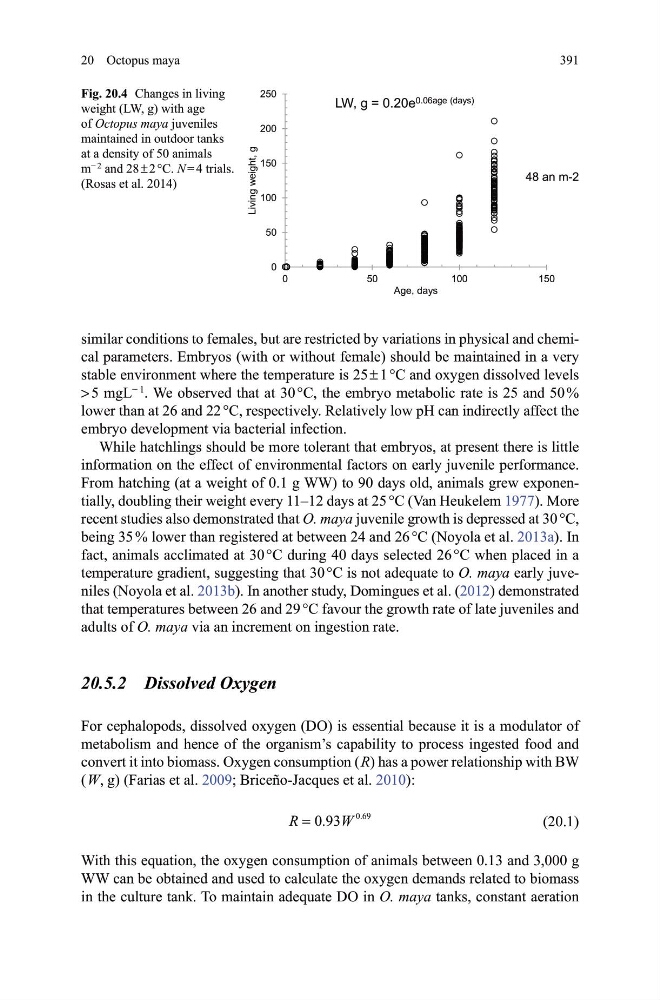
From hatching (at a weight of 0.1 g WW) to 90 days old, animals grew exponentially, doubling their weight every 11–12 days at 25 °C (Van Heukelem 1977). More
recent studies also demonstrated that O� maya juvenile growth is depressed at 30 °C,
being 35 % lower than registered at between 24 and 26 °C (Noyola et al. 2013a). In
fact, animals acclimated at 30 °C during 40 days selected 26 °C when placed in a
temperature gradient, suggesting that 30 °C is not adequate to O� maya early juveniles (Noyola et al. 2013b). In another study, Domingues et al. (2012) demonstrated
that temperatures between 26 and 29 °C favour the growth rate of late juveniles and
adults of O� maya via an increment on ingestion rate.
20.5.2 Dissolved Oxygen
For cephalopods, dissolved oxygen (DO) is essential because it is a modulator of
metabolism and hence of the organism’s capability to process ingested food and
convert it into biomass. Oxygen consumption ( R) has a power relationship with BW
( W, g) (Farias et al. 2009; Briceño-Jacques et al. 2010):
(20.1)
With this equation, the oxygen consumption of animals between 0.13 and 3,000 g
WW can be obtained and used to calculate the oxygen demands related to biomass
in the culture tank. To maintain adequate DO in O� maya tanks, constant aeration
0.69
0.93
R
W
=
/:J H DJHGD\V
/LYLQJZHLJKWJ
$JHGD\V
DQP
Fig. 20.4 Changes in living
weight (LW, g) with age
of Octopus maya juveniles
maintained in outdoor tanks
at a density of 50 animals
m
− 2
and 28 ± 2 °C. N = 4 trials.
(Rosas et al. 2014)
20 Octopus maya
similar conditions to females, but are restricted by variations in physical and chemical parameters. Embryos (with or without female) should be maintained in a very
stable environment where the temperature is 25 ± 1 °C and oxygen dissolved levels
> 5 mgL
− 1
. We observed that at 30 °C, the embryo metabolic rate is 25 and 50 %
lower than at 26 and 22 °C, respectively. Relatively low pH can indirectly affect the
embryo development via bacterial infection.
While hatchlings should be more tolerant that embryos, at present there is little
information on the effect of environmental factors on early juvenile performance.
From hatching (at a weight of 0.1 g WW) to 90 days old, animals grew exponentially, doubling their weight every 11–12 days at 25 °C (Van Heukelem 1977). More
recent studies also demonstrated that O� maya juvenile growth is depressed at 30 °C,
being 35 % lower than registered at between 24 and 26 °C (Noyola et al. 2013a). In
fact, animals acclimated at 30 °C during 40 days selected 26 °C when placed in a
temperature gradient, suggesting that 30 °C is not adequate to O� maya early juveniles (Noyola et al. 2013b). In another study, Domingues et al. (2012) demonstrated
that temperatures between 26 and 29 °C favour the growth rate of late juveniles and
adults of O� maya via an increment on ingestion rate.
20.5.2 Dissolved Oxygen
For cephalopods, dissolved oxygen (DO) is essential because it is a modulator of
metabolism and hence of the organism’s capability to process ingested food and
convert it into biomass. Oxygen consumption ( R) has a power relationship with BW
( W, g) (Farias et al. 2009; Briceño-Jacques et al. 2010):
(20.1)
With this equation, the oxygen consumption of animals between 0.13 and 3,000 g
WW can be obtained and used to calculate the oxygen demands related to biomass
in the culture tank. To maintain adequate DO in O� maya tanks, constant aeration
0.69
0.93
R
W
=
/:J H DJHGD\V
/LYLQJZHLJKWJ
$JHGD\V
DQP
Fig. 20.4 Changes in living
weight (LW, g) with age
of Octopus maya juveniles
maintained in outdoor tanks
at a density of 50 animals
m
− 2
and 28 ± 2 °C. N = 4 trials.
(Rosas et al. 2014)