

390
C. Rosas et al.
When octopuses reach 10 g WW, PVC pipes are offered as a refuge in a proportion
of three per animal. Results of massive juvenile growth suggest that an exponential
growth curve and survival around 60 % can be obtained. Weights of 100–150 g at
day 100–120 at 29 ± 2 °C have been obtained (Fig. 20.4).
Monthly grading in the tanks is necessary to avoid cannibalism and can provide survival rates of 60–70 %. Preliminary trials of O� maya growth indicate that
a broodstock bank could be obtained within 6–7 months of culture, with animals
> 500 g WW. Although at present there is no clear indication of what triggers functional maturity in Octopodidae species, temperature, changes in light intensity and
photoperiod, as well as copulation could play an important role at the start of the
vitellogenesis process in O� maya. Currently, broodstock of O� maya is obtained by
separating young females (around 30 g WW) from males, just to avoid early spawns
of animals lower than 60 g, since they produce few eggs.
20.5 Water Quality for O. maya Culture
20.5.1 Temperature
Water quality can be defined as a function of each phase of octopus culture. For
females under functional maturation, levels of oxygen dissolved > 5 mg L
− 1
,
ammonia < 1 mg L
− 1
, salinity > 32 psu and pH > 8 should be maintained to ensure
spawning, with temperatures > 28 °C inhibiting female maturation. Embryos require
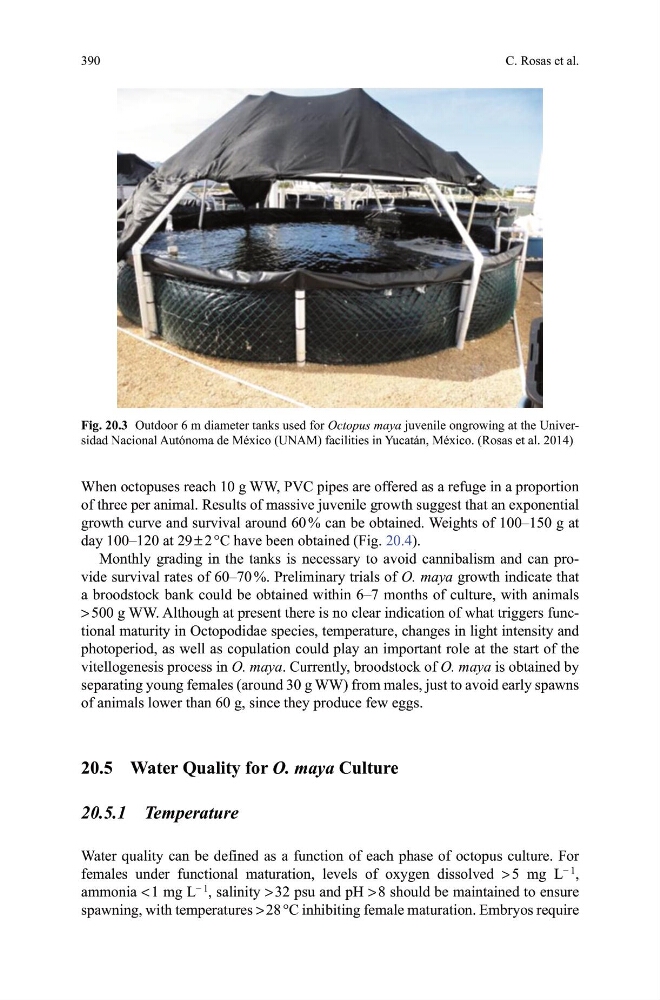
Fig. 20.3 Outdoor 6 m diameter tanks used for Octopus maya juvenile ongrowing at the Universidad Nacional Autónoma de México (UNAM) facilities in Yucatán, México. (Rosas et al. 2014)
C. Rosas et al.
When octopuses reach 10 g WW, PVC pipes are offered as a refuge in a proportion
of three per animal. Results of massive juvenile growth suggest that an exponential
growth curve and survival around 60 % can be obtained. Weights of 100–150 g at
day 100–120 at 29 ± 2 °C have been obtained (Fig. 20.4).
Monthly grading in the tanks is necessary to avoid cannibalism and can provide survival rates of 60–70 %. Preliminary trials of O� maya growth indicate that
a broodstock bank could be obtained within 6–7 months of culture, with animals
> 500 g WW. Although at present there is no clear indication of what triggers functional maturity in Octopodidae species, temperature, changes in light intensity and
photoperiod, as well as copulation could play an important role at the start of the
vitellogenesis process in O� maya. Currently, broodstock of O� maya is obtained by
separating young females (around 30 g WW) from males, just to avoid early spawns
of animals lower than 60 g, since they produce few eggs.
20.5 Water Quality for O. maya Culture
20.5.1 Temperature
Water quality can be defined as a function of each phase of octopus culture. For
females under functional maturation, levels of oxygen dissolved > 5 mg L
− 1
,
ammonia < 1 mg L
− 1
, salinity > 32 psu and pH > 8 should be maintained to ensure
spawning, with temperatures > 28 °C inhibiting female maturation. Embryos require
Fig. 20.3 Outdoor 6 m diameter tanks used for Octopus maya juvenile ongrowing at the Universidad Nacional Autónoma de México (UNAM) facilities in Yucatán, México. (Rosas et al. 2014)