

392
C. Rosas et al.
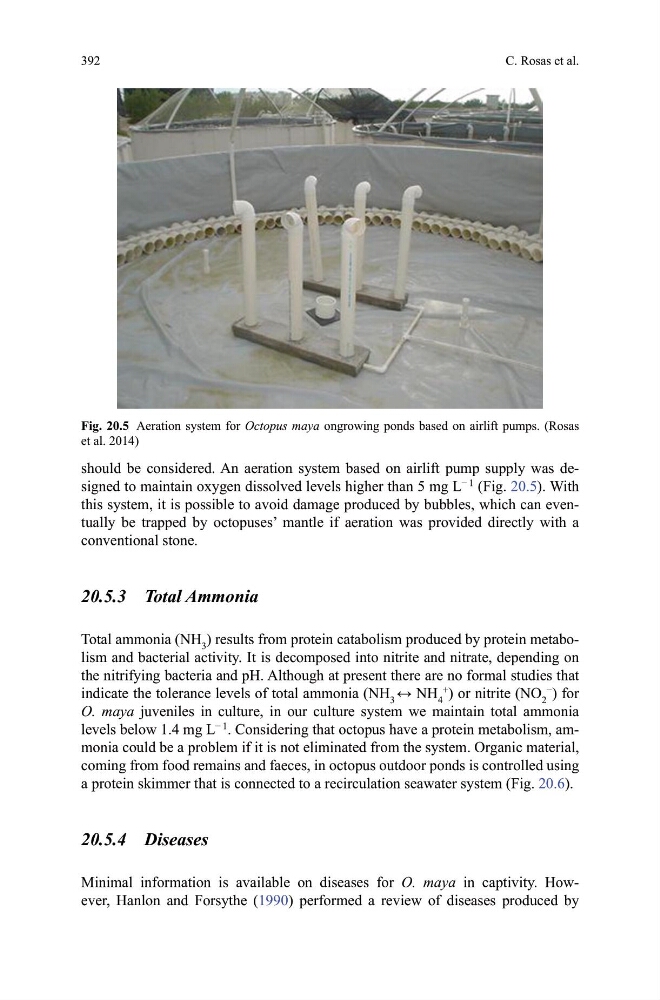
should be considered. An aeration system based on airlift pump supply was designed to maintain oxygen dissolved levels higher than 5 mg L
− 1
(Fig. 20.5). With
this system, it is possible to avoid damage produced by bubbles, which can eventually be trapped by octopuses’ mantle if aeration was provided directly with a
conventional stone.
20.5.3 Total Ammonia
Total ammonia (NH 3 ) results from protein catabolism produced by protein metabolism and bacterial activity. It is decomposed into nitrite and nitrate, depending on
the nitrifying bacteria and pH. Although at present there are no formal studies that
indicate the tolerance levels of total ammonia (NH 3 ↔ NH 4
+
) or nitrite (NO 2
−
) for
O� maya juveniles in culture, in our culture system we maintain total ammonia
levels below 1.4 mg L
− 1
. Considering that octopus have a protein metabolism, ammonia could be a problem if it is not eliminated from the system. Organic material,
coming from food remains and faeces, in octopus outdoor ponds is controlled using
a protein skimmer that is connected to a recirculation seawater system (Fig. 20.6).
20.5.4 Diseases
Minimal information is available on diseases for O� maya in captivity. However, Hanlon and Forsythe (1990) performed a review of diseases produced by
Fig. 20.5 Aeration system for Octopus maya ongrowing ponds based on airlift pumps. (Rosas
et al. 2014)
C. Rosas et al.
should be considered. An aeration system based on airlift pump supply was designed to maintain oxygen dissolved levels higher than 5 mg L
− 1
(Fig. 20.5). With
this system, it is possible to avoid damage produced by bubbles, which can eventually be trapped by octopuses’ mantle if aeration was provided directly with a
conventional stone.
20.5.3 Total Ammonia
Total ammonia (NH 3 ) results from protein catabolism produced by protein metabolism and bacterial activity. It is decomposed into nitrite and nitrate, depending on
the nitrifying bacteria and pH. Although at present there are no formal studies that
indicate the tolerance levels of total ammonia (NH 3 ↔ NH 4
+
) or nitrite (NO 2
−
) for
O� maya juveniles in culture, in our culture system we maintain total ammonia
levels below 1.4 mg L
− 1
. Considering that octopus have a protein metabolism, ammonia could be a problem if it is not eliminated from the system. Organic material,
coming from food remains and faeces, in octopus outdoor ponds is controlled using
a protein skimmer that is connected to a recirculation seawater system (Fig. 20.6).
20.5.4 Diseases
Minimal information is available on diseases for O� maya in captivity. However, Hanlon and Forsythe (1990) performed a review of diseases produced by
Fig. 20.5 Aeration system for Octopus maya ongrowing ponds based on airlift pumps. (Rosas
et al. 2014)