

360
J. Nabhitabhata
The small-scale facilities are appropriate for culturing a small-sized cephalopod like
Amphioctopus aegina� Such facilities require less space and maintenance cost compared to the larger species. However, the differences in methodology between the
culture of this species in an open system and in a closed system should be studied in
order to maximise production and reduce costs.
The moderate size, benthic habit, good adaptability and tolerance to different
culture conditions of this species are prominent characteristics that favour its aquaculture as an ornamental animal. Since Amphioctopus aegina is a ‘newcomer’ species, this demand needs to be initiated through commercial channels as a new ‘pet’.
With those mentioned prominent characteristics, there is already a demand for
other octopus species as experimental models for neurophysiology and ethology
(i.e. O� vulgaris); this demand could include Amphioctopus aegina as an option and
another model organism.
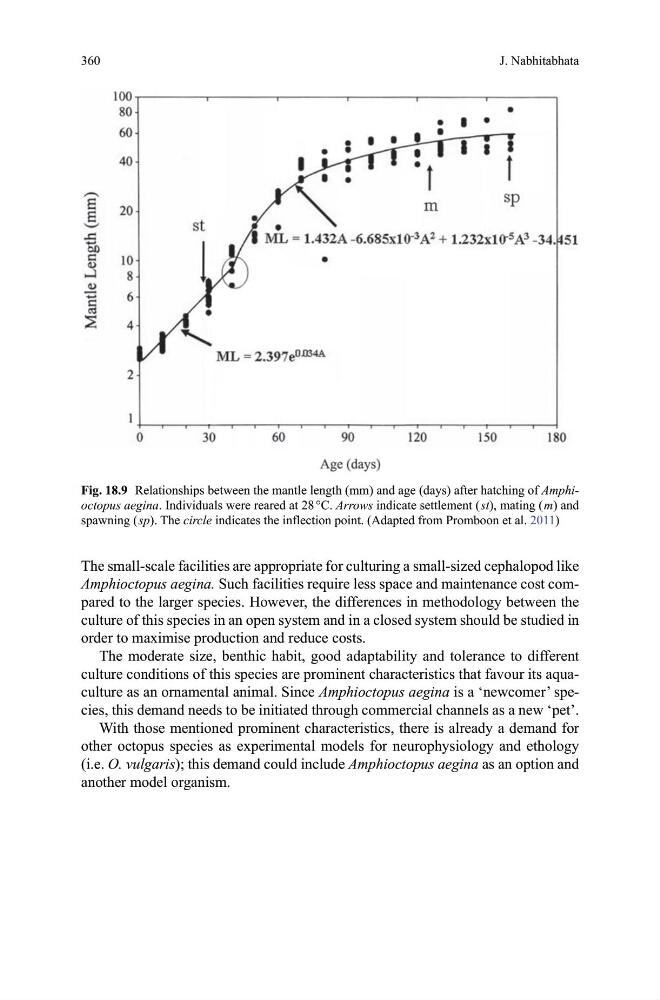
Fig. 18.9 Relationships between the mantle length (mm) and age (days) after hatching of Amphioctopus aegina. Individuals were reared at 28 °C. Arrows indicate settlement ( st), mating ( m) and
spawning ( sp). The circle indicates the inflection point. (Adapted from Promboon et al. 2011)
J. Nabhitabhata
The small-scale facilities are appropriate for culturing a small-sized cephalopod like
Amphioctopus aegina� Such facilities require less space and maintenance cost compared to the larger species. However, the differences in methodology between the
culture of this species in an open system and in a closed system should be studied in
order to maximise production and reduce costs.
The moderate size, benthic habit, good adaptability and tolerance to different
culture conditions of this species are prominent characteristics that favour its aquaculture as an ornamental animal. Since Amphioctopus aegina is a ‘newcomer’ species, this demand needs to be initiated through commercial channels as a new ‘pet’.
With those mentioned prominent characteristics, there is already a demand for
other octopus species as experimental models for neurophysiology and ethology
(i.e. O� vulgaris); this demand could include Amphioctopus aegina as an option and
another model organism.
Fig. 18.9 Relationships between the mantle length (mm) and age (days) after hatching of Amphioctopus aegina. Individuals were reared at 28 °C. Arrows indicate settlement ( st), mating ( m) and
spawning ( sp). The circle indicates the inflection point. (Adapted from Promboon et al. 2011)