

358
J. Nabhitabhata
model (30–70 days) and the following phase, from maturity onwards, by a quadratic
regression model (70–160 days, Fig. 18.10):
W 4.325 10 A
11 6.190
=
×
−
(18.5)
and
W 1.546A 3.249 10 A 80.765
3 2
=
+
×
−
−
(18.6)
The conversion efficiency peaks for a period of about 2 months from 60 to 130 days,
because of an energy storage process prior to reproduction, since mating is around
day 125. Survival from hatching to mating is 1 %, and from settlement to mating
is about 10 %. Spawning is at about 1 month after mating, at an age of around
150 days. Spawning females cease food intake and die within about 17 days after
paralarval hatching. The lifespan lasts for approximately 200 days or about 6–8
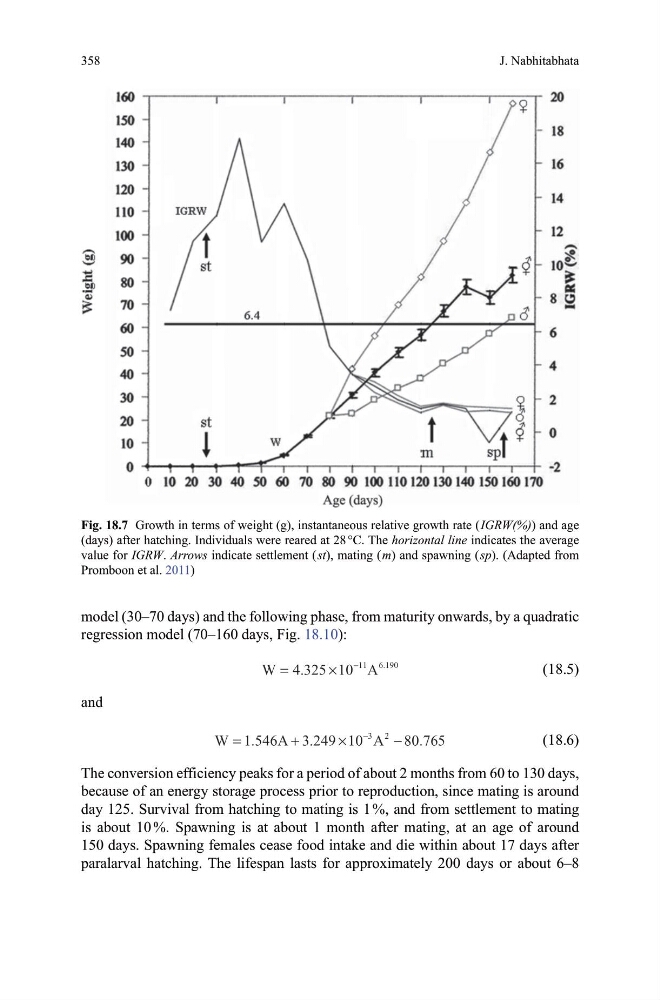
Fig. 18.7 Growth in terms of weight (g), instantaneous relative growth rate ( IGRW(%)) and age
(days) after hatching. Individuals were reared at 28 °C. The horizontal line indicates the average
value for IGRW. Arrows indicate settlement ( st), mating ( m) and spawning ( sp). (Adapted from
Promboon et al. 2011)
J. Nabhitabhata
model (30–70 days) and the following phase, from maturity onwards, by a quadratic
regression model (70–160 days, Fig. 18.10):
W 4.325 10 A
11 6.190
=
×
−
(18.5)
and
W 1.546A 3.249 10 A 80.765
3 2
=
+
×
−
−
(18.6)
The conversion efficiency peaks for a period of about 2 months from 60 to 130 days,
because of an energy storage process prior to reproduction, since mating is around
day 125. Survival from hatching to mating is 1 %, and from settlement to mating
is about 10 %. Spawning is at about 1 month after mating, at an age of around
150 days. Spawning females cease food intake and die within about 17 days after
paralarval hatching. The lifespan lasts for approximately 200 days or about 6–8
Fig. 18.7 Growth in terms of weight (g), instantaneous relative growth rate ( IGRW(%)) and age
(days) after hatching. Individuals were reared at 28 °C. The horizontal line indicates the average
value for IGRW. Arrows indicate settlement ( st), mating ( m) and spawning ( sp). (Adapted from
Promboon et al. 2011)